Why LLMs as Tools Still Require Human Judgment and Oversight
An LLM’s unpredictability doesn’t settle whether it’s a tool. The more useful test is whether a person can direct its work, judge the output, and stay accountable for the result.
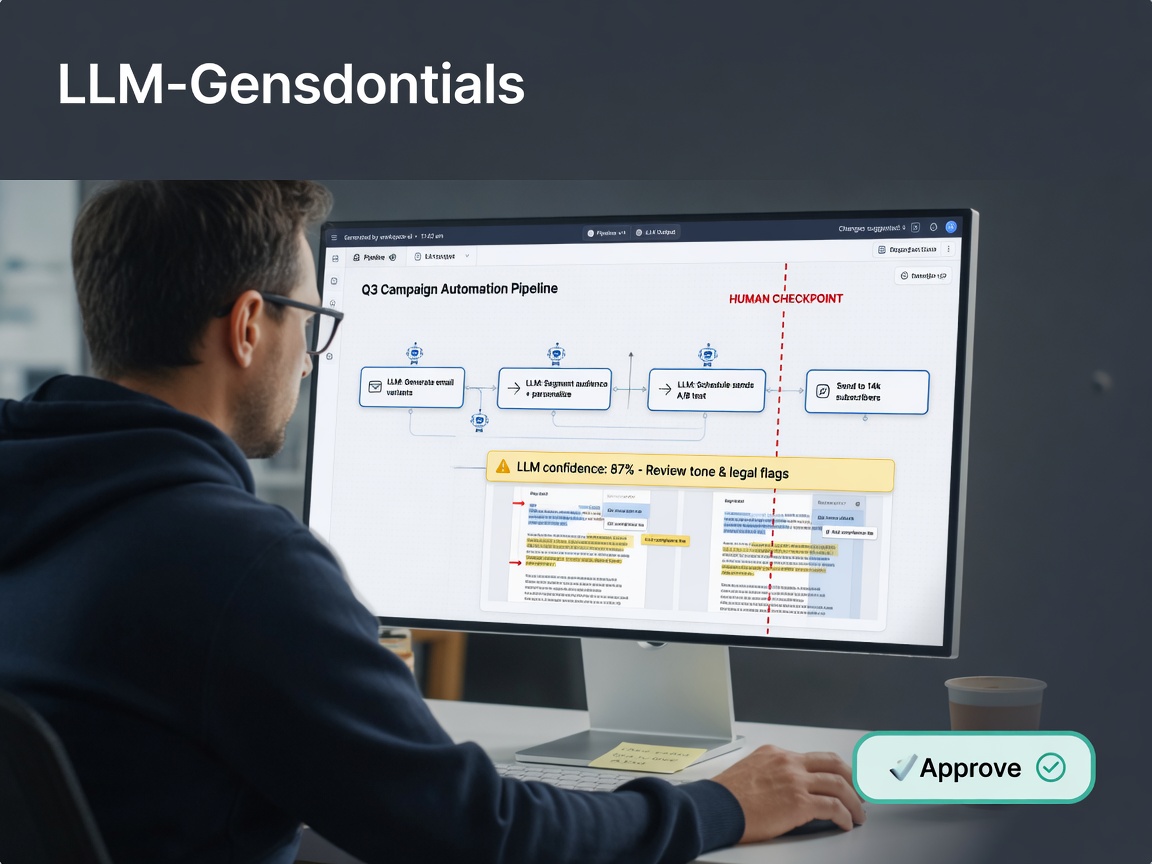
Automation needs a narrow first win
The best first AI workflow is usually a repeated task with a clear input, clear output, and a human approval step.
LLMs can function as tools, but the useful distinction is not whether they behave predictably every time. It is whether someone can direct the model, assess what it returns, and stay responsible for the result. That makes “LLMs as tools” a claim about how they’re used, not a promise that they work like a wrench.
LLMs as tools depend on human direction
The source article argues that unpredictability alone does not disqualify an LLM from being a tool. Tools can automate work: compilers and spreadsheets do, too. The harder question is what the person using the tool contributes. Skilled use involves giving direction and feedback, applying expertise, and judging the output. Delegating without understanding the task is a different kind of use.
That distinction matters when building with an LLM. If I were adding one to a workflow, I’d ask where the human can correct it and what knowledge is needed to spot a bad answer. Those aren’t abstract questions about whether the software is a tool. They’re design questions about who checks the result and what happens when the output is wrong. The source doesn’t offer a deployment recipe, but its standard is practical: human judgment remains part of effective use.

Worth a look
Phugialy Picks

AI Engineering: Building Applications with Foundation Models
A practical guide to building real-world applications with foundation models and LLMs.

GMKtec K15 AI Mini PC Oculink Intel Ultra 5 125U 32GB DDR5 512GB SSD | Desktop Computer AI Boost, 3X M.2 2280 Storage Expansion, Dual NIC...

Agentic AI Engineering: Systems That Reason and Act Autonomously – Designing, Building, and Prompting LLM-Based Agents for Real-World Deployment
Some Phugialy Picks use affiliate links. If you buy through one, Phugialy may earn a commission. It doesn't change what we recommend. Full disclosure →
Automation doesn’t erase intellectual work
It’s tempting to treat automation as evidence that a person has skipped the work. But automation is already a feature of tools such as compilers and spreadsheets. The relevant question is what the person does around that automation: whether they understand the task, guide the system, and evaluate its result.
My read is that this is a better test than arguing over whether using an LLM counts as “real work.” In an integration, the useful boundary is whether the person using it can catch errors and take responsibility for the outcome. If that expertise is absent, fluent output can make delegation look more reliable than the process actually is. If the person supplies direction and judgment, automation can handle part of the work without replacing those responsibilities.
Describe software failures without inventing motives
The article also pushes back on describing failures with language such as “go rogue,” “escape containment,” or “conspire.” Those phrases can suggest human motives without evidence. A failure may still matter, but calling it a conspiracy doesn’t explain what happened.
For a developer, the practical move is to describe the observed failure and investigate it, rather than treating anthropomorphic language as a diagnosis. That’s my interpretation, not a claim that every failure is easy to explain: the source’s point is narrower, that motive-laden descriptions go beyond the evidence when no human intent has been established. The same discipline applies to judging an LLM as a tool. Look at the work it performs, the oversight around it, and the failures you can actually identify. That gives you a more useful basis for deciding where it belongs than either blind delegation or dismissing it because it can be unpredictable.
Holiday picks
Thanksgiving: early shopping
Start early: products for hosting, travel and home, plus the gear you have been watching.

Audio
Mid-size buyJLab, JBuds Lux ANC, Over Ear Headphones, Active Noise Cancelling, Bluetooth, Spatial Audio, Sage
View on Amazon (opens in a new tab): JLab, JBuds Lux ANC, Over Ear Headphones, Active Noise Cancelling, Bluetooth, Spatial Audio, SagePrices change daily. Check today's price on Amazon.
 Trending now
Home & Kitchen
eufy C28 Robot Vacuum Cleaner and Mop for pet hair, 15,000 Pa
View on Amazon (opens in a new tab): eufy C28 Robot Vacuum Cleaner and Mop for pet hair, 15,000 PaPrices change daily. Check today's price on Amazon.
 Trending now
Home & Kitchen
De'Longhi Magnifica Duo Automatic Espresso Machine, Milk Frother, Silver
View on Amazon (opens in a new tab): De'Longhi Magnifica Duo Automatic Espresso Machine, Milk Frother, SilverPrices change daily. Check today's price on Amazon.
We earn from qualifying purchases made through these links, at no extra cost to you, as an Amazon Associate and through other affiliate programs. Disclosure. See all Thanksgiving picks
Got a question about how this applies to you? →
For a related look at oversight and verification, read “The Linux Kernel's AI Pivot: Technical Merit vs. the Verification Bottleneck.”
Keep reading
Follow the thread

The Architecture of Autonomy: Why Your Workflows Are Brittle
Phu explores the shift from rigid, brittle 'If/Then' automation workflows to resilient, goal-oriented agentic fleets, arguing that the key to scaling business operations is managing failure as an architectural parameter.
Read this noteSame lane, different angle
The Cognitive Debt of AI: Why I'm Restricting My Kids' Access to 'Smart' Assistants
An engineering-based perspective on why AI in education often creates 'cognitive debt' and how to use prompt engineering to force AI to act as a Socratic tutor rather than an answer-generator.
Beyond the Model: Hardening Your AI Workflow
Securing neural networks isn't about protecting the model weights; it's about treating AI as an untrusted software component. I break down how to implement input/output guardrails to prevent injection and data leakage.