AI-Designed CPU Frostbite: What the Results Show
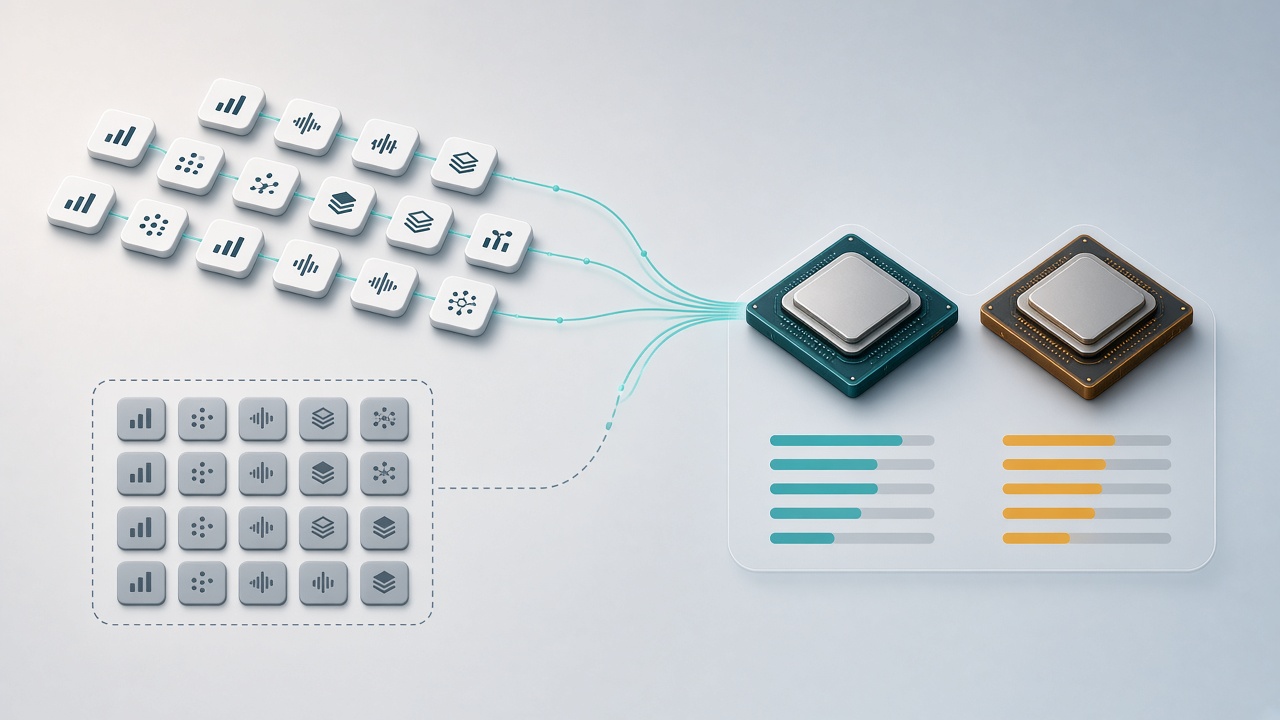
Frostbite reportedly achieved 4.59x the performance-per-watt of a modern in-order CPU core across 25 workloads. The detail I’d investigate before trusting the headline is how the AI-designed process performed on the 15 workloads held back until final evaluation.

Automation needs a narrow first win
The best first AI workflow is usually a repeated task with a clear input, clear output, and a human approval step.
Frostbite is an AI-designed CPU that reportedly delivered 4.59x the performance-per-watt of a modern dual-issue, in-order superscalar core across 25 workloads. The result is notable, but the more useful question for anyone building hardware is how the design process held together across the whole stack—and what the benchmark does, and does not, establish.
What the AI-designed CPU actually claims
The source article describes Frostbite as a general-purpose CPU with a new instruction set, co-designed by AI systems across the software and hardware stack. Those systems iterated over the compiler, ISA, architecture, microarchitecture, RTL, verification, and final GDS. That is a much broader claim than using AI to optimize one isolated block: the reported work spans the path from programming model to physical design.
The performance comparison needs its qualifiers attached. The reported 4.59x figure is performance-per-watt against a modern dual-issue, in-order superscalar CPU core—not a claim that Frostbite is 4.59 times faster in every workload or a comparison with every current processor. The team initially chose 25 workloads and held 15 back until the final evaluation. Holding out workloads is a useful check against tuning only to a visible test set, though the available summary does not describe the workloads or the exact measurement setup.
Worth a look
Phugialy Picks

GMKtec K15 AI Mini PC Oculink Intel Ultra 5 125U 32GB DDR5 512GB SSD | Desktop Computer AI Boost, 3X M.2 2280 Storage Expansion, Dual NIC...

GEEKOM IT15 AI Mini PC, Intel Ultra 9 285H(99 Tops), 32GB DDR5, 1TB SSD | The Most Powerful Workstation,Arc 140T GPU,WiFi 7,8K Business D...

PCIe 4.0 x4 64Gbps Compatible eGPU DOCK, with OCuLink SFF-8612 8311 to PCIe x16 and SFF-8611 Male Cable, Enclosure supports Standard ATX Power and External Graphics Cards GPU for Laptop Mini PC
Some Phugialy Picks use affiliate links. If you buy through one, Phugialy may earn a commission. It doesn't change what we recommend. Full disclosure →
Interaction nets put the model in the design
Frostbite uses interaction nets, a computational model in which computation is local and dependencies and ownership of values are explicit. The article presents that as a foundation for a design with “zero architectural priors.” I read that phrase as a description of the project’s ambition, not evidence that the design process had no assumptions at all: the team still had to choose the model, tools, and evaluation workloads.
One practical detail stands out. The team built ASL, a formal specification language, and used it to write Arcmodel, Frostbite’s system model. The article also reports a speed advantage of roughly 200x over RTL simulation, alongside a “within 1–5%” figure. The summary available here does not say what the 1–5% measures, so I would not use it to infer a particular accuracy guarantee. Still, building a specification language and system model suggests that the project treated verification and iteration as part of the design problem, rather than treating generated RTL as the whole result.
The held-out workloads are the test to follow
For an engineering team, the opportunity is not necessarily to copy Frostbite’s architecture. It is to test whether AI-assisted co-design can explore choices across software and hardware that a narrower optimization loop would leave untouched. The hard integration question is whether the result stays useful when the workload changes and the evaluation has to account for the actual system boundary. Those details are not established by the performance-per-watt headline alone.
I would treat Frostbite as a reason to investigate the method, not as a ready-made case for adopting AI-designed processors. The strongest follow-up evidence would make the held-out workload results and measurement setup clear, then show whether the advantage persists beyond this evaluation. Until then, the interesting result is not simply that AI produced a CPU; it is that a cross-stack design process produced a measurable result worth trying to reproduce.
Holiday picks
Thanksgiving: early shopping
Start early: products for hosting, travel and home, plus the gear you have been watching.

Cleaning & Care
Small add-onScreen Mom Screen Cleaner Spray (16oz)
Buy if: You've been wiping your monitor with your shirt sleeve.
Skip if: You already have a cleaning routine sorted.
View on Amazon (opens in a new tab): Screen Mom Screen Cleaner Spray (16oz)Prices change daily. Check today's price on Amazon.
 Trending now
Home & Kitchen
eufy C28 Robot Vacuum Cleaner and Mop for pet hair, 15,000 Pa
View on Amazon (opens in a new tab): eufy C28 Robot Vacuum Cleaner and Mop for pet hair, 15,000 PaPrices change daily. Check today's price on Amazon.
 Trending now
Home & Kitchen
De'Longhi Magnifica Duo Automatic Espresso Machine, Milk Frother, Silver
View on Amazon (opens in a new tab): De'Longhi Magnifica Duo Automatic Espresso Machine, Milk Frother, SilverPrices change daily. Check today's price on Amazon.
We earn from qualifying purchases made through these links, at no extra cost to you, as an Amazon Associate and through other affiliate programs. Disclosure. See all Thanksgiving picks
Got a question about how this applies to you? →
For a related look at evaluation beyond a single result, read “Coding-Agent Model Evaluation Needs a Production Loop.”
Keep reading
Follow the thread

AI Research Automation: What the Evidence Really Shows
AI is already helping researchers move faster, but speed on a well-defined task is not the same as knowing which question to ask. That gap may matter more than any single benchmark when judging claims about automated research.
Read this noteSame lane, different angle
AI Alignment by Incentive Design: What It Can Show
Mechanism design tries to make desirable behavior the rational choice for AI models, even when their internal workings are hard to read. The proposals are interesting; the unresolved question is whether those incentives hold up beyond the setup they were designed for.
How Wikipedia Tries to Detect AI-Generated Content
Pangram’s share of flagged new Wikipedia articles and drafts fell from perhaps 20 percent to 15 or 16 percent. That sounds like progress until you ask whether the change came from policy, model changes, or something else. The bigger problem may be citations that point to real sources but misrepresent what they say.