AI Perplexity Benchmark: A Limit, Not a Safety Test
Perplexity may offer AI companies a more durable way to compare progress than benchmarks that quickly go stale. But a shared score is not a safety rule: the hard part is agreeing on what it should trigger and how behavior will be monitored.
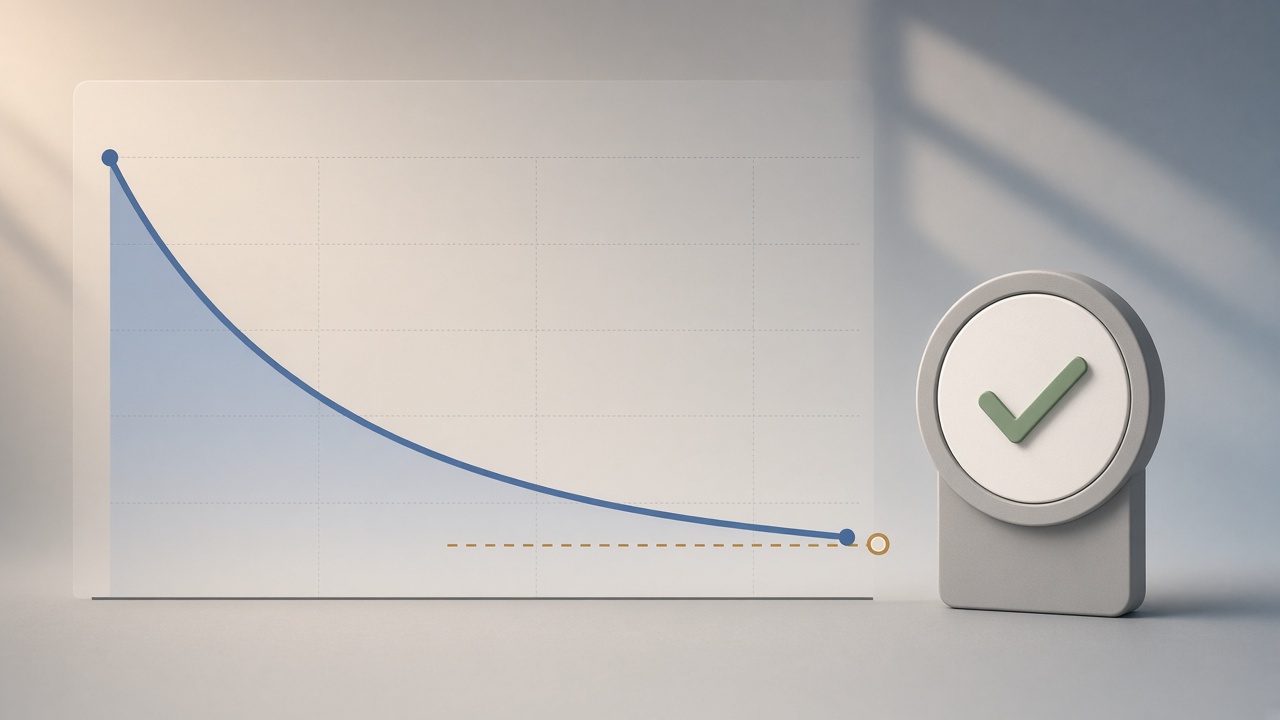
Automation needs a narrow first win
The best first AI workflow is usually a repeated task with a clear input, clear output, and a human approval step.
OpenAI chief scientist Jakub Pachocki is proposing perplexity as a shared AI progress benchmark—and potentially as a basis for common limits on development. The proposal has a practical appeal: an agreed metric could be easier to compare over time than a rotating collection of capability tests. But an AI perplexity benchmark measures prediction, not whether a system is safe or understandable.
What an AI Perplexity Benchmark Measures
Perplexity measures how well a model predicts the next token on average; lower perplexity means better predictions. Pachocki argues that downstream-capability benchmarks quickly become outdated, while perplexity has remained informative since GPT-3.5. He sees it as a possible shared benchmark for general intelligence and the speed of AI development.
The source cites GPT-4 at about 0.91 and also notes losses below 0.8. Those figures suggest the metric is being used to track model performance, but they do not establish a universal cutoff or explain which evaluation settings should govern comparisons. That distinction matters: a number becomes useful for coordination only if companies calculate it consistently and agree on what the number means.
Worth a look
Phugialy Picks

livho Blue Light Blocking Computer Glasses
We'd buy this if: You spend most of your day staring at a screen and haven't tried blue light glasses yet.
We'd skip this if: You already wear prescription glasses with a blue light coating, or don't notice eye strain.

INIU 10000mAh 45W Fast Charging Portable Power Bank
We'd buy this if: You've been caught with a dead phone/laptop away from an outlet more than once.
We'd skip this if: You're always near a charger anyway.

OMOTON C2 Adjustable Aluminum Phone Stand
We'd buy this if: You want your phone upright on your desk for calls/notifications without a cable getting in the way.
We'd skip this if: You never keep your phone on your desk.
Some Phugialy Picks use affiliate links. If you buy through one, Phugialy may earn a commission. It doesn't change what we recommend. Full disclosure →
Lower Perplexity Can Signal Capabilities, Not Explain Them
Pachocki links lower perplexity to the emergence of capabilities in cybersecurity and mathematics. That makes the measure more interesting than a narrow language-model score: it may offer a way to notice capability shifts even when specific benchmarks stop being informative.
The careful word is “may.” The source does not show that perplexity predicts when a capability will appear, how reliably it does so, or whether the relationship holds across models and evaluation conditions. In practice, that leaves perplexity as a possible warning signal, not a complete account of what a model can do. A trend line can tell you that predictions are improving without telling you which downstream tasks will become easier, or how to monitor the resulting behavior.
Common Limits Need More Than a Shared Number
Pachocki’s proposal is for AI companies to agree on common limits tied to a perplexity threshold, and not cross that threshold until their ability to understand and monitor AI behavior reaches a concrete milestone. The important part is the proposed combination: a quantitative boundary plus a behavioral-monitoring condition. Neither alone answers the governance problem.
The real test is whether organizations can agree on the threshold, the evaluation protocol, and what counts as having reached the monitoring milestone. The source summary does not specify those details or describe an existing agreement. My read is that perplexity could help make development pace more legible, but it cannot carry the burden of defining safe progress by itself. A shared metric is useful only if it triggers a shared response—and if the monitoring condition is concrete enough to verify rather than merely promise.
So the proposal is worth taking seriously as a coordination idea, not as a ready-made safety rule. The signal to watch is whether a concrete threshold and independently checkable monitoring milestone emerge together; without both, a common score risks being a common vocabulary with no common limit.

Holiday picks
Thanksgiving: early shopping
Start early: products for hosting, travel and home, plus the gear you have been watching.

Audio
Big purchaseSony WH-1000XM5 Premium Noise Cancelling Wireless Headphones
View on Amazon (opens in a new tab): Sony WH-1000XM5 Premium Noise Cancelling Wireless HeadphonesPrices change daily. Check today's price on Amazon.
 Trending now
Home & Kitchen
De'Longhi Magnifica Duo Automatic Espresso Machine, Milk Frother, Silver
View on Amazon (opens in a new tab): De'Longhi Magnifica Duo Automatic Espresso Machine, Milk Frother, SilverPrices change daily. Check today's price on Amazon.
 Trending now
Home & Kitchen
Keurig K-Elite Single Serve K-Cup Pod Coffee Maker, Brushed Silver
View on Amazon (opens in a new tab): Keurig K-Elite Single Serve K-Cup Pod Coffee Maker, Brushed SilverPrices change daily. Check today's price on Amazon.
We earn from qualifying purchases made through these links, at no extra cost to you, as an Amazon Associate and through other affiliate programs. Disclosure. See all Thanksgiving picks
Got a question about how this applies to you? →
Keep reading
Follow the thread

Anthropic IPO Puts AI Safety Under Market Pressure
Anthropic’s first day on the public market shows investor appetite, not a path to profitability. The harder question is whether rapid revenue growth can cover frontier AI’s compute costs without putting safety commitments under pressure.
Read this noteSame lane, different angle
Generative AI Risk Assessment Needs an Approval Boundary
Standard Bank Group’s generative AI risk assessment automates evidence gathering and testing, but it does not automate the bank’s approval decision. That distinction matters: the account describes a way to prepare tracea
MedChemBench Tests AI Reasoning, Not Drug Discovery
GPT-6.2 Astra scored 84.5% on MedChemBench, but the strongest results came from structure work and evidence-based explanations—not compound selection or property prediction. And the benchmark does not show that models can discover drugs or improve lab decisions.