When Hallucinations Help: Rethinking Vision Model Accuracy
Hallucinated captions made vision language models *more* accurate across nine tasks in a new evaluation study - and the practical question isn't whether that's weird, it's whether you can trust any multimodal output you'
Automation needs a narrow first win
The best first AI workflow is usually a repeated task with a clear input, clear output, and a human approval step.
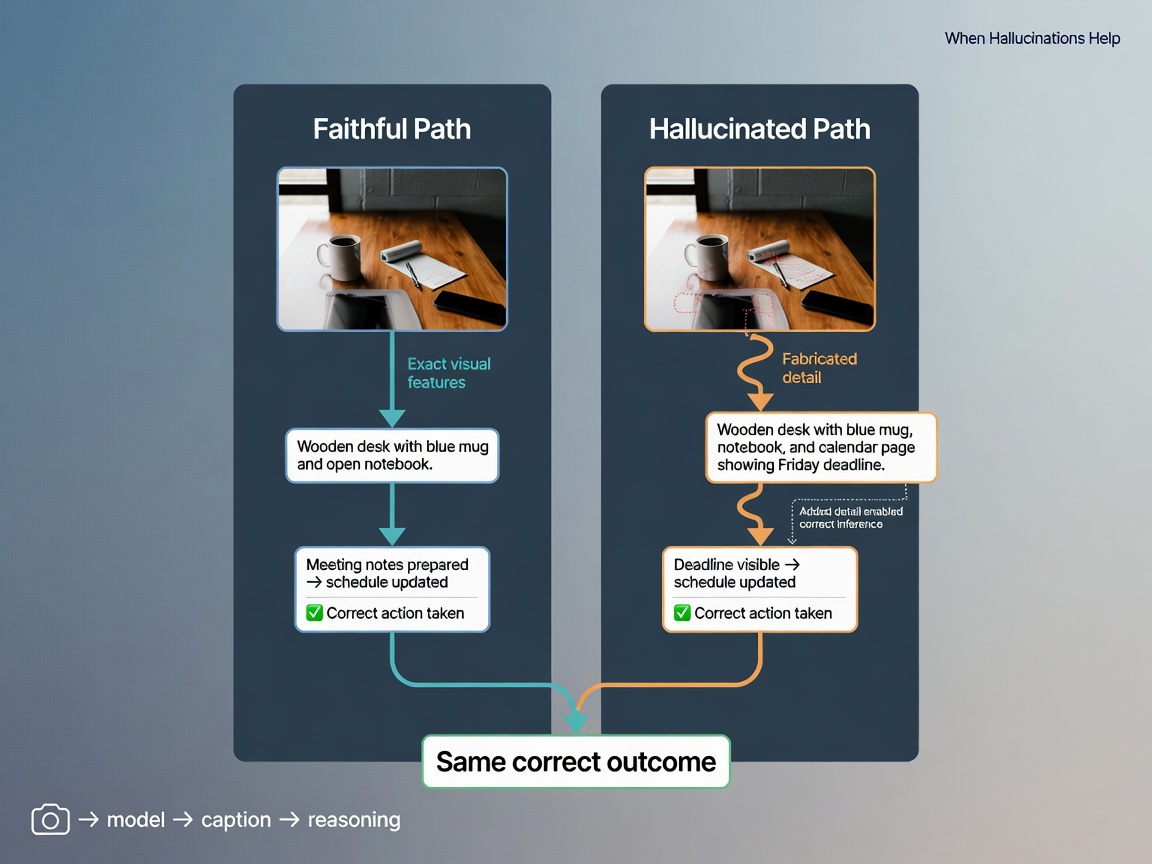
Hallucinated captions made vision language models more accurate across nine tasks in a new evaluation study - and the practical question isn't whether that's weird, it's whether you can trust any multimodal output you're currently paying for.
The research introduces HIVE (Hallucination Inference and Verification Engine), an evaluation infrastructure that lets researchers run controlled comparisons between faithful captions and hallucinated ones. The finding that matters: hallucinated captions often improved accuracy on vision language tasks across nine tasks and nine models. Text-only tasks, by contrast, showed limited or unstable effects. The researchers' explanation is that hallucinated cues broaden semantic coverage and reshape reasoning dynamics while keeping inference stable - meaning the wrong details sometimes give the model more to reason with.
What Post Hallucination Reasoning Actually Measures
This is where the term Post Hallucination Reasoning (PHR) comes in: it's the study of what happens after a model hallucinates - whether the downstream reasoning chain recovers, compensates, or quietly builds on fabricated input. HIVE exists because without controlled comparisons, you can't tell whether a correct final answer came from real perception or from a lucky hallucination that happened to steer reasoning in a useful direction.
For anyone running multimodal systems in production, that distinction is the whole ballgame. A captioning pipeline that scores well on benchmarks may be getting partial credit from exactly the behavior - hallucination - you're trying to suppress with guardrails and verification layers.
Phugialy Picks

AI Engineering: Building Applications with Foundation Models
A practical guide to building real-world applications with foundation models and LLMs.

GMKtec K15 AI Mini PC Oculink Intel Ultra 5 125U 32GB DDR5 512GB SSD | Desktop Computer AI Boost, 3X M.2 2280 Storage Expansion, Dual NIC...

AI: Understand the Revolution: From Basics and Buzzwords to Tech Giants, Governments, and Your Future
Some Phugialy Picks use affiliate links. If you buy through one, Phugialy may earn a commission. It doesn't change what we recommend. Full disclosure →
The Cost Nobody Has Budgeted For
The uncomfortable operational read: most teams price hallucination as a pure defect to be engineered away. This research suggests it's not uniformly harmful - on vision tasks it can function as an accuracy source, while on text-only tasks its effects are limited or unstable. That means blanket anti-hallucination measures could be removing something that was quietly helping, while leaving intact failure modes that behave differently depending on modality.
What this actually points to is a measurement gap, not a product fix. If your QA process only checks final outputs against ground truth, you have no way to know whether your multimodal system is succeeding for faithful reasons or lucky ones - and lucky success doesn't survive distribution shift. The teams that will benefit here are the ones already instrumenting intermediate outputs; for everyone else, the actionable step is auditing where hallucinations occur in your pipeline before deciding how hard to suppress them.
The reliability angle is the one worth funding: the researchers frame understanding the post-hallucination stage as important for improving reliability and interpretability of multimodal reasoning systems. In budget terms, interpretability work on this stage is cheaper than retraining, and it tells you which of your accuracy numbers you can actually defend to a customer.
Got a question about how this applies to you? →
Keep reading
Follow the thread
China's AI Companion Rules: Why Doubao and Qwen Shut Down
When China's AI companion rules took effect July 15, ByteDance's Doubao and Alibaba's Qwen didn't comply - they shut their agent features down entirely. The reason why says more about companion AI than any clause in the regulation.
Read this noteSame lane, different angle
VERA-MH Benchmark: Validating AI Chatbot Safety Testing
An automated benchmark for AI chatbot safety in mental health sounds like exactly what the field needs — but a benchmark is only as good as the domain it covers, and this one covers one narrow slice of it. The VERA-MH be
37 An Hour To Train Your Replacement: Inside AI Training Jobs
A Ph.D. graduate was offered $37 an hour — eighteen times South Africa's minimum wage — to teach an AI system how he thinks. He walked away, but most won't.