AI Text Watermarking May Narrow Diversity Across Responses
A watermarked answer can remain good on its own and still become less useful when you ask again. The evidence points to greater similarity across responses, but the human evaluations described do not test whether users notice or care.
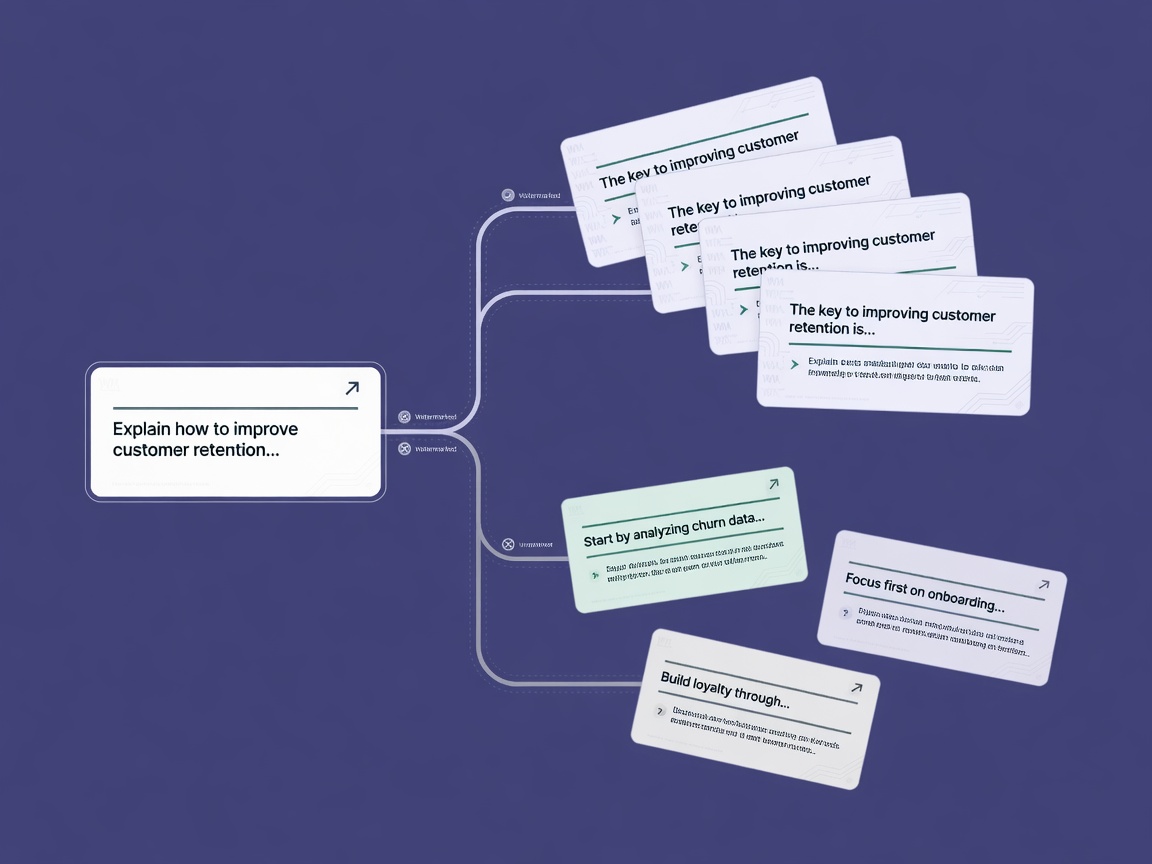
Automation needs a narrow first win
The best first AI workflow is usually a repeated task with a clear input, clear output, and a human approval step.
AI text watermarking may preserve the quality of one answer while making multiple answers to the same prompt more alike. That is a narrower and more consequential question than whether a single watermarked response reads well: repeated attempts and comparisons depend on getting meaningfully different outputs.
A quality claim about one answer, not a set
Anthropic’s stated claim is that “Watermarking does not impact the quality of Claude’s output.” The analysis points out that the quality evaluation concerns individual responses, not conversations or several responses generated from the same prompt. Those are different units of evaluation. A system can produce a strong answer once and still offer less variation when asked again.
The distinction matters most where users treat repetition as a feature. A writer may retry a prompt to find a different direction; someone comparing repeated answers may look for consistency as one clue about confidence. If the outputs cluster around the same phrasing or approach, the experience changes even if each answer remains acceptable on its own. That does not establish that watermarks make answers worse. It means individual-response quality does not settle the question of response diversity.
Worth a look
Phugialy Picks

AI Engineering: Building Applications with Foundation Models
A practical guide to building real-world applications with foundation models and LLMs.

GMKtec K15 AI Mini PC Oculink Intel Ultra 5 125U 32GB DDR5 512GB SSD | Desktop Computer AI Boost, 3X M.2 2280 Storage Expansion, Dual NIC...

2084 and the AI Revolution, Updated and Expanded Edition: How Artificial Intelligence Informs Our Future
Some Phugialy Picks use affiliate links. If you buy through one, Phugialy may earn a commission. It doesn't change what we recommend. Full disclosure →
The similarity signal is concrete, but limited
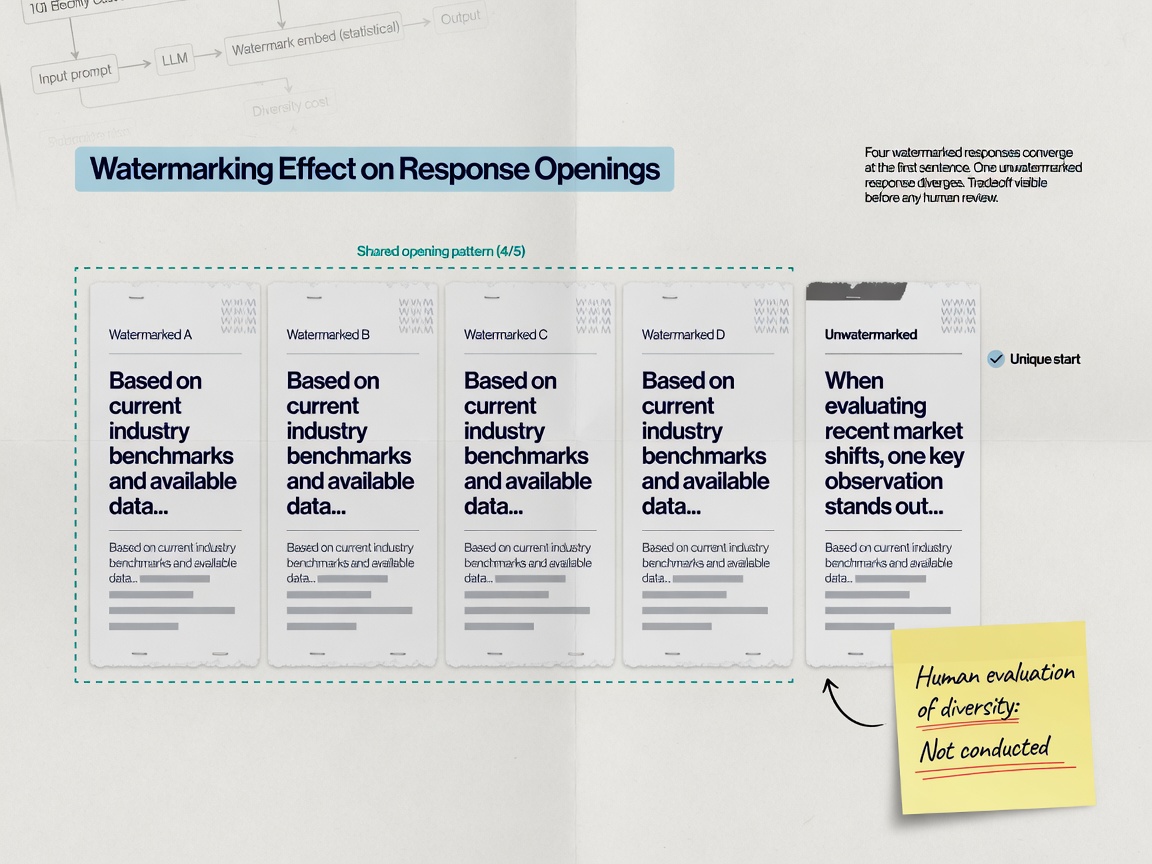
The linked SynthID-Text research describes a diversity/detectability trade-off: responses to the same prompt can be more similar when watermarked than when unwatermarked. In the small open-model test described by the article, four of five watermarked answers began in a near-identical way, while three unwatermarked answers opened differently. That is an illustrative signal, not a broad measurement of how users experience the effect.
The numbers support a specific observation about openings in one small test. They do not establish that every watermarked answer will converge, or that the same pattern appears in Claude. The article uses the result to raise a plausible concern about repeated prompting and creative writing, rather than to show that those uses have already been harmed at scale. That boundary is worth keeping in view: a measurable difference in similarity is not automatically a meaningful loss for every task.
Human evaluation leaves diversity untested
The gap is not simply that the test is small. The source article says it could not find human evaluations in the paper that tested the aspect most affected by reduced diversity. If people judged single outputs for quality, those judgments would not answer whether a group of outputs gives users useful alternatives. The evaluation may support a claim about individual response quality while leaving this separate property unresolved.
This gets framed as a dispute over whether watermarking affects quality, but the actual weight falls on what quality is being measured. For a user seeking one adequate answer, the reported claim may be enough. For a user relying on retries, creative variation, or comparison across answers, the missing test is central. The narrower claim that survives is that the cited research reports greater similarity among watermarked responses in its described setting; it does not establish how often that difference matters to people using Claude. Human testing of multiple answers to the same prompt would make that claim more useful.
Got a question about how this applies to you? →
For the broader limits of watermark claims, see “AI Text Watermarking: What It Proves And What It Doesn't.”
Keep reading
Follow the thread

Autonomous AI Research Still Depends on Human Steering
Models can improve when people steer them. The harder question is whether that counts as autonomous research when the person supplies the crucial direction.
Read this noteSame lane, different angle
Why AI Benchmark Coverage Misses Most American Work
AI benchmark coverage reaches only a narrow slice of work across the US economy, according to an analysis that estimates 90% of American working hours involve tasks with little or no coverage. That gap matters: benchmark
When Hallucinations Help: Rethinking Vision Model Accuracy
Hallucinated captions made vision language models *more* accurate across nine tasks in a new evaluation study - and the practical question isn't whether that's weird, it's whether you can trust any multimodal output you'