Why AI Benchmark Coverage Misses Most American Work
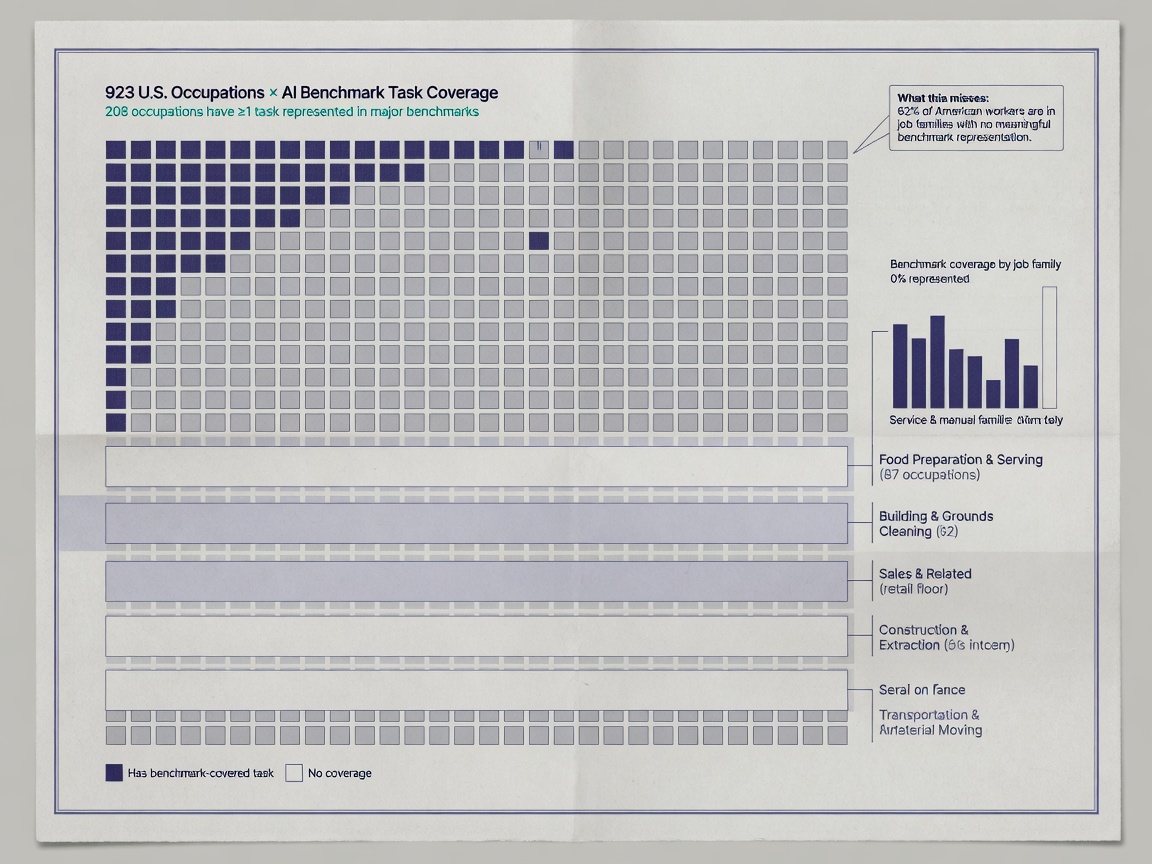
A review of 29 AI benchmarks estimates that 90% of American working hours involve tasks with little or no benchmark coverage. The bigger issue is not just how much work is missing, but which kinds of work make it into the tests.
Automation needs a narrow first win
The best first AI workflow is usually a repeated task with a clear input, clear output, and a human approval step.
AI benchmark coverage reaches only a narrow slice of work across the US economy, according to an analysis that estimates 90% of American working hours involve tasks with little or no coverage. That gap matters: benchmark scores can look precise while representing a limited—and uneven—sample of the work people actually do.
AI benchmark coverage leaves most occupations out
The analysis mapped prompts from 29 AI benchmarks to O*NET tasks, covering a total of 18,797 tasks across occupations. A task counted as covered only if it mapped to at least five benchmark prompts. By that measure, just 208 of 923 occupations had even one task represented, and six of 22 job families had no such occupations.
The 90% estimate is about working hours spent on tasks with little or no benchmark coverage, not a claim that AI cannot perform those tasks. That distinction is important. The analysis measures what benchmarks test; it does not establish what models can or cannot do across all work.
Worth a look
Phugialy Picks

AI Engineering: Building Applications with Foundation Models
A practical guide to building real-world applications with foundation models and LLMs.

GMKtec K15 AI Mini PC Oculink Intel Ultra 5 125U 32GB DDR5 512GB SSD | Desktop Computer AI Boost, 3X M.2 2280 Storage Expansion, Dual NIC...

Agentic AI Engineering: Systems That Reason and Act Autonomously – Designing, Building, and Prompting LLM-Based Agents for Real-World Deployment
Some Phugialy Picks use affiliate links. If you buy through one, Phugialy may earn a commission. It doesn't change what we recommend. Full disclosure →
AI-exposed tasks and larger wage bills get more attention
Tasks rated as AI-exposed were about six times more likely to appear in benchmarks than tasks rated unexposed. Coverage also favored tasks in occupations with larger wage bills, even after accounting for AI exposure. The analysis describes smaller, middle-income knowledge-work jobs as undercovered.
My read: this is a problem of what gets measured before it is a verdict on model capability. If benchmark coverage tracks exposure and wage bills, then a benchmark suite may be more informative about the work researchers and evaluators prioritize than about the full range of work AI might encounter. That is an interpretation of the coverage pattern, not a finding that the benchmarks are useless or that model performance is poor on omitted tasks.
What benchmark gaps mean for evaluation
A benchmark result is only as useful as the tasks it represents. The analysis gives a concrete reason to be cautious when using current benchmark scores to make broad claims about AI’s readiness for work: most American working hours, by its estimate, concern tasks with little or no representation. It does not show how results would change with a more representative benchmark set, or whether the five-prompt threshold is the right bar for meaningful coverage.
The authors call the findings provisional because the initial benchmark list is incomplete and its selection criteria involve subjective judgment. That caveat is not a footnote to ignore; it limits how firmly we should treat the exact coverage figures. But it does not erase the practical concern. Better coverage would make comparisons more relevant, while still leaving the separate question of how well models perform on those tasks.
For now, I would treat benchmark scores as evidence about tested tasks, not as a proxy for the whole labor market. The next useful signal is whether broader benchmark inventories change this coverage picture—especially for the smaller, middle-income knowledge-work jobs the analysis says are underrepresented.
Got a question about how this applies to you? →
For a related look at how agent evaluations frame task completion, read “Stop Training Agents to Just 'Get the Job Done'.”
Keep reading
Follow the thread

Evaluating Temporal Preservation in Conversational Image Editing
OCCUR-Bench introduces a diagnostic benchmark specifically for evaluating temporal preservation in conversational image editing. While many models claim to handle image manipulation well, they often fail at maintaining c
Read this noteSame lane, different angle
ARC-AGI-1 Without Fine-Tuning: What Orchestration Bought
An open-weight model running in non-thinking mode under a strict budget just hit 67.25% pass@2 on the ARC-AGI-1 evaluation set at $0.62 per task — no benchmark-specific training involved. That's the claim from a recent a
When Hallucinations Help: Rethinking Vision Model Accuracy
Hallucinated captions made vision language models *more* accurate across nine tasks in a new evaluation study - and the practical question isn't whether that's weird, it's whether you can trust any multimodal output you'