Generative AI for Information Is Growing, Not Agents
Generative AI is already a common route to information, but that does not mean people are ready to hand over tasks to agents or let AI write the news. The gap between those uses is the part product teams should pay attention to.

Automation needs a narrow first win
The best first AI workflow is usually a repeated task with a clear input, clear output, and a human approval step.
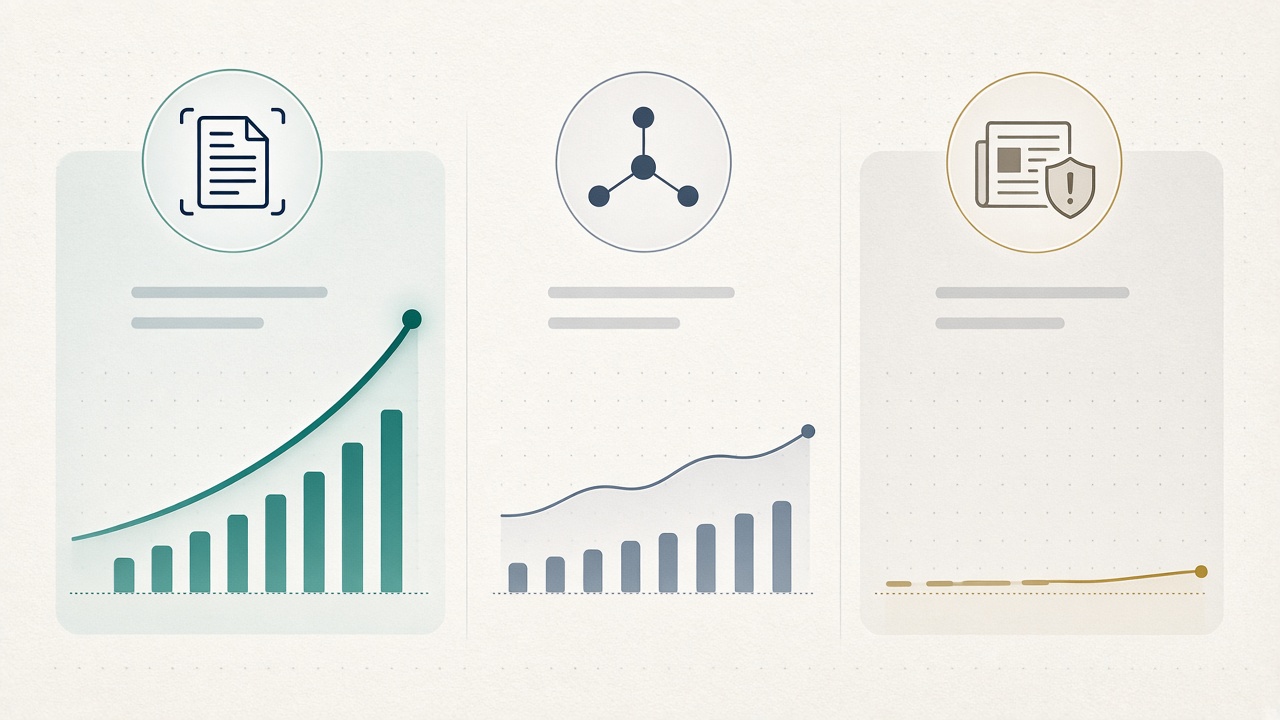
Thirty-eight percent of respondents across countries used generative AI for information in the last week, up from 24% in 2025 and 11% in 2024. That makes generative AI for information a practical product question: people are already using it to research topics, answer factual questions, and get advice, but that does not mean they want AI handling every information task.
Generative AI for information is becoming a routine path
A nine-country report finds conversational AI increasingly acting as an information intermediary. Across countries, 57% of respondents said they saw or engaged with AI-generated answers or summaries in the previous week. That includes encounters through existing services such as search engines and news media, not just direct conversations with an AI tool.
Weekly AI use is also rising: 51% of respondents across the six countries with past data said they now use AI weekly, including 49% in the U.S. Those figures describe different things—general weekly use, exposure to generated answers, and using generative AI to get information—so they should not be collapsed into one adoption number. Together, though, they show that AI is becoming part of how people reach information, both by choice and as a feature inside services they already use.
For someone building an information product, my read is that the useful unit is the task, not the chatbot. Researching a topic or getting a quick factual answer is a clear fit for a lower-friction interface. Whether users will trust the result, return to it, or tolerate errors in messy real-world questions is not answered by these usage figures.
Worth a look
Phugialy Picks

AI Engineering: Building Applications with Foundation Models
A practical guide to building real-world applications with foundation models and LLMs.

GMKtec K15 AI Mini PC Oculink Intel Ultra 5 125U 32GB DDR5 512GB SSD | Desktop Computer AI Boost, 3X M.2 2280 Storage Expansion, Dual NIC...

2084 and the AI Revolution, Updated and Expanded Edition: How Artificial Intelligence Informs Our Future
Some Phugialy Picks use affiliate links. If you buy through one, Phugialy may earn a commission. It doesn't change what we recommend. Full disclosure →
AI agent use and AI-created news remain separate tests
The adoption story changes when the system is expected to act on a user’s behalf or produce news. Across all nine countries, 67% said they had not used an AI agent in the last week. And just 12% were very or somewhat comfortable with news made entirely by AI; that rose to 19% when there was some human oversight. In six core countries, 9% said they used AI for news, up from 6% in 2025 and 3% in 2024.
That is not a contradiction. My interpretation is that people can accept AI as a faster route to information without being ready to delegate actions or accept AI as the author of news. The report also notes a widening gap in shared understanding of LLM capability, and that uneven uptake separates daily users from people who have never used AI. A demo that works for a frequent user may not explain itself—or earn trust—with everyone else.
Build around the information job, not the agent demo
The practical opportunity is to make information tasks easier without assuming users want an autonomous agent or AI-written reporting. I would treat conversational answers and summaries as an interface to evaluate, not as proof that users want a fully automated workflow. The source supports growing use for information; it does not show that people want agents to take over the next step.
For news products, the comfort figures make human oversight a meaningful distinction to test, though they do not establish that oversight alone solves trust. For other information tools, the report gives a reason to test direct question-answering and research flows with both regular AI users and people who have never used it. The signal to watch is whether information use keeps growing while agent use and comfort with AI-created news remain much lower. That gap is where product expectations need to stay grounded.
Got a question about how this applies to you? →
For a related look at AI answers inside search, read “From Search Results to Query Fan-out: The Reality of Google’s AI Expansion.”
Keep reading
Follow the thread

AI Training Data Needs Better Agent Evaluations
Handshake’s AI training business reportedly reached $1 billion in gross annualized revenue about a year after launch. Its benchmark demonstrations make the less comfortable point: a polished final answer can hide mistakes in how an agent handled the task.
Read this noteSame lane, different angle
Autonomous Security Operations: What Greenlight Shows
Greenlight says its AI system resolves more than 90 percent of security and risk cases. The architecture behind that figure includes escalation, memory, and a feedback pipeline—but the rate alone does not show whether the hardest mistakes are being caught.
GPT-6 Cyber and the Uneven Costs of AI Deployment
GPT-6 Cyber is restricted to approved testers, but that does not establish that it makes security work safer. Meanwhile, research points to a steep energy penalty for some non-English prompts—a reminder that AI deployment costs are not evenly distributed.