Training-Free Multimodal Attribution: What Holds Up
A training-free method locates source evidence using only attention heads during prefill — at one-seventh of prompting's latency. The benchmark behind it is also new territory.

Automation needs a narrow first win
The best first AI workflow is usually a repeated task with a clear input, clear output, and a human approval step.
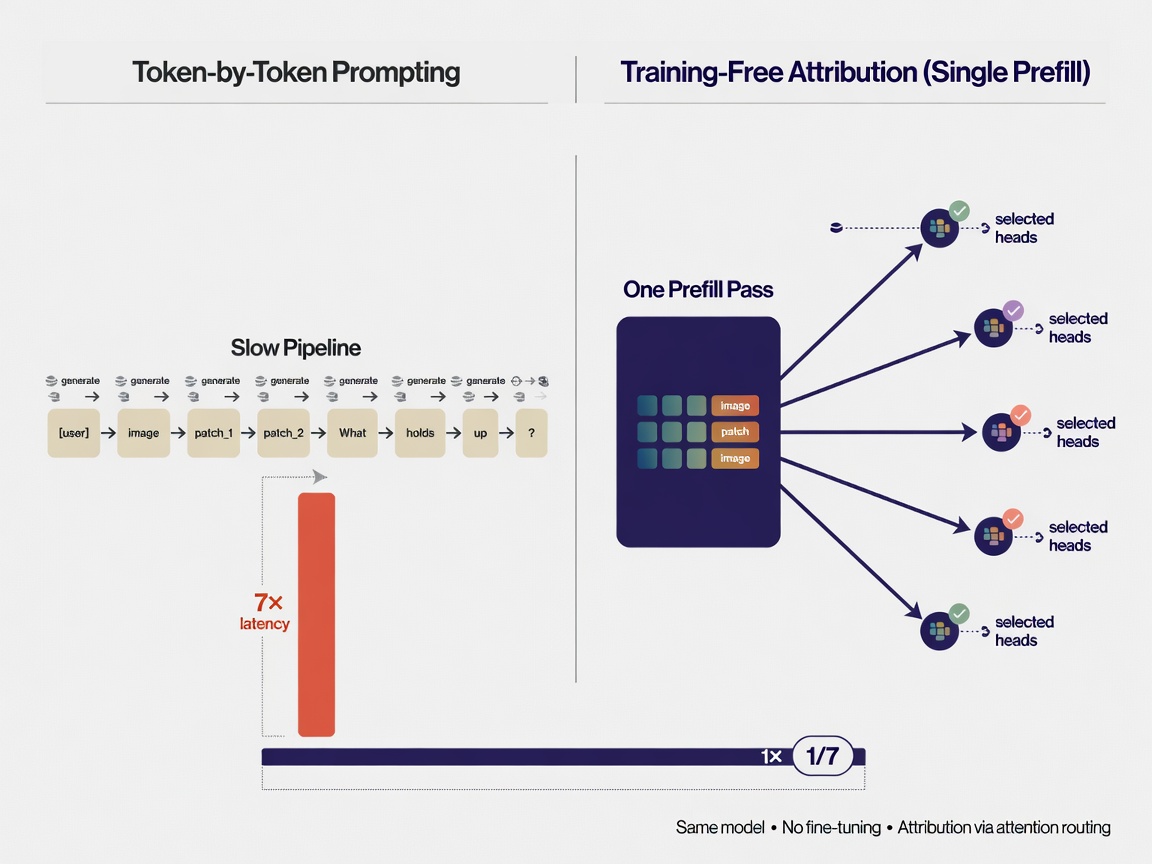
A new paper on arXiv introduces MultAttnAttrib, a training-free multimodal attribution method that finds source evidence in long documents using nothing more than a model's prefill pass and its own attention heads — no fine-tuning, no extra model, no retrieval pipeline bolted on the side. Alongside it comes MultAttrEval, described as the first benchmark dataset built specifically for multimodal attribution in long-form documents. The headline number: attribution at up to one-seventh of the direct inference latency compared to prompting the same base model.
What Training-Free Actually Buys You
The phrase "training-free" gets thrown around a lot, but here it means something concrete. Instead of training a dedicated attribution model or crafting elaborate few-shot prompts and hoping the model cites the right passages, MultAttnAttrib runs a prefill pass over the document and reads out selected attention heads to locate where the evidence actually lives. The model's internal attention does the work that would otherwise require either labeled training data or expensive inference-time reasoning.
The practical consequence is latency. Prompting-based attribution means generating citations token by token, which multiplies your inference cost on every response. Cutting that to one-seventh of direct inference latency on the same base model is not an incremental win — for anyone running attribution at scale over long documents, it's the difference between a feature you can afford and one you can't.
Worth a look
Phugialy Picks

AI Engineering: Building Applications with Foundation Models
A practical guide to building real-world applications with foundation models and LLMs.

GMKtec K15 AI Mini PC Oculink Intel Ultra 5 125U 32GB DDR5 512GB SSD | Desktop Computer AI Boost, 3X M.2 2280 Storage Expansion, Dual NIC...

AI: Understand the Revolution: From Basics and Buzzwords to Tech Giants, Governments, and Your Future
Some Phugialy Picks use affiliate links. If you buy through one, Phugialy may earn a commission. It doesn't change what we recommend. Full disclosure →
What The Benchmark Does And Doesn't Tell You
MultAttrEval matters because attribution claims have historically been evaluated on whatever short snippets a paper's authors happened to test on. Long-form documents are where attribution gets genuinely hard: evidence is scattered, context spans pages, and a confidently wrong citation looks identical to a correct one from the outside. Having a purpose-built dataset for this setting is real progress — it's the first of its kind, per the source article.
The paper reports improved accuracy over various attribution-generation methods, including strong prompting-based approaches. That's worth taking seriously. But my instinct is to ask what "improved accuracy" means at deployment scale: how many document types are in MultAttrEval, how well attention-head localization holds up on formats the benchmark doesn't cover, and whether the selected heads generalize across models or were tuned per architecture. None of those answers are in what we have here, and they're exactly where training-free methods tend to surprise you in production.
Where This Actually Fits In Practice
The real story here isn't that prompting-based attribution is dead — it's that there's now a credible middle path between "trust whatever citations the model generates" and "build and maintain a bespoke attribution system." If you need provenance for RAG outputs or document-grounded answers and your current approach is prompt engineering plus prayer, this suggests attention-based localization is worth prototyping before you invest in fine-tuning anything.
What I'd want to see before committing: independent replication on documents outside MultAttrEval, and clarity on how sensitive head selection is across base models. The latency claim is measured against prompting on the same base model — which is fair — but production systems often mix models, and the method's portability is an open question.
Still, this holds up better than most training-free claims I've looked at. It names its mechanism precisely (prefill pass plus selected attention heads), ships its own benchmark rather than borrowing someone else's, and frames its wins narrowly instead of claiming generality it hasn't tested. That's more rigor than most of what crosses my desk.
Got a question about how this applies to you? →
Keep reading
Follow the thread
MADB: Where Music AI Actually Stands on Human Judgment
Models asked to judge music like humans do fall substantially short — and for once we know because someone built the benchmark first instead of shipping demos.
Read this noteSame lane, different angle
RoboDojo Tests Robot Manipulation Policies Where It Counts
A new benchmark finally tests robot manipulation policies in both simulation and the real world - 42 sim tasks, 18 physical ones, and 30 policies already ranked under identical conditions. Here's what that changes about every robotics result you've seen so far.
FSU-QA Tests Foresight Intelligence in Vision-Language Models
Small Vision-Language Models fine-tuned on FSU-QA beat much larger frontier models at anticipating future events - but only when measured by FSU-QA itself. That circularity is the part worth thinking about before citing this result.