Compositional Visual Reasoning: The 5-Stage Shift Explained
A new survey of 100+ studies maps five stages of compositional visual reasoning - and explains why end-to-end models give plausible but wrong answers on multi-hop visual questions. The benchmark catalog alone is worth the read.
Automation needs a narrow first win
The best first AI workflow is usually a repeated task with a clear input, clear output, and a human approval step.
A new survey of compositional visual reasoning (CVR) synthesizes over 100 studies and traces a five-stage shift in how multimodal AI handles visual tasks: from prompt-enhanced language-centric pipelines, through tool-enhanced LLMs and tool-enhanced VLMs, to chain-of-thought reasoning and unified agentic vision-language models. If you're building anything where a model has to look at an image and answer questions about it reliably, that progression is the map you want.
What Compositional Visual Reasoning Actually Is
The core idea is simple to state and hard to implement: decompose visual tasks into grounded, interpretable reasoning steps guided by visual perception, rather than mapping image-plus-question directly to an answer in one shot. Humans do this naturally - we take high-dimensional, uncompressed visual input, abstract it into underlying structures, and manipulate those concepts as symbolic representations. Visual reasoning is inherently compositional: recognize objects and attributes, ground them in visual evidence, model the relations among them, and recombine those elements to support new inferences.
CVR is the attempt to give machines that same structure. The survey's authors define it as a research frontier in multimodal AI aimed at exactly this - decomposition, grounding of intermediate concepts, and multi-step logical inference - and they argue it deserves treatment as its own paradigm, distinct from the general-purpose reasoning and neurosymbolic frameworks that existing surveys cover.
Worth a look
Phugialy Picks

AI Engineering: Building Applications with Foundation Models
A practical guide to building real-world applications with foundation models and LLMs.

GMKtec K15 AI Mini PC Oculink Intel Ultra 5 125U 32GB DDR5 512GB SSD | Desktop Computer AI Boost, 3X M.2 2280 Storage Expansion, Dual NIC...

AI: Understand the Revolution: From Basics and Buzzwords to Tech Giants, Governments, and Your Future
Some Phugialy Picks use affiliate links. If you buy through one, Phugialy may earn a commission. It doesn't change what we recommend. Full disclosure →
Why End-to-End Models Break on Multi-Hop Questions
The survey's sharpest material is its diagnosis of monolithic approaches. Holistic models often exploit spurious correlations and linguistic priors instead of performing grounded inference - which produces plausible but incorrect answers and undermines generalization to novel scenarios. Anyone who has shipped a VQA system and watched it ace the test set and then fall apart on real images will recognize this failure mode immediately.
The scaling problem is just as important: scaling up data and compute for monolithic models does not yield proportional gains when tasks demand multi-hop reasoning, spatial understanding, or precise grounding. And holistic models struggle to recombine objects, attributes, and relations in novel configurations - which is precisely what most real-world visual tasks require. You don't get compositionality for free by adding parameters.
Against that, the survey credits compositional approaches with advantages in cognitive alignment, semantic fidelity, robustness, interpretability, and data efficiency, plus reduced language biases and hallucinations. The interpretability point is the one I'd weight most heavily in production: making intermediate evidence and inference explicit means you can actually debug where a pipeline went wrong, instead of staring at an end-to-end model wondering which layer introduced the error.
What the Survey Gives You as a Builder
Practically, this paper works as a structured reference. It provides a unified taxonomy, a historical roadmap, and a critical outlook for CVR, along with formalized core definitions and descriptions of the architectural designs, strengths, and limitations of each of the five paradigm stages. It also catalogs 60+ benchmarks and the commonly used metrics relevant to CVR - which is the part I'd actually open first, because benchmark selection is where most of these projects quietly go wrong.
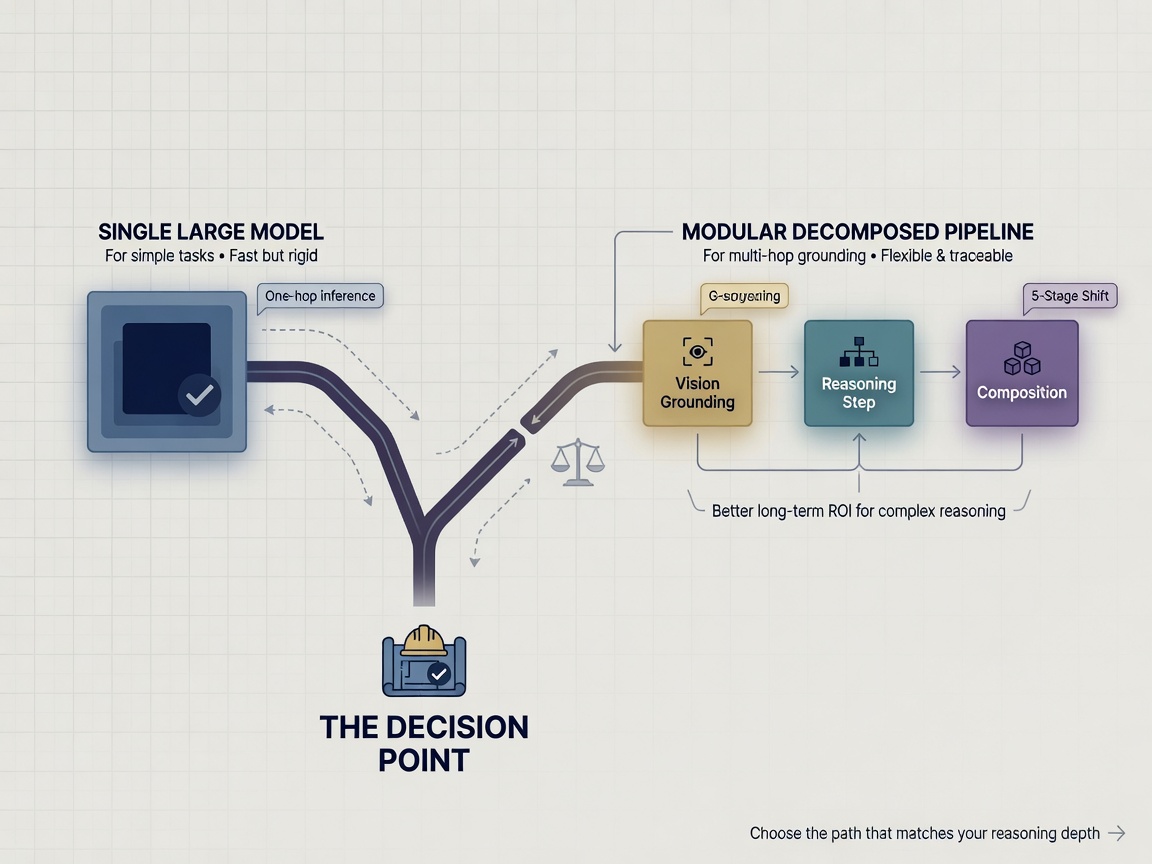
The five-stage progression is worth internalizing because it tells you where the field is heading: prompt-enhanced language-centric pipelines were the first attempt, tool-enhanced LLMs and then tool-enhanced VLMs added real perception and manipulation capabilities, and the current edge is chain-of-thought reasoning and unified agentic VLMs that handle decomposition internally.
Where I'd Put My Money
The real story here, as I read it, is that the field is converging on a compromise: unified agentic VLMs that keep the interpretability and grounding benefits of decomposition without the glue-code fragility of the older pipeline era. The survey identifies open challenges and future directions but - based on what's summarized here - doesn't claim those challenges are solved, and I'd take that seriously. The gap between a clean benchmark run and messy production images is exactly where explicit decomposition either saves you or adds a pile of failure points of its own.
My practical read: if your use case demands precise grounding or multi-hop reasoning over novel object configurations, the compositional literature is now mature enough that building on it beats fine-tuning a monolithic model and hoping. If your task is closer to single-shot description or classification at scale, the added pipeline complexity probably isn't paying for itself yet. The survey's own framing - that monolithic scaling hits diminishing returns specifically on multi-hop, spatial, and grounding tasks - is the decision boundary I'd use.
Got a question about how this applies to you? →
For a related look at how multimodal architectures are being restructured under real constraints, see "Why Graph Encoders Are Winning the Multimodal MRI Generation Race".
Keep reading
Follow the thread

Spectral Attacks Reveal a Hidden Weak Spot in Vision-Language Models
Researchers found a way to attack vision-language models using the model's own internal geometry — aligning representations with the subspaces the model cares about least. It beats existing baselines, and the same insight could make these models tougher.
Read this noteSame lane, different angle
FSU-QA Tests Foresight Intelligence in Vision-Language Models
Small Vision-Language Models fine-tuned on FSU-QA beat much larger frontier models at anticipating future events - but only when measured by FSU-QA itself. That circularity is the part worth thinking about before citing this result.
Training-Free Multimodal Attribution: What Holds Up
A training-free method locates source evidence using only attention heads during prefill — at one-seventh of prompting's latency. The benchmark behind it is also new territory.