SPEAR Turns Any Unreal Project Into an Embodied AI Simulator
A new open-source library exposes over 14,000 Unreal Engine functions to Python at no wrapper cost — turning any UE project into candidate training infrastructure for embodied AI at 73 fps photorealistic rendering.
Automation needs a narrow first win
The best first AI workflow is usually a repeated task with a clear input, clear output, and a human approval step.
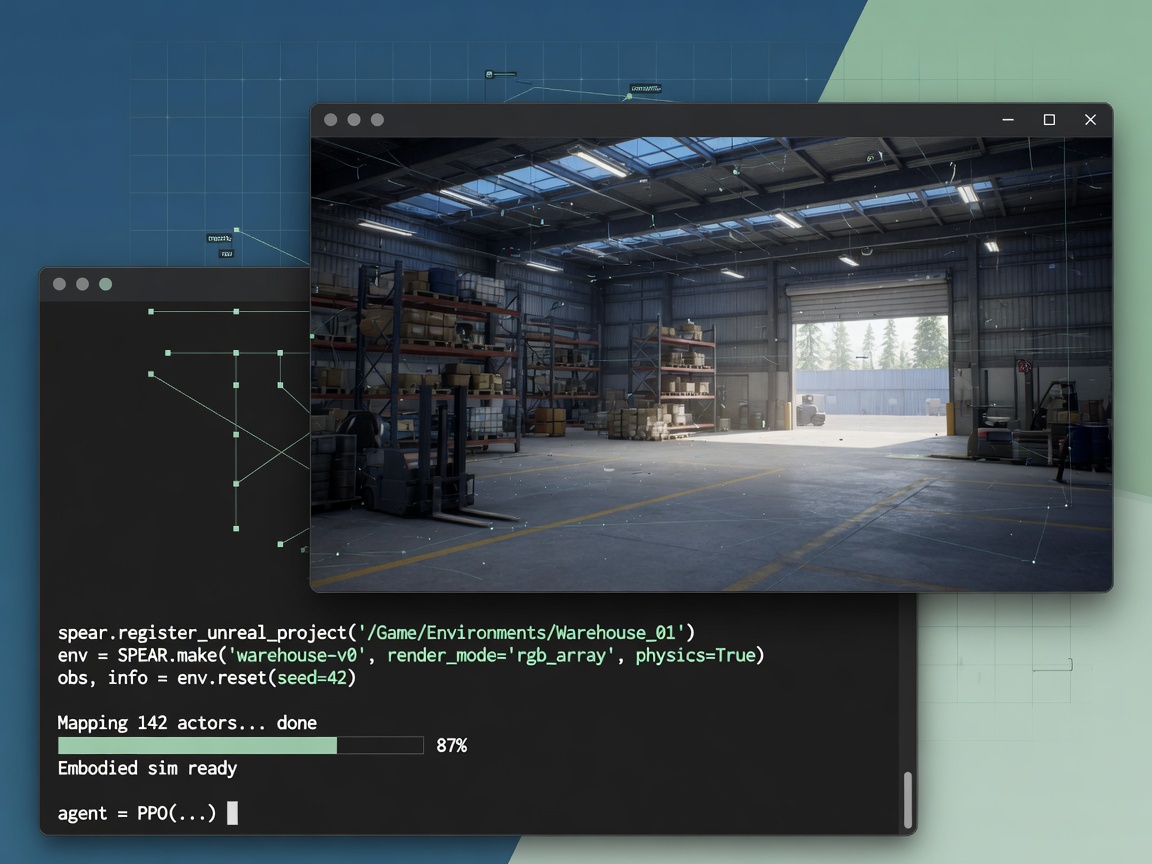
Simulator performance is one of those unglamorous bottlenecks that quietly decides who can train embodied AI at scale and who can't. A new open-source tool called SPEAR just moved that line: it's a Python library that connects to and programmatically controls any Unreal Engine application through a modular plugin architecture, exposing over 14,000 UE functions to Python — an order-of-magnitude increase in programmable functionality over existing UE-based simulators — while rendering 1920x1080 photorealistic images directly into NumPy arrays at 73 frames per second, roughly an order of magnitude faster than existing UE plugins.
What the Numbers Actually Show
The headline figures are concrete. Existing UE-based simulators expose hand-crafted Python interfaces typically consisting of hundreds of functions; SPEAR reaches 14,000-plus by hooking directly into UE's runtime reflection system via a C++ interface. That means Python can find classes, call functions, and manipulate variables on objects dynamically at runtime using strings as keys — no hand-crafted wrapper code for each class, function, and variable.
The rendering speed claim has a documented basis too. In tested UE-based simulators, returning a 1920x1080 image to Python can be 20-35x slower than rendering the same image to the viewport in a standalone UE application with no Python communication — significant communication overhead when moving large blocks of data like high-resolution images. SPEAR attacks that directly: it implements a mechanism for passing NumPy arrays back and forth between UE functions and user Python code without any data copying, and it provides an asynchronous variant of every function to avoid synchronizing with UE.
Beyond speed and coverage, SPEAR provides ground truth image modalities not available in any existing UE-based simulator — non-diffuse intrinsic image decomposition, material IDs, and physically based shading parameters. For anyone generating synthetic training data for segmentation, depth estimation, or 3D reconstruction, that's not a nice-to-have; it's supervision signal that previously required custom engineering.
Worth a look
Phugialy Picks

AI Engineering: Building Applications with Foundation Models
A practical guide to building real-world applications with foundation models and LLMs.

GMKtec K15 AI Mini PC Oculink Intel Ultra 5 125U 32GB DDR5 512GB SSD | Desktop Computer AI Boost, 3X M.2 2280 Storage Expansion, Dual NIC...

Agentic AI Engineering: Systems That Reason and Act Autonomously – Designing, Building, and Prompting LLM-Based Agents for Real-World Deployment
Some Phugialy Picks use affiliate links. If you buy through one, Phugialy may earn a commission. It doesn't change what we recommend. Full disclosure →
Why the Architecture Matters More Than the Benchmarks
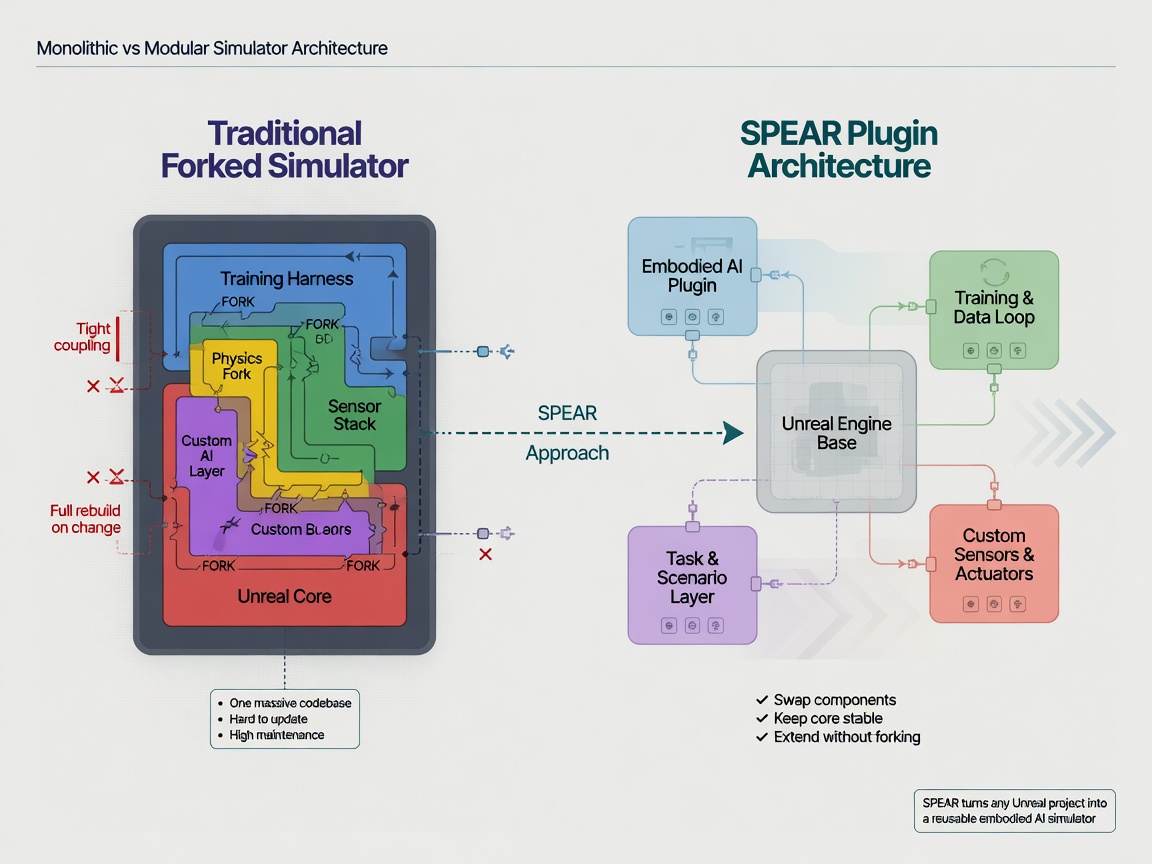
The deeper change is structural. Most existing UE-based simulators are distributed as large monolithic applications, often requiring their own custom fork of the 10+ million line UE codebase. That makes it hard to integrate them into existing projects or bring third-party assets in. SPEAR is instead implemented as a set of modular plugins enabled in any UE application by adding a single-line declaration to a project file.
That single-line integration is the part I'd watch commercially. It effectively turns any Unreal Engine project — including commercial game content — into a candidate simulation environment. The source notes that commercial video games have been successfully repurposed into AI simulators before, from Atari 2600 games to modern strategy, racing, and open-world titles, but existing game-based approaches either require hand-crafted scripting interfaces from game developers or work as unintrusive wrappers intercepting graphics driver calls with limited ability to observe or manipulate underlying game state. SPEAR's reflection-system approach removes both constraints.
There's also a workflow argument: Unreal's Blueprints system exposes nearly every class, function, and property visible to the reflection system but is unfamiliar to most AI practitioners and stored in a proprietary binary format — incompatible with diffing, merging, or AI coding assistants. The editor's Python environment exposes comparable functionality but only automates offline content-creation tasks inside the editor; it can't script standalone applications. SPEAR scripts standalone applications, live simulations inside the editor, UE's path tracer, and the editor itself through one unified programming model — text-native end to end.
Who This Helps and What Has to Be True
The obvious beneficiaries are research teams doing reinforcement learning for sensorimotor control, autonomous driving simulation work (SPEAR renders photorealistic city-scale environments), dexterous manipulation and quadruped locomotion research — all fields where interactive simulators are core scientific infrastructure. Demonstrated uses include controlling multiple embodied agents with distinct action spaces (humans, cars, robots) across several in-the-wild UE projects, synchronized multi-view renders of detailed human faces, manipulating UE's procedural content generation systems, co-simulation with MuJoCo physics via interactive coordination between simulators (MuJoCo is used as an external physics engine alongside SPEAR), and editing scenes with natural language through an AI coding assistant.
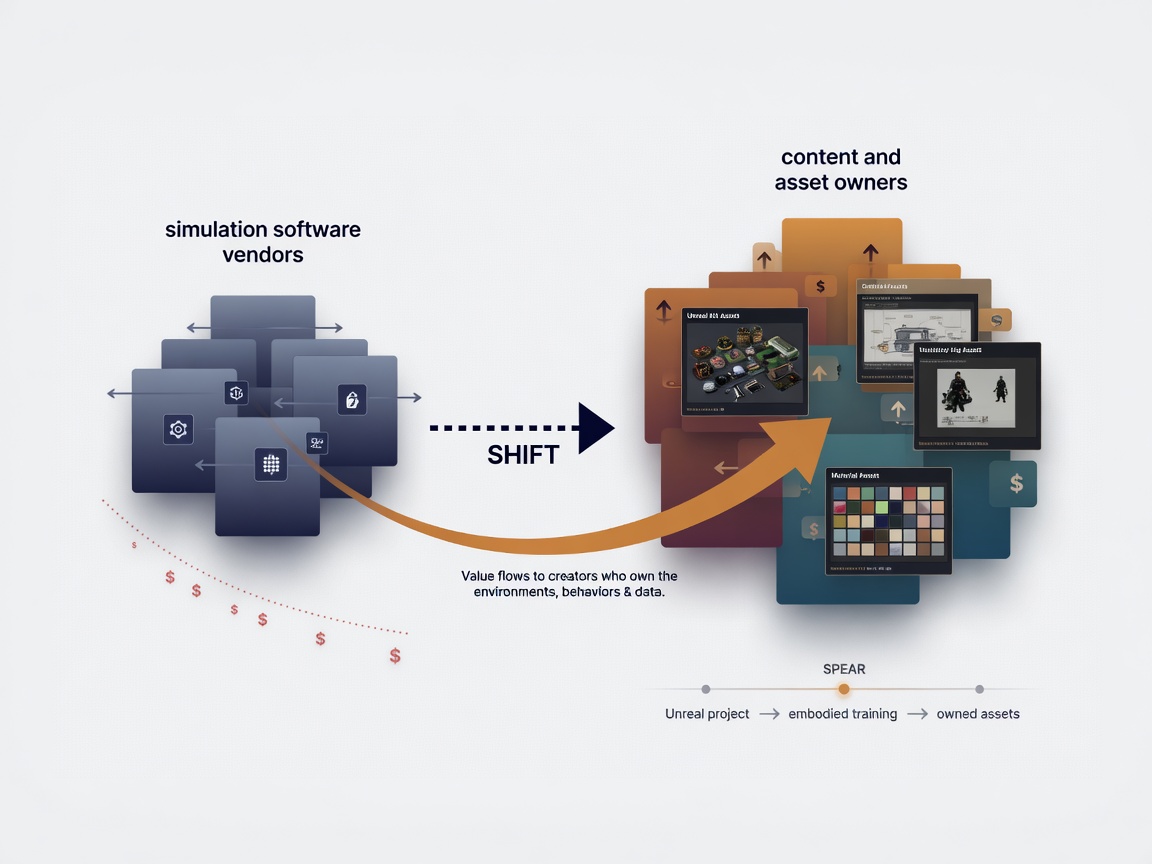
The real story here isn't the feature list — it's what lowering the integration cost does to the market structure around simulation tooling. Closed-source commercial platforms like IsaacSim have competed partly on turnkey convenience; open-source engines competed on flexibility but demanded heavy engineering (custom forks of million-line codebases). A tool that makes full-fidelity Unreal simulation nearly free to attach shifts value away from simulator vendors toward whoever controls compelling environments and assets — potentially game studios sitting on photorealistic worlds they never intended to sell as training data.
My read: this only matters at commercial scale if three things hold — that teams actually adopt it rather than staying on incumbent platforms with existing integrations; that rights holders don't wall off their content from synthetic-data generation; and that community-built environments emerge around it rather than everyone rebuilding bespoke scenes alone. None of those are settled yet.
What would confirm this direction within a year: third-party projects shipping SPEAR-compatible environments without custom forks being involved anywhere in the pipeline.
Got a question about how this applies to you? →
Keep reading
Follow the thread

TimEE: Time Series Classification With Zero Real Training Data
A time series is just a list of numbers measured over time - heartbeats, sensor readings, stock prices - and classifying one usually means training a new model from scratch for every single dataset. TimEE, a new 4.5M-par
Read this noteSame lane, different angle
Soft Robot Policy Learning Just Got Up To 40x Faster
A 40x speedup in simulation training sounds like a lab curiosity until you price what simulation time actually costs. New research on soft robot policy learning reports that switching to implicit time-stepping cuts train
RoboDojo Tests Robot Manipulation Policies Where It Counts
A new benchmark finally tests robot manipulation policies in both simulation and the real world - 42 sim tasks, 18 physical ones, and 30 policies already ranked under identical conditions. Here's what that changes about every robotics result you've seen so far.