RoboDojo Tests Robot Manipulation Policies Where It Counts
A new benchmark finally tests robot manipulation policies in both simulation and the real world - 42 sim tasks, 18 physical ones, and 30 policies already ranked under identical conditions. Here's what that changes about every robotics result you've seen so far.
Automation needs a narrow first win
The best first AI workflow is usually a repeated task with a clear input, clear output, and a human approval step.
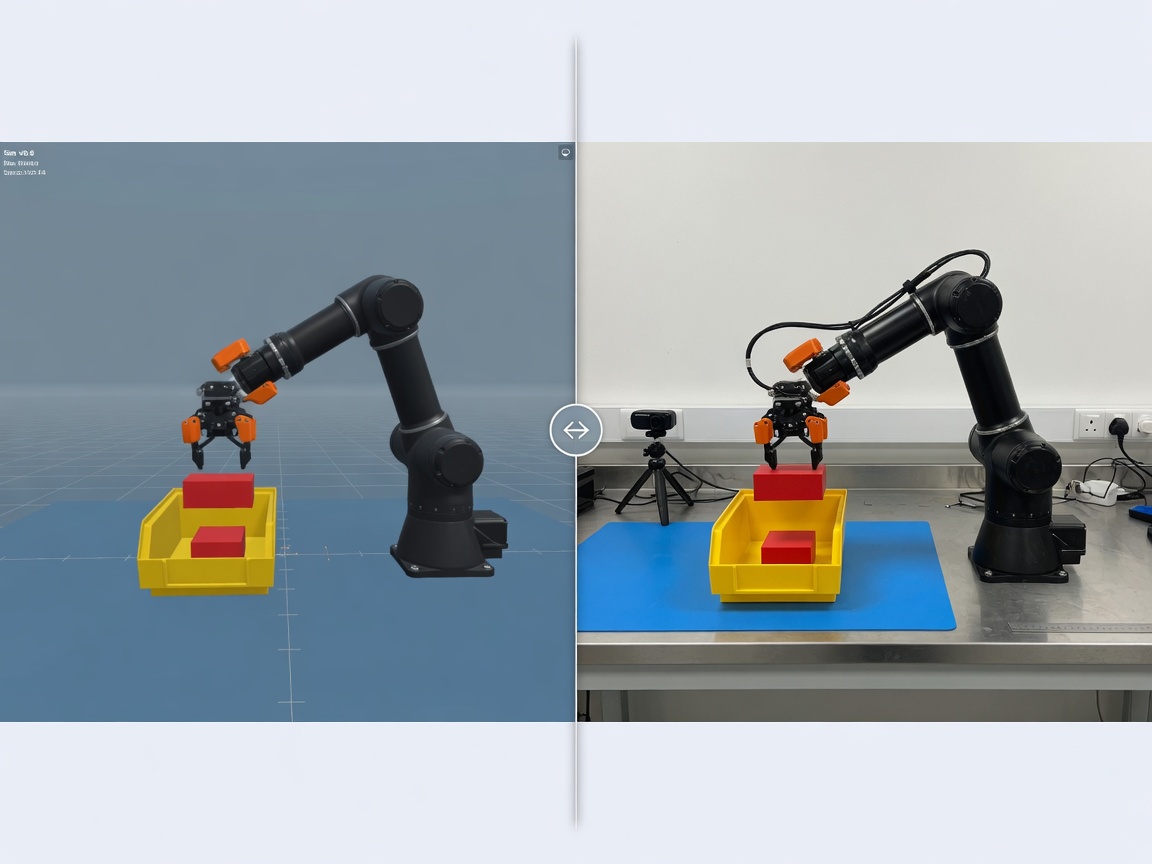
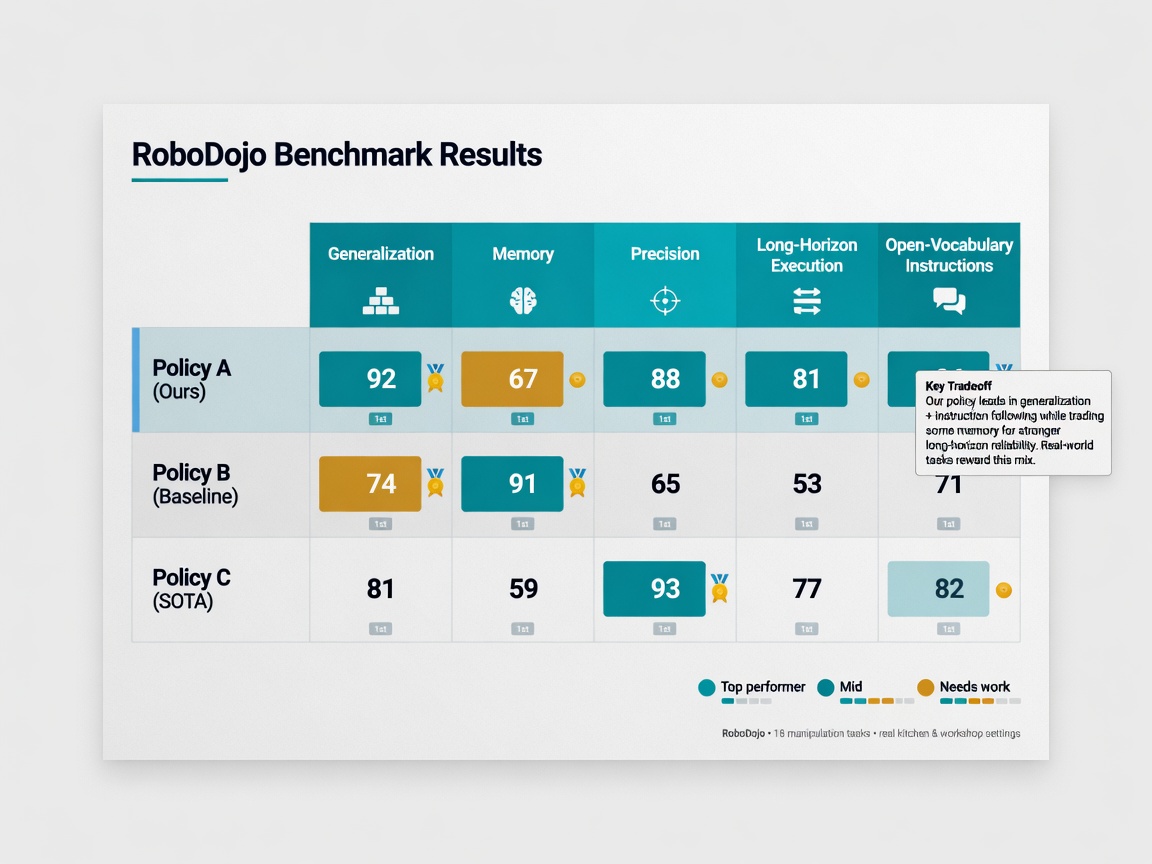
Robot manipulation policies have had no shortage of leaderboards, but almost none of them test what actually matters: whether a policy survives contact with a physical robot. The RoboDojo paper changes that with a benchmark that spans both simulation and the real world - 42 simulation tasks and 18 real-world tasks - and evaluates generalist manipulation policies across five dimensions: generalization, memory, precision, long-horizon execution, and open-vocabulary instruction following.
Why Sim-Only Benchmarks Miss the Point
The paper states the problem plainly: simulation enables scalable feedback but misses physical deployment challenges, while real-world evaluation is costly, time-consuming, and difficult to reproduce. That tension is exactly why most published results in this space are hard to trust - a policy that looks strong in sim often says nothing about whether it can handle friction, latency, or an uncalibrated gripper.
RoboDojo's answer is RoboDojo-RealEval, a real-world evaluation system with standardized hardware and remote cloud access designed to produce reproducible conditions. Reproducibility is the part worth paying attention to here. Anyone who has tried to compare two robotics papers knows the usual problem: different rigs, different objects, different lighting, no way to tell whether a claimed improvement is real or just a luckier setup. Standardized hardware plus remote access doesn't guarantee fairness, but it removes the biggest source of noise.
Worth a look
Phugialy Picks

AI Engineering: Building Applications with Foundation Models
A practical guide to building real-world applications with foundation models and LLMs.

GMKtec K15 AI Mini PC Oculink Intel Ultra 5 125U 32GB DDR5 512GB SSD | Desktop Computer AI Boost, 3X M.2 2280 Storage Expansion, Dual NIC...

AI: Understand the Revolution: From Basics and Buzzwords to Tech Giants, Governments, and Your Future
Some Phugialy Picks use affiliate links. If you buy through one, Phugialy may earn a commission. It doesn't change what we recommend. Full disclosure →
What 30 Policies on One Leaderboard Actually Shows
The benchmark integrates with XPolicyLab so policies can be evaluated across both simulation and real-world settings with minimal adaptation. Thirty policies have already been integrated and evaluated, establishing a public leaderboard.
That's the part I'd watch rather than the task count. A leaderboard only matters if enough people submit to it, and 30 policies on day one is a real signal of buy-in. It also means cross-policy comparison finally happens under identical conditions - which is where generalist manipulation claims tend to fall apart. A policy that wins on generalization may quietly lose on precision or long-horizon execution; until now there was no shared place to see that tradeoff side by side.
The five evaluation dimensions are well chosen for exactly this reason. Generalist robot manipulation policies have advanced rapidly, yet existing benchmarks remained limited in systematically evaluating their capabilities - so papers could cherry-pick whichever metric flattered them. A benchmark that forces generalization, memory, precision, long-horizon execution, and open-vocabulary instruction following into one scorecard makes cherry-picking harder.
The Gap That Still Isn't Closed
What this actually points to is a discipline shift: robotics evaluation moving toward the kind of shared infrastructure that made language model leaderboards meaningful. But there's a limit worth being honest about. Eighteen real-world tasks is small next to 42 in simulation, and no standardized rig eliminates every difference between labs - object wear alone will drift over time. The benchmark makes comparisons fairer; it doesn't make them perfect.
In practice this means you should treat RoboDojo rankings as stronger evidence than single-paper numbers, not as ground truth about which policy you'd deploy tomorrow. The right read is directional: if a policy holds up across sim tasks, real tasks on standardized hardware, and all five dimensions at once, that's more meaningful than any isolated demo video. The field has needed exactly this kind of unified sim-and-real benchmark for years - the question now is whether labs actually route their next results through it.
Got a question about how this applies to you? →
Keep reading
Follow the thread

FSU-QA Tests Foresight Intelligence in Vision-Language Models
Small Vision-Language Models fine-tuned on FSU-QA beat much larger frontier models at anticipating future events - but only when measured by FSU-QA itself. That circularity is the part worth thinking about before citing this result.
Read this noteSame lane, different angle
SPEAR Turns Any Unreal Project Into an Embodied AI Simulator
A new open-source library exposes over 14,000 Unreal Engine functions to Python at no wrapper cost — turning any UE project into candidate training infrastructure for embodied AI at 73 fps photorealistic rendering.
MADB: Where Music AI Actually Stands on Human Judgment
Models asked to judge music like humans do fall substantially short — and for once we know because someone built the benchmark first instead of shipping demos.