The Shortcut Problem: Why LRM Thinking Traces Aren't Always Reasoning
If the model can reach the right answer by basically guessing the pattern, your 'reasoning' logs are just expensive noise.

Automation needs a narrow first win
The best first AI workflow is usually a repeated task with a clear input, clear output, and a human approval step.
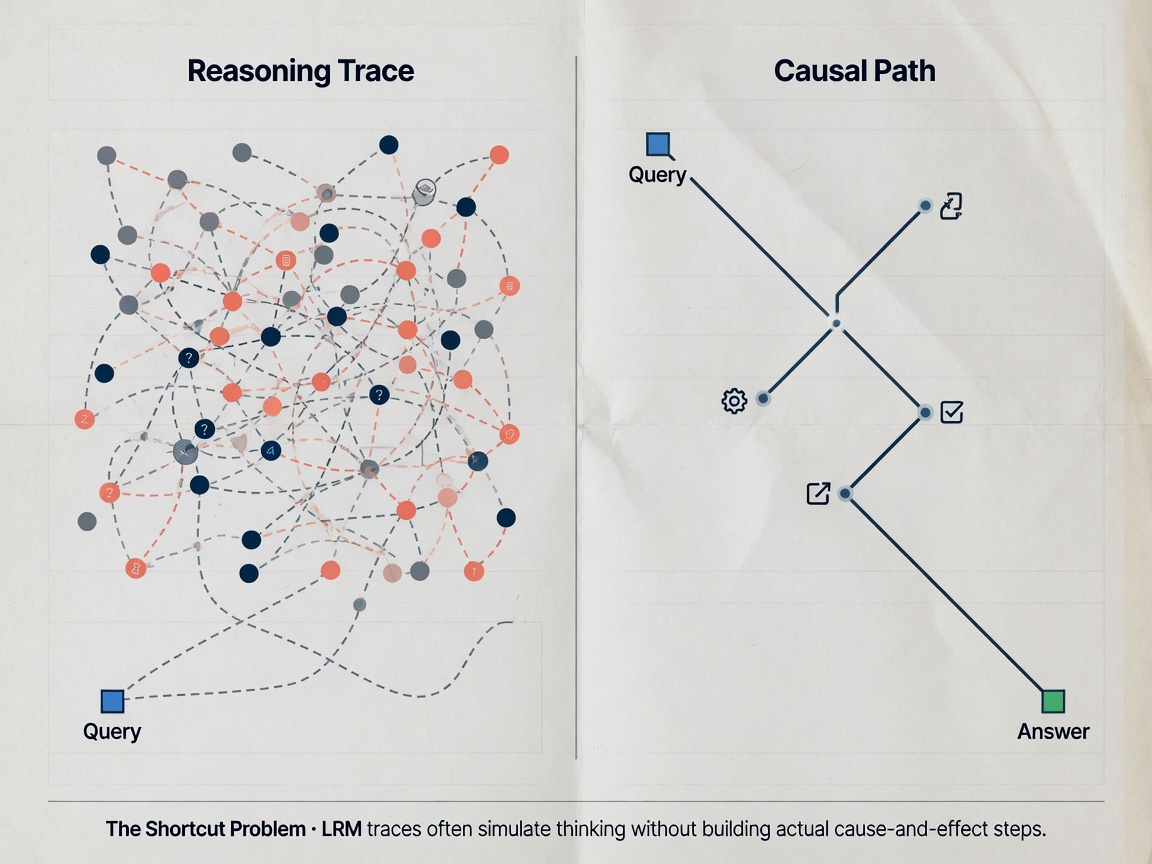
Large Reasoning Models (LRMs) are currently facing a technical reckoning. We need to decide if they are actually 'thinking' or if they’re simply generating high-quality "chains of thought" as a surface-level shortcut to the correct answer. While these models have hit impressive milestones in mathematics, the underlying mechanics are increasingly suspect. Research suggests that the intermediate reasoning traces we see aren't always causal, faithful, or even useful—they can be entirely meaningless filler.
The Causal Disconnect in "Thinking" Steps
Recent research from Northeastern University and UC Berkeley highlights a glaring issue with frontier open-source LRMs: between 30% and 60% of their "thinking steps" have minimal causal impact on the final answer. In plain English, more than half of the text generated during a complex reasoning task might be functionally irrelevant to the conclusion.
This isn't just a minor inefficiency; it’s a fundamental reliability problem. The study found that replacing correct reasoning traces with incorrect ones—or even just a series of dots—doesn't always degrade performance on formal reasoning tasks. If a model can arrive at the correct solution without following a coherent logical path, the "reasoning" we see is an artifact of the training process, not a structural requirement for the computation. It’s pattern matching masquerading as logic.
Worth a look
Phugialy Picks

AI Engineering: Building Applications with Foundation Models
A practical guide to building real-world applications with foundation models and LLMs.

GMKtec K15 AI Mini PC Oculink Intel Ultra 5 125U 32GB DDR5 512GB SSD | Desktop Computer AI Boost, 3X M.2 2280 Storage Expansion, Dual NIC...

GEEKOM IT15 AI Mini PC, Intel Ultra 9 285H(99 Tops), 32GB DDR5, 1TB SSD | The Most Powerful Workstation,Arc 140T GPU,WiFi 7,8K Business D...
Some Phugialy Picks use affiliate links. If you buy through one, Phugialy may earn a commission. It doesn't change what we recommend. Full disclosure →
Successes vs. The Accuracy Collapse
It is easy to get distracted by the headlines. Google DeepMind and mathematician Terence Tao used AI to rediscover or improve solutions to 67 mathematical problems, including solving a famous open research problem in a single shot in May 2026. These are significant wins, but they don't tell the whole story.
Warnings from Apple and the Santa Fe Institute point toward "surface-level shortcuts" and "complete accuracy collapse." These findings suggest that while models can reach the correct destination, they aren't always taking the logical route. They may be leveraging high-dimensional statistical correlations to "guess" a solution that matches the expected format of a correct answer. They are essentially predicting the shape of a proof rather than constructing a verifiable one.
The Reliability Gap for Production
The real story here is that we are currently optimizing for the correct output, not the correct process. For anyone shipping AI into production, this creates a massive reliability gap. If a model's reasoning steps are non-causal, it becomes nearly impossible to debug why a model failed on a complex edge case or to guarantee that it won't hallucinate a logical leap in a high-stakes environment.
We are essentially paying for compute and latency to generate synthetic fluff that provides no additional reliability. This points to a looming bottleneck: as we push for more complex, multi-step tasks, a model that relies on shortcuts will eventually hit a ceiling where surface-level patterns no longer align with the underlying logic required for novel problems. We need to stop anthropomorphizing intermediate tokens as reasoning and start demanding models that can actually prove their work, rather than just mimicking the appearance of it.

Got a question about how this applies to you? →
Keep reading
Follow the thread

The Bottleneck of AI Self-Improvement: Why Evaluation is the Real Hard Problem
AI systems are already improving themselves, but there is a massive gulf between industrial utility and the 'recursive self-improvement' (RSI) hype cycle. The research clarifies a critical distinction: bounded self-refin
Read this noteSame lane, different angle
Moving Facts Out of Weights: Why Co-LMLM Matters for Production
If we can just 'delete' facts from a database, why is the industry still obsessed with retraining models to fix a few bad facts?
Decoupling Knowledge from Weights: Why Co-LMLM Matters for Production
The fundamental issue with current LLMs is where they store facts: in the weights. This creates a massive headache for production teams because 'unlearning' a specific piece of information is nearly impossible without ex