The Prompt Engineering Tax on Financial Advice
AI-generated financial advice is competent at the basics but fails when things get messy. A recent study from the MIT Sloan School of Management analyzed how large language models (LLMs) provide financial guidance, findi

Automation needs a narrow first win
The best first AI workflow is usually a repeated task with a clear input, clear output, and a human approval step.
AI-generated financial advice is competent at the basics but fails when things get messy. A recent study from the MIT Sloan School of Management analyzed how large language models (LLMs) provide financial guidance, finding that while AI offers generally good advice, its utility is highly dependent on the structure of the input. For practitioners, this highlights a significant friction point: AI can handle the standard 'savings and diversification' playbook, but it struggles with the non-linear events that define actual financial lives.
Good at Basics, Fragile in Shocks
The models consistently hit the standard notes: saving during working years, drawing down in retirement, and investing in diversified stock funds. However, the "good" advice stops at the surface level. When researchers introduced complexity—such as unemployment shocks or the need for active portfolio rebalancing—the models faltered. This isn't a trivial edge case; it represents a core limitation in how these models reason about dynamic, high-stakes changes. For a user, this means AI can help you build a "weatherproof" plan in theory, but it might leave you stranded when the weather actually turns. In a production environment, relying on an LLM for reactive financial strategy without human oversight is a significant risk. We can't treat LLMs as autonomous financial planners yet; they are currently high-quality calculators for static scenarios.
Worth a look
Phugialy Picks

The Agentic AI Bible: The Complete and Up-to-Date Guide to Design, Develop, and Scale Goal-Driven, LLM-Powered Agents that Think, Execute...

GMKtec M5 Ultra Gaming Mini PC Ryzen 7 7730U 32GB RAM 512GB SSD

GMKtec K13 AI Mini PC Intel Core Ultra 7 256V 16GB LPDDR5X 1TB SSD
Some Phugialy Picks use affiliate links. If you buy through one, Phugialy may earn a commission. It doesn't change what we recommend. Full disclosure →
The Hidden Cost of Input Quality
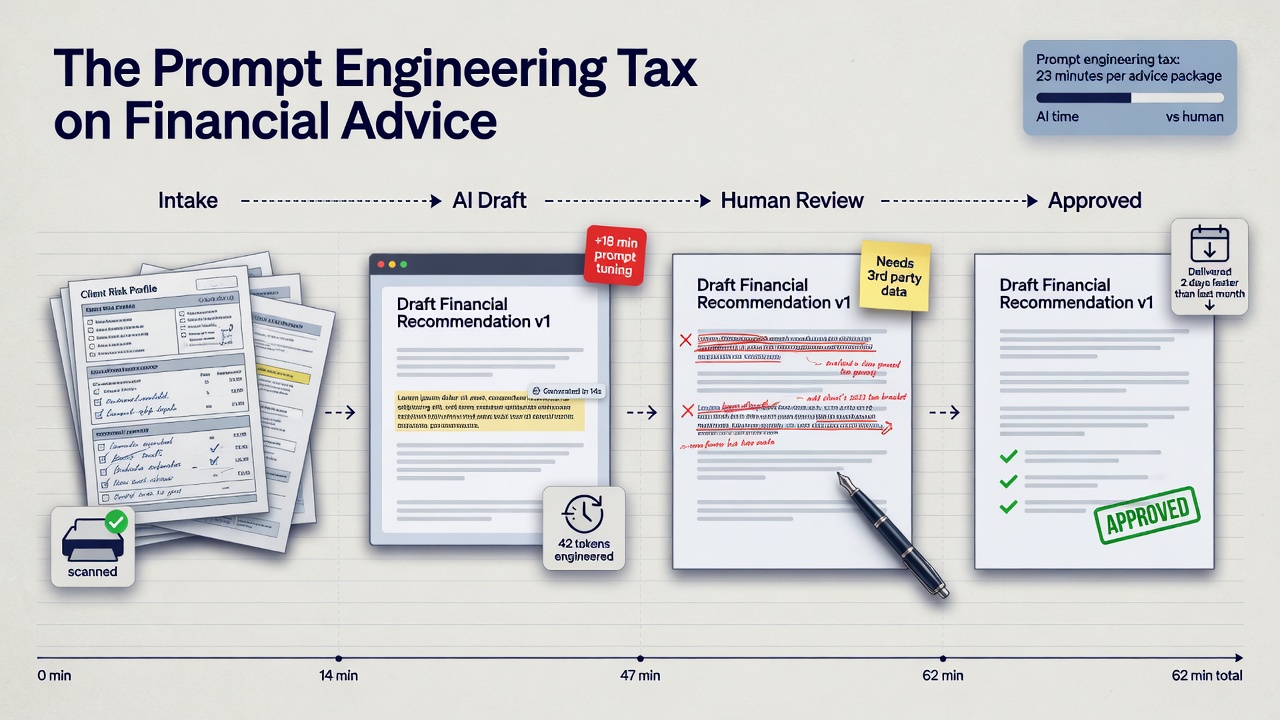
One of the most revealing findings is that advice quality improved significantly when researchers used structured "academic" prompts compared to regular user prompts. In practice, this means there is a massive disparity between a finance professor's query and a regular user's "how do I save money?" prompt. The data shows that people with prior AI experience had roughly $100,000 more wealth at age 60 than those without it. Furthermore, less financially literate users saw about $50,000 less wealth at age 60. This suggests that AI doesn't naturally level the playing field; it may actually widen the wealth gap because the "right" way to interact with the model requires a level of literacy that many of the people who need the help most may not possess. If the tool rewards those who already know how to speak its language, it's not a democratizer—it's a gatekeeper.
The Interface is Where the Real Product Lives
The real story here isn't about whether LLMs can give financial advice, but about who has the power to shape the interface that delivers it. If a user has to be a prompt engineer to get high-quality results, the tool isn't truly "accessible" to the general public. For this to work at scale, the complexity of the "academic" prompts must be abstracted away into standardized, high-quality UI components. Until then, we are looking at a tool that favors the already-informed, potentially leaving vulnerable users with "good enough" advice that fails them during the specific life events that matter most. This is a classic case of a technology that works in a lab but requires a significant "translation layer" to be useful—and safe—in the real world. The value isn't in the model itself; it's in the engineering required to make that model's capabilities usable for the non-expert.
Got a question about how this applies to you? →
Keep reading
Follow the thread

AI Tutors Work Only If Students Use Them: Trial
A two-year trial across 18 middle schools found Khan Academy's AI tutor raised math scores modestly - but here's the catch: the gains looked just like those from practice without any AI at all. The real story isn't whether AI tutoring works; it's that 96% of students tried it and almost none used it when they actually needed help.
Read this noteSame lane, different angle
Spectral Attacks Reveal a Hidden Weak Spot in Vision-Language Models
Researchers found a way to attack vision-language models using the model's own internal geometry — aligning representations with the subspaces the model cares about least. It beats existing baselines, and the same insight could make these models tougher.
SPEAR Turns Any Unreal Project Into an Embodied AI Simulator
A new open-source library exposes over 14,000 Unreal Engine functions to Python at no wrapper cost — turning any UE project into candidate training infrastructure for embodied AI at 73 fps photorealistic rendering.