Google Earth’s Image Generation Rollback: A Lesson in Guardrail Debt
Google just pulled the plug on its image generation feature in Google Earth. The reason? Policy violations. Even though the generated images were watermarked as AI-generated and kept in a 'private' sandbox—meaning they w
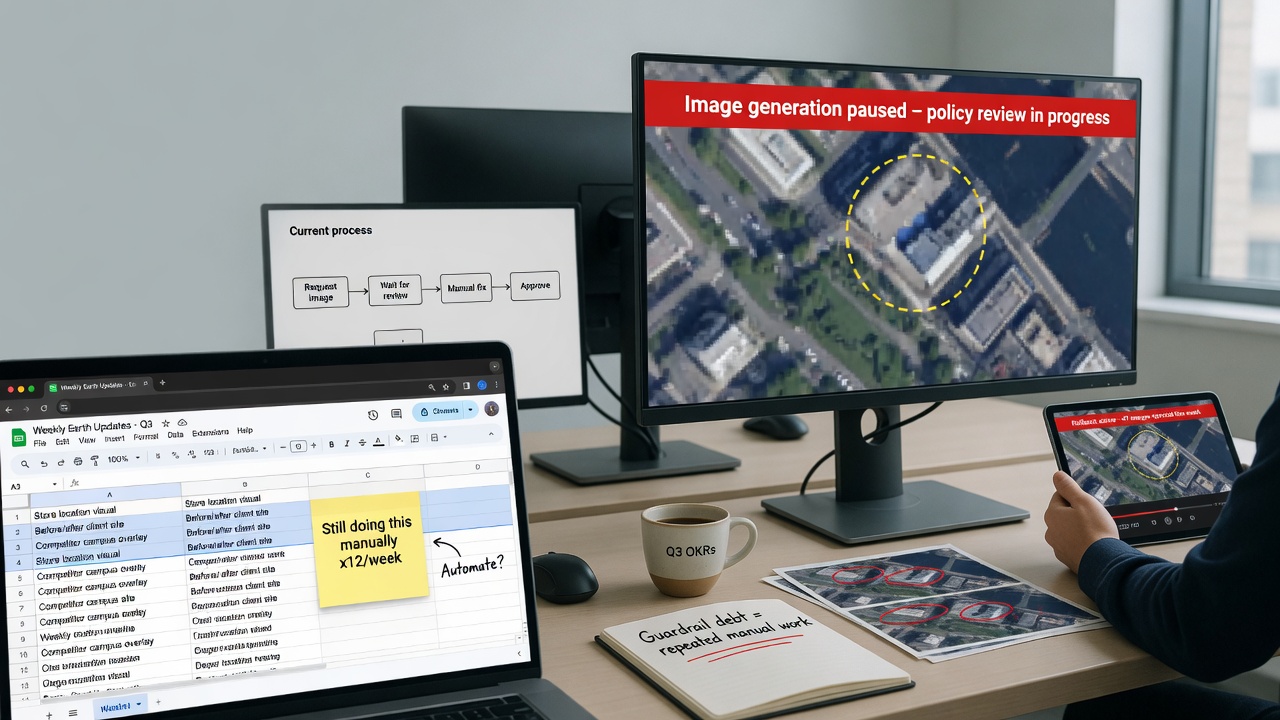
Automation needs a narrow first win
The best first AI workflow is usually a repeated task with a clear input, clear output, and a human approval step.
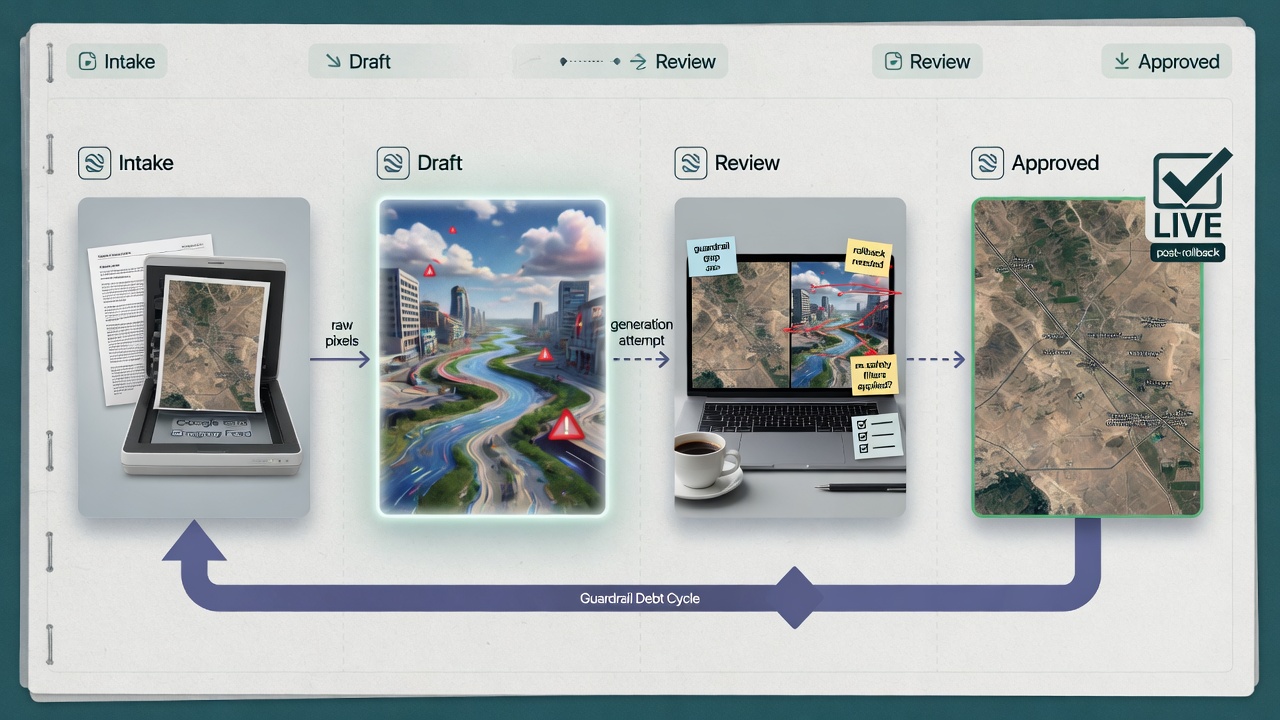
Google just pulled the plug on its image generation feature in Google Earth. The reason? Policy violations. Even though the generated images were watermarked as AI-generated and kept in a 'private' sandbox—meaning they weren't visible to other users in the main experience—they still crossed lines that Google’s safety protocols couldn't handle. For anyone actually shipping products with generative AI, this is a massive reality check: 'Private' is not a synonym for 'Safe.' You can't just wrap a wild model in a UI and call it 'safe by design.' If the underlying weights have the capacity to produce prohibited content, that risk exists regardless of who sees the output.
The 'Private Sandbox' Fallacy in AI Deployment
We often talk about isolation as a safety feature, but Google Earth proves that isolation is just a delay tactic. When you’re building with generative models, the 'sandbox' is an illusion if the core model isn't governed. If a model can hallucinate a prohibited landmark or generate non-compliant imagery, that capability is baked into the system. For developers, the lesson here is clear: you cannot rely on UI-level restrictions to solve model-level problems. If you aren't addressing the core output behavior at the prompt, fine-tuning, or system-level instructions, you're just building a house on sand. You need to solve for the 'worst-case' output, not just the 'average' user experience.
Worth a look
Phugialy Picks

AI Engineering: Building Applications with Foundation Models
A practical guide to building real-world applications with foundation models and LLMs.

GMKtec K15 AI Mini PC Oculink Intel Ultra 5 125U 32GB DDR5 512GB SSD | Desktop Computer AI Boost, 3X M.2 2280 Storage Expansion, Dual NIC...

GEEKOM IT15 AI Mini PC, Intel Ultra 9 285H(99 Tops), 32GB DDR5, 1TB SSD | The Most Powerful Workstation,Arc 140T GPU,WiFi 7,8K Business D...
Some Phugialy Picks use affiliate links. If you buy through one, Phugialy may earn a commission. It doesn't change what we recommend. Full disclosure →
Reliability as a Hard Architectural Constraint
Google’s reasoning hits on a fundamental truth: "We know that people uniquely trust Google Earth for a reliable view of the world." This is what I call the 'Reliability Tax.' In a low-stakes creative app like Midjourney, a hallucination is a quirk—it's part of the fun. But in a high-trust geospatial tool, a hallucination is a product failure. It breaks the primary value proposition of the platform. As we move from 'cool' experimental demos to integrated production tools, our tolerance for synthetic errors drops to near zero. For builders, this means safety isn't a checkbox you tick at the end of a sprint; it’s a core architectural constraint that dictates what features are even viable to ship in the first place.
Planning for the Era of Feature Volatility
When Google says they are "working on implementing stronger guardrails," they are admitting that the current state of the art is still struggling with production-scale safety. The real story here is the transition from experimental flexibility to governed infrastructure. For those of us integrating these APIs into our own stacks, the practical takeaway is to prepare for feature volatility. We are entering an era where a provider can—and will—turn off a feature without warning if the liability of a 'hallucination' outweighs the utility of the tool. If your production roadmap depends on a specific AI behavior that isn't fully governed by the provider yet, your architecture is fragile. Don't just build for what the API can do today; build for what the provider is willing to let you keep tomorrow.
Got a question about how this applies to you? →
Keep reading
Follow the thread

Moving Past the AI Mythology: Engineering Social Collaboration
We need to stop treating "Artificial Intelligence" as a literal description of the technology and start treating it as a misleading label. For developers trying to integrate these models into production, the mythological
Read this noteSame lane, different angle
The Institutionalization of Frontier AI Labs: From Software to Infrastructure
Frontier AI labs are no longer just software companies; they are becoming providers of cognitive infrastructure. This shift moves them out of the realm of traditional tech and into a space where they function as a struct
Debian’s AI Policy: Responsibility Isn't Automated
If you can't defend every line an LLM spat out, you have no business hitting 'merge'.