Moving Facts Out of Weights: Why Co-LMLM Matters for Production
If we can just 'delete' facts from a database, why is the industry still obsessed with retraining models to fix a few bad facts?

Automation needs a narrow first win
The best first AI workflow is usually a repeated task with a clear input, clear output, and a human approval step.
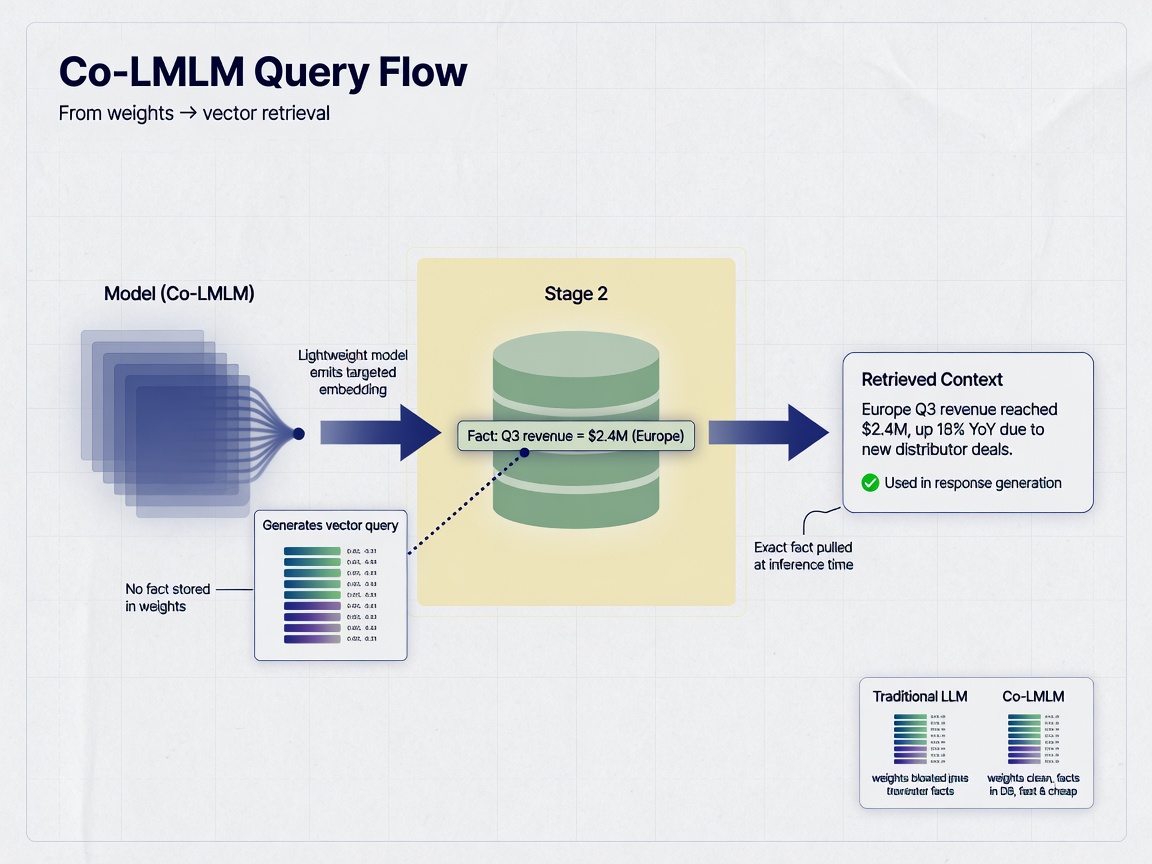
Co-LMLM changes the fundamental architecture of how we handle facts in language models. Instead of trying to bake every piece of information into the model's weights—a process that is messy, expensive, and prone to hallucinations—it externalizes that knowledge into a human-readable knowledge base (KB). By treating the model as an engine that queries a library rather than a brain trying to recall every fact perfectly, we solve one of the biggest hurdles in factual precision.
Moving from Memorization to Vector Queries
The technical shift here is the use of continuous vector queries. Most previous relational models relied on structured tuples, which are too rigid for the nuances of natural language. Co-LMLM uses vector queries to fetch knowledge, which keeps inference costs low while maintaining flexibility. During pre-training, the model learns to tag free-form factual spans from arbitrary text, moving beyond the "Wikipedia-only" limitation of earlier models. This means the KB can be populated from a much wider variety of raw data, making it actually useful for specialized enterprise domains.
The numbers are hard to ignore. A 360M scale Co-LMLM model achieved lower perplexity than models trained on 40x more data. On the SimpleQA benchmark, it performed on par with gpt-4o-mini and outperformed Claude Sonnet 4.5. The takeaway? When you stop forcing a small model to "know" everything, it becomes significantly more efficient at its actual job: processing language and retrieving the right information at the right time.
Worth a look
Phugialy Picks

AI Engineering: Building Applications with Foundation Models
A practical guide to building real-world applications with foundation models and LLMs.

livho Blue Light Blocking Computer Glasses
We'd buy this if: You spend most of your day staring at a screen and haven't tried blue light glasses yet.
We'd skip this if: You already wear prescription glasses with a blue light coating, or don't notice eye strain.
INIU 10000mAh 45W Fast Charging Portable Power Bank
We'd buy this if: You've been caught with a dead phone/laptop away from an outlet more than once.
We'd skip this if: You're always near a charger anyway.
Some Phugialy Picks use affiliate links. If you buy through one, Phugialy may earn a commission. It doesn't change what we recommend. Full disclosure →
The Production Reality: Editable Knowledge
For anyone shipping AI into production, the real winner here is the "editable" nature of the KB. In standard LLMs, "unlearning" a specific fact or correcting a hallucination usually requires expensive fine-tuning or brittle prompt engineering that often degrades other capabilities. Co-LMLM allows for direct unlearning through standard database operations. Because the knowledge is externalized and attributable to source material, you can swap, update, or delete facts without touching the model weights.
The New Bottleneck: Data Engineering
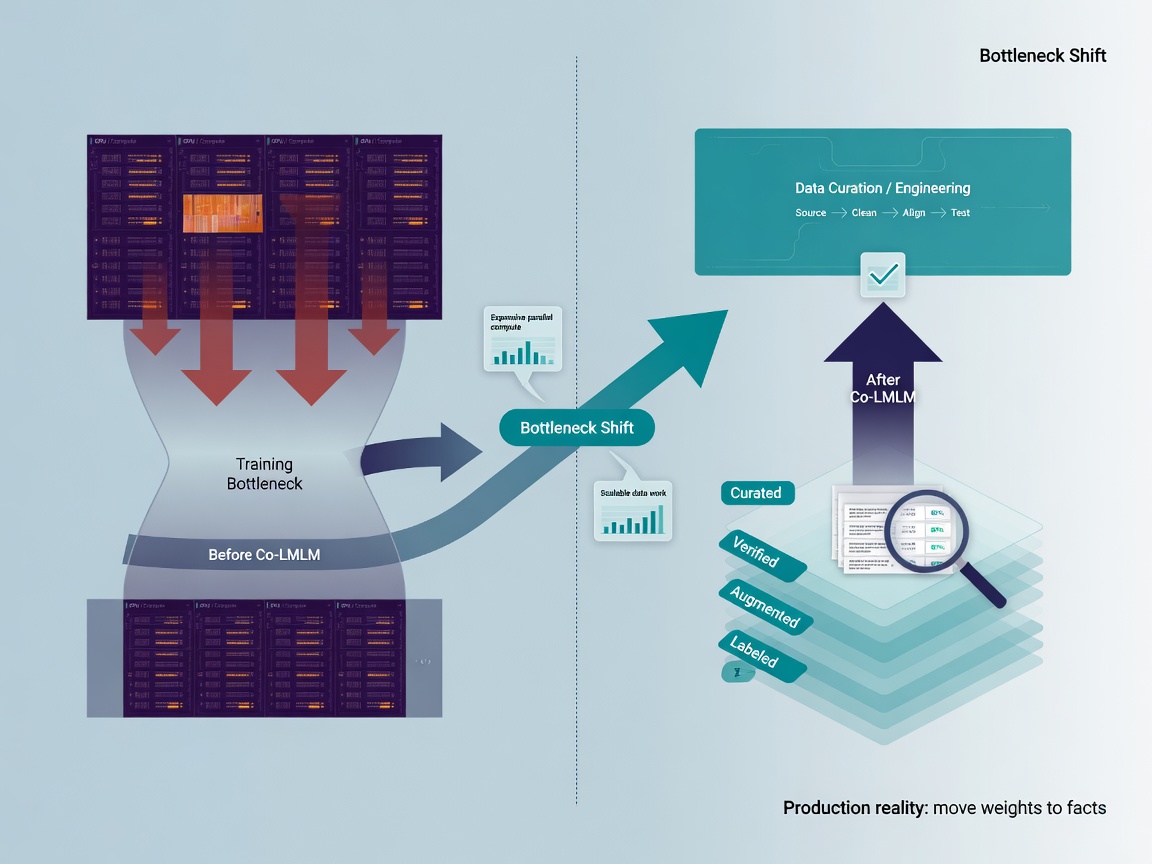
But let's be real about the trade-offs. The "intelligence" is shifting. The paper highlights an annotation pipeline to tag factual spans in arbitrary text. This is the part that won't be easy to scale at a massive, general-purpose level. To make Co-LMLM work for your company, you aren't just training a model; you are building and maintaining a high-quality, human-readable knowledge base.
Co-LMLM isn't a "plug-and-play" replacement for vanilla LLMs. It’s a move toward a modular architecture where the model is the reasoning engine and the KB is the source of truth. This is a pragmatic win for reliability and compliance, but it shifts the bottleneck from "how many GPUs can we throw at this?" to "how accurately can we curate the knowledge base?"
Got a question about how this applies to you? →
Keep reading
Follow the thread

Decoupling Knowledge from Weights: Why Co-LMLM Matters for Production
The fundamental issue with current LLMs is where they store facts: in the weights. This creates a massive headache for production teams because 'unlearning' a specific piece of information is nearly impossible without ex
Read this noteSame lane, different angle
The Shortcut Problem: Why LRM Thinking Traces Aren't Always Reasoning
If the model can reach the right answer by basically guessing the pattern, your 'reasoning' logs are just expensive noise.
The Bottleneck of AI Self-Improvement: Why Evaluation is the Real Hard Problem
AI systems are already improving themselves, but there is a massive gulf between industrial utility and the 'recursive self-improvement' (RSI) hype cycle. The research clarifies a critical distinction: bounded self-refin