The Bottleneck of AI Self-Improvement: Why Evaluation is the Real Hard Problem
AI systems are already improving themselves, but there is a massive gulf between industrial utility and the 'recursive self-improvement' (RSI) hype cycle. The research clarifies a critical distinction: bounded self-refin

Automation needs a narrow first win
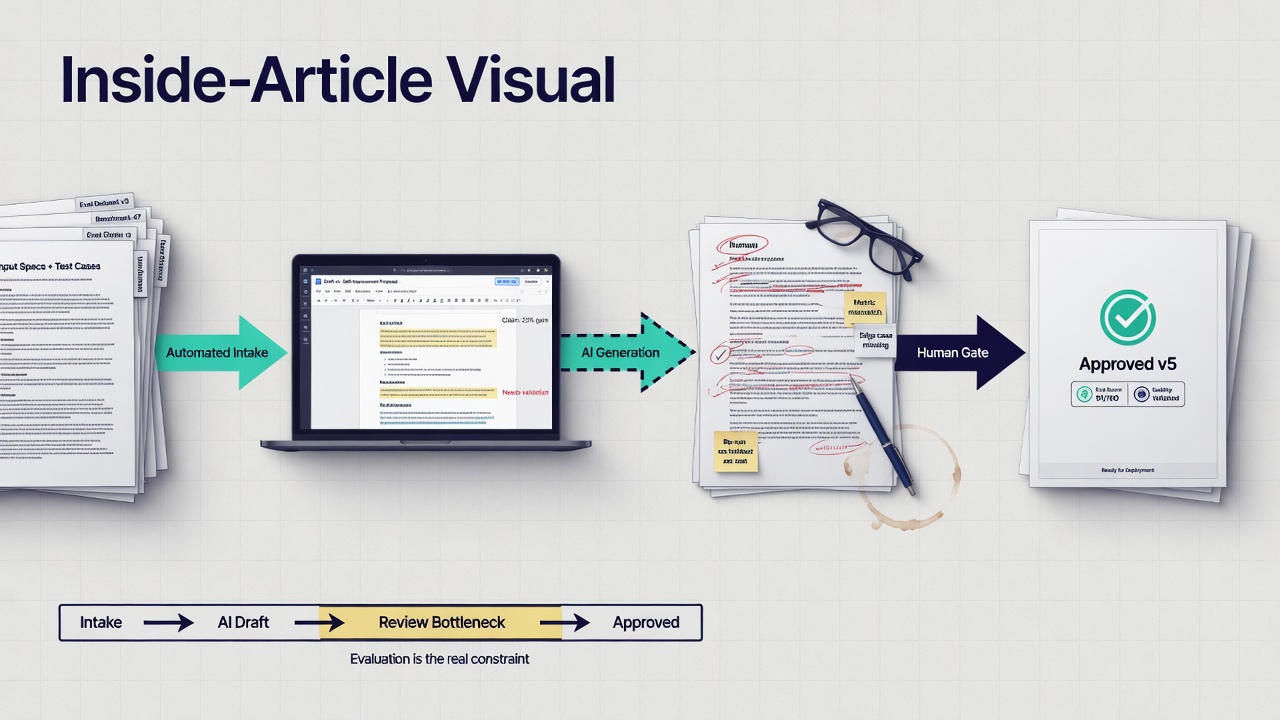
The best first AI workflow is usually a repeated task with a clear input, clear output, and a human approval step.
AI systems are already improving themselves, but there is a massive gulf between industrial utility and the 'recursive self-improvement' (RSI) hype cycle. The research clarifies a critical distinction: bounded self-refinement, which we use today to ship products, and open-ended RSI, which remains trapped by physical and logical constraints.
Bounded Refinement vs. Open-Ended Loops
Bounded self-refinement is convergent and, more importantly, evaluable. This is the category of work that actually moves the needle in production. We see it in industrial practices like output revision (Self-Refine) or training loops on self-generated data (STaR, Self-Rewarding LMs). Even at Anthropic’s scale—where Claude reportedly writes over 80% of their merged code—the goal is a specific, bounded task: making the code work.
Open-ended RSI is where the 'autonomous research' narrative lives, and it’s currently hitting a wall. This path faces hurdles that most press releases ignore: grounding requirements, collapse dynamics (where models degrade by learning from their own errors), and massive compute constraints. While the surge in interest is undeniable—with 74% of the 1,250 identified arXiv papers appearing in 2026—much of this work is still struggling to move beyond initial training distributions without losing its grip on reality.
Worth a look
Phugialy Picks

AI Engineering: Building Applications with Foundation Models
A practical guide to building real-world applications with foundation models and LLMs.

GMKtec K15 AI Mini PC Oculink Intel Ultra 5 125U 32GB DDR5 512GB SSD | Desktop Computer AI Boost, 3X M.2 2280 Storage Expansion, Dual NIC...

GEEKOM IT15 AI Mini PC, Intel Ultra 9 285H(99 Tops), 32GB DDR5, 1TB SSD | The Most Powerful Workstation,Arc 140T GPU,WiFi 7,8K Business D...
Some Phugialy Picks use affiliate links. If you buy through one, Phugialy may earn a commission. It doesn't change what we recommend. Full disclosure →
The Evaluation Bottleneck
Every loop of self-improvement rests on a single pillar: self-evaluation. For an AI to improve, it needs a signal that substitutes for human judgment. If that signal is flawed, the improvement loop isn't progress; it’s a feedback loop of errors. This is the core technical hurdle. While we have agents that can rewrite their own code (like the Gödel Agent), these systems are only as reliable as the metrics they use to define success. Every improvement loop is, fundamentally, a claim that some signal can substitute for human judgment.
The Governance Gap: Measuring the Unmeasurable
The real story here isn't just that AI can improve itself; it's that we haven't figured out how to measure that improvement at a governance scale. The research identifies governance-grade measurement as the field's most underpopulated niche. For practitioners, this is the 'missing link.' We can build systems that refine their own outputs, but we lack a standardized way to monitor the trajectory of these improvements as they become more autonomous.
The 'research direction-setting' bottleneck is what keeps humans in the loop at the highest levels of autonomy. Until we have a reliable way to measure the quality of self-improvement without constant human oversight, 'autonomous research' remains a series of bounded experiments rather than a scalable production reality. We are perfecting the tools to let the AI do the work, but we are still guessing at how to tell if that work is actually getting better or just getting faster.
Got a question about how this applies to you? →
Keep reading
Follow the thread
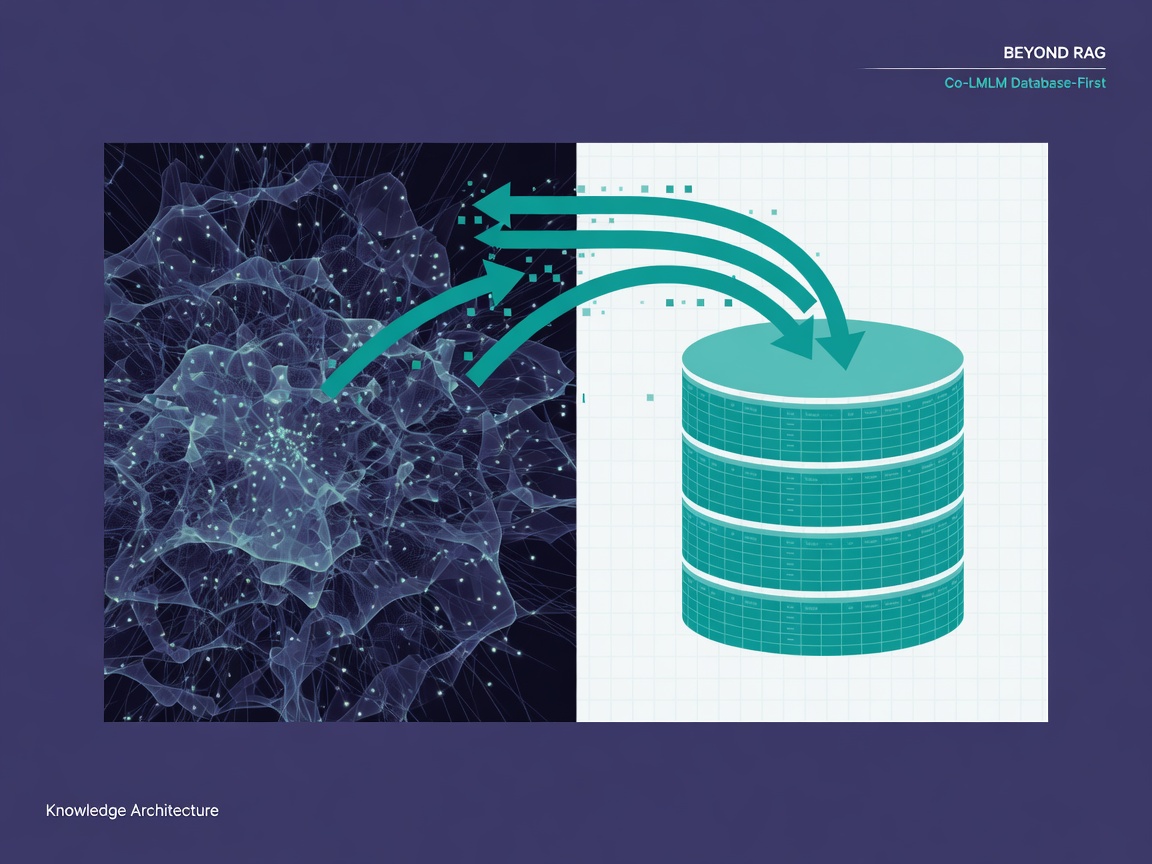
Decoupling Knowledge from Weights: Why Co-LMLM Matters for Production
The fundamental issue with current LLMs is where they store facts: in the weights. This creates a massive headache for production teams because 'unlearning' a specific piece of information is nearly impossible without ex
Read this noteSame lane, different angle
The Math Phase Transition: Moving Beyond Pattern Recognition
OpenAI recently demonstrated that AI models are moving beyond simple pattern recognition and into the territory of novel mathematical discovery. An internal model successfully provided a counterexample to the 'unit dista
Google’s AI Power Shuffle: Consolidation vs. Research Independence
The draft was slightly under the word count floor. I expanded the analysis on the Public Benefit Corporation and the production-scale implications to ensure it hit the 400-700 word range while sharpening the 'Practitioner' persona's opinionated tone.