The Production Risk of Offloading Reasoning to Deep Research Tools
Deep Research tools from Google and OpenAI are fundamentally shifting the unit economics of information gathering. We’re moving from a world where complex research took days to one where it happens in minutes. For develo
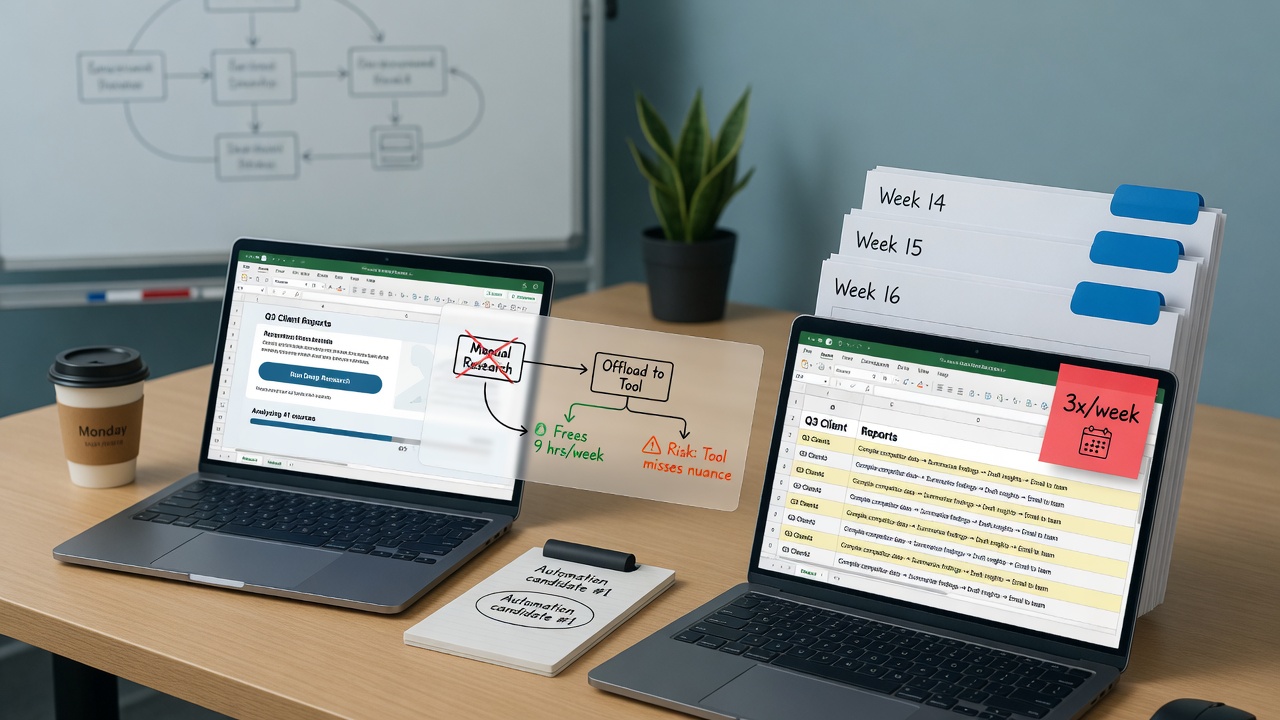
Automation needs a narrow first win
The best first AI workflow is usually a repeated task with a clear input, clear output, and a human approval step.
Deep Research tools from Google and OpenAI are fundamentally shifting the unit economics of information gathering. We’re moving from a world where complex research took days to one where it happens in minutes. For developers and engineers, this isn't just a convenience—it’s a massive shift in how we allocate cognitive resources. But there’s a catch: if we stop doing the heavy lifting of initial reasoning, we lose the ability to spot the edge cases that actually break production systems.
The Productivity Trap of Offloading Reasoning
Offloading mundane tasks to models like Gemini, ChatGPT, or Claude can be a net positive for productivity. When the AI handles the repetitive data gathering, it theoretically frees us up for more fulfilling types of thinking. However, there is a razor-thin line between offloading "grunt work" and offloading the core reasoning process.
The risk here is "lazy thinking." When students copy-paste assignments without original thought, it’s a clear failure of autonomy. In a production environment, this manifests as accepting an AI-generated architecture or research summary without verifying the underlying logic. If the AI is doing the heavy lifting of reasoning, you lose the mental model of the system. You gain speed, but you lose the ability to navigate the messy middle where production data deviates from a clean example. If you don't understand the underlying logic, you won't know how to debug it when it hits an edge case that wasn't in the training set.
Worth a look
Phugialy Picks

The Agentic AI Bible: The Complete and Up-to-Date Guide to Design, Develop, and Scale Goal-Driven, LLM-Powered Agents that Think, Execute...

Ultimate Microsoft Power Automate Desktop: Leverage Microsoft's Robotic Process Automation Capabilities to Automate Routine Tasks for Enh...

Master AI for Beginners: Develop Artificial Intelligence Basics, Understand Machine Learning, and Unlock the Power of Automation for Busi...
Some Phugialy Picks use affiliate links. If you buy through one, Phugialy may earn a commission. It doesn't change what we recommend. Full disclosure →
Using AI to Extend Rather Than Replace Hypotheses
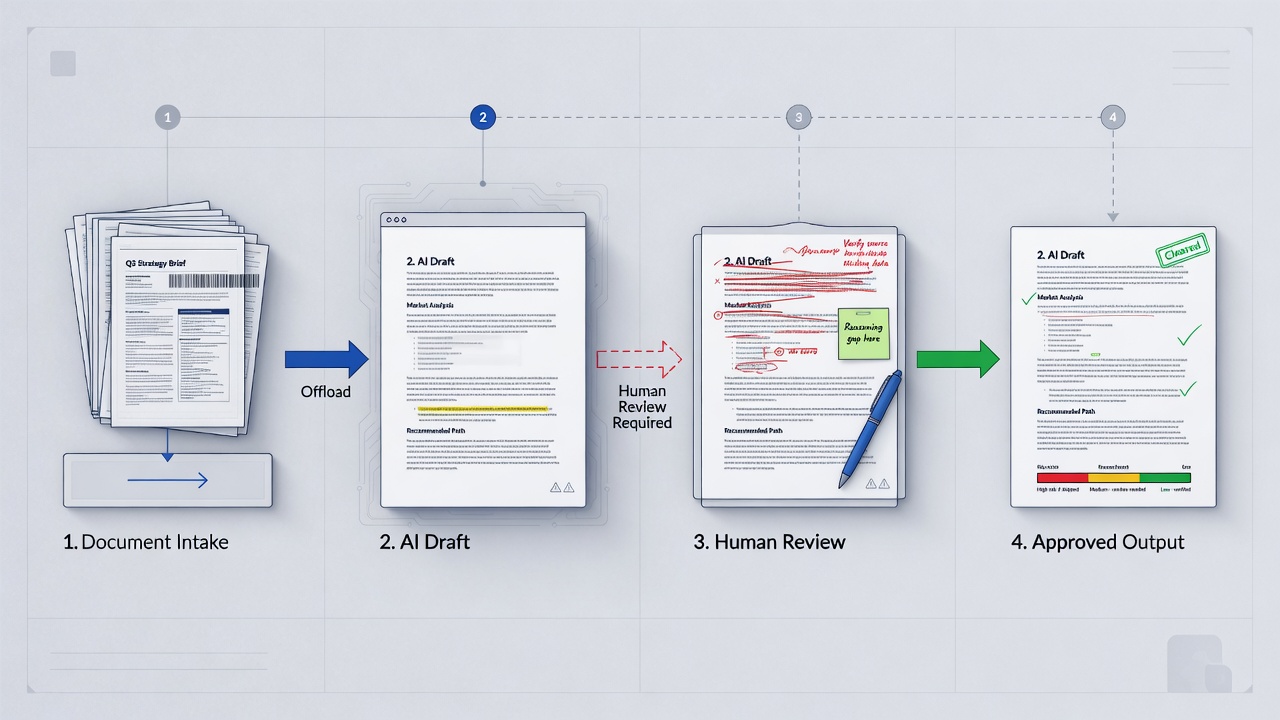
The most practical path forward isn't to replace human thought, but to use AI as a testing ground for human-generated hypotheses. Don't start from a blank page and ask the AI "what should I do?" Instead, define the problem, establish the constraints, and form the hypothesis yourself.
From an integration standpoint, this means the human must own the initial "why." You use Deep Research tools to stress-test that hypothesis, look for contradictions, or find supporting data points. This keeps you in the driver's seat. The move is to build a workflow where the AI is the "adversary" or the "validator," not the author. If you let the model generate the initial thinking, you're essentially building on a foundation you didn't inspect—a recipe for massive technical debt.
The Real Story of Cognitive Atrophy
What this actually points to is a looming trade-off in how we develop technical skills. As tools become more capable of handling complex queries, the "muscle memory" of research and reasoning begins to atrophy. The real story here is that while these tools work for the "happy path," we need to be wary of what happens when they hit a logic wall or provide a hallucination that looks plausible.
If we rely on AI to provide the "perfect" answer, we lose the ability to understand the "why" behind the "what." For anyone shipping production software, the goal should be to maintain human autonomy over the critical path of reasoning while leveraging AI to accelerate the tedious parts of the journey. We need to ensure that while we are saving time, we aren't also outsourcing our ability to think through the hardest problems.
Got a question about how this applies to you? →
Keep reading
Follow the thread

The Great Leveling: Why AI is a Productivity Power-Up for Newcomers
Imagine a world where the most daunting part of starting a new career—the mountain of routine research, the tedious drafting, and the repetitive data sorting—is handled by a digital partner before you even sit down. This
Read this noteSame lane, different angle
ReviewCerberus: Moving Beyond the "Chatty" AI Code Review
ReviewCerberus handles git branch diffs and outputs structured reports with severity levels. It includes a Verification Mode to cut down on the AI hallucinations that usually plague automated code reviews.
SciReasoner: One Model Reasons Across Proteins, Molecules, Crystals
Proteins, molecules, and crystals share almost nothing on the surface - different representations, different tools, different vocabularies entirely. What if one model could reason natively across all three? That's the pr