From Sci-Fi to Standard: Building the Public Health Nervous System
Let’s be real: for a while, talking about AI in healthcare felt like watching a high-budget sci-fi movie—spectacular to look at, but you couldn't actually step inside the set. That's all about to change. The Coalition fo
Automation needs a narrow first win
The best first AI workflow is usually a repeated task with a clear input, clear output, and a human approval step.
Let’s be real: for a while, talking about AI in healthcare felt like watching a high-budget sci-fi movie—spectacular to look at, but you couldn't actually step inside the set. That's all about to change. The Coalition for Health AI (CHAI) is launching the Public Health Use Case and Learning Scaling Engine (PULSE), and it’s not just another 'cool tech' pilot. It’s a concerted effort to build the actual infrastructure required to bring generative AI into the heart of our communities.
Supercharging the Front Lines with High-Octane AI
The sheer scale of the PULSE program is nothing short of a game-changer. We aren't just talking about a few isolated experiments; this initiative will support trials across 10 different state, local, tribal, or territorial jurisdictions. To make this happen, OpenAI and Anthropic are donating 10 enterprise licenses with the capacity to reach up to 2,000 public health practitioners. This is a massive injection of high-level capability into the hands of the people on the front lines.
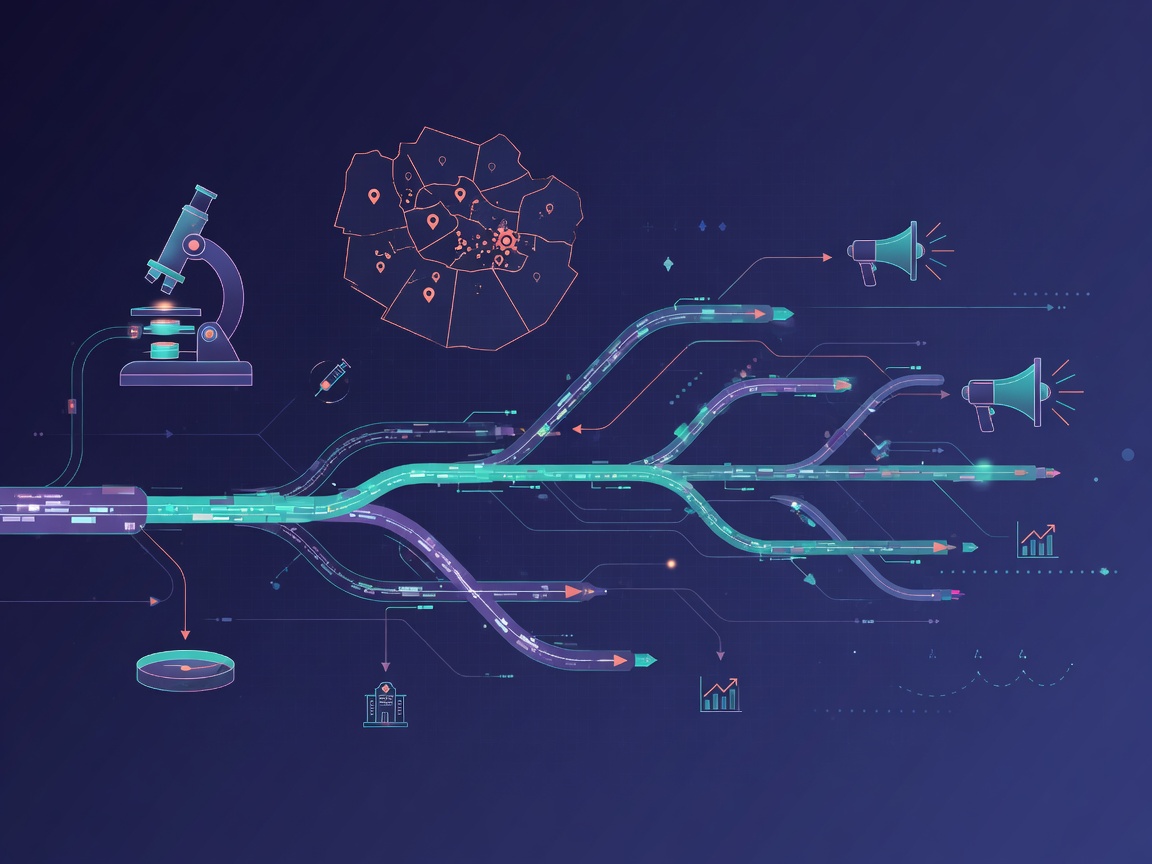
The use cases they’re targeting are incredibly high-impact. From biosurveillance and drug-wave prediction to mapping social determinants of health (SDoH) and automated clinical-data retrieval, these tools are designed to solve some of the most pressing bottlenecks in modern medicine. They’re also tackling "operations and efficiency" and "public communications/translation"—essentially aiming to help health departments do more with less by streamlining the administrative heavy lifting that often slows down life-saving work.
Worth a look
Phugialy Picks

The Agentic AI Bible: The Complete and Up-to-Date Guide to Design, Develop, and Scale Goal-Driven, LLM-Powered Agents that Think, Execute...

INIU 10000mAh 45W Fast Charging Portable Power Bank
We'd buy this if: You've been caught with a dead phone/laptop away from an outlet more than once.
We'd skip this if: You're always near a charger anyway.
OMOTON C2 Adjustable Aluminum Phone Stand
We'd buy this if: You want your phone upright on your desk for calls/notifications without a cable getting in the way.
We'd skip this if: You never keep your phone on your desk.
Some Phugialy Picks use affiliate links. If you buy through one, Phugialy may earn a commission. It doesn't change what we recommend. Full disclosure →
Turning "What If" into a Proven Playbook
What makes PULSE different from a standard tech trial is its obsession with longevity. With Accenture overseeing the onboarding and development of implementation playbooks, the goal isn't just to see if the tech works—it’s to figure out how to make it work everywhere. Pilots are scheduled to kick off in autumn 2026, with the goal of releasing these playbooks in 2027.
This is a deliberate, measured approach. By involving CHAI to develop broader governance standards, including organizational policies and governance structures, the program acknowledges that technology alone isn't the solution. Success depends on trust and execution. They are creating a blueprint so that when these tools go live, they aren't just "plug and play" experiments; they are standardized, safe, and governed components of public health infrastructure.
The Real Story: Building a Standardized Nervous System
The real story here isn't just the fact that health departments are getting access to OpenAI or Anthropic models; it’s that this project is quietly solving the "how-to" problem for the 40% of local health departments currently sitting on the sidelines. Right now, many agencies are hesitant because they don't have a roadmap. PULSE provides that roadmap.
Give this a year or two, and we won't be talking about "testing AI." We'll be looking at a standardized "nervous system" for public health where biosurveillance and communication tools are as common as electricity. By creating playbooks and governance standards now, PULSE is ensuring that when the next crisis hits, the response isn't hampered by a lack of infrastructure. They are building the rails that will allow public health to become more proactive, rather than just reactive.
Got a question about how this applies to you? →
Keep reading
Follow the thread

The Institutionalization of Frontier AI Labs: From Software to Infrastructure
Frontier AI labs are no longer just software companies; they are becoming providers of cognitive infrastructure. This shift moves them out of the realm of traditional tech and into a space where they function as a struct
Read this noteSame lane, different angle
Debian’s AI Policy: Responsibility Isn't Automated
If you can't defend every line an LLM spat out, you have no business hitting 'merge'.
The Technical Debt of Unconsented Training Data
For anyone building in the AI space, the line between 'human-made' and 'machine-output' isn't just a philosophical debate—it’s becoming a massive trust and scalability problem. We recently saw a creator with a 20-year ha