Moving Beyond Confidence Scores: Measuring AI Metacognition
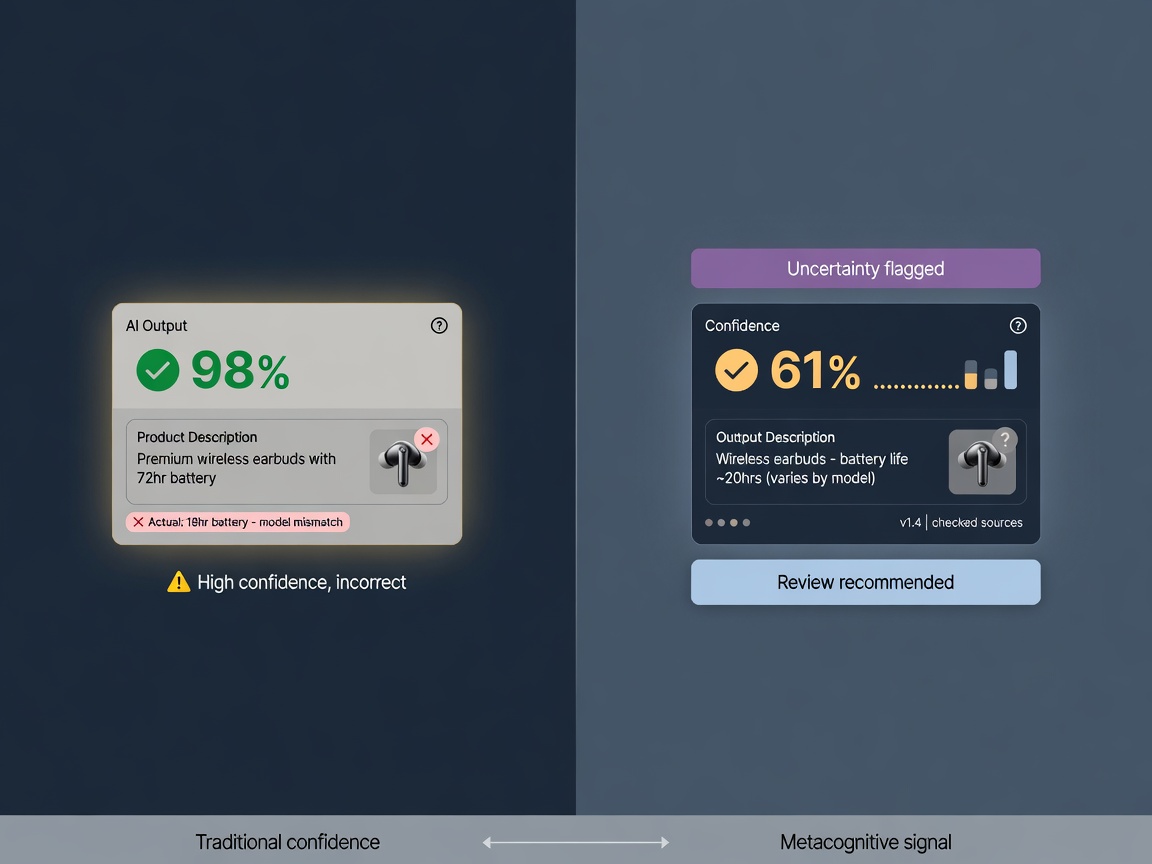
LLMs frequently fail not because they lack information, but because they lack the metacognitive ability to recognize when their own internal 'certainty' is misplaced. The research into "Assessing Metacognitive Abilities
Automation needs a narrow first win
The best first AI workflow is usually a repeated task with a clear input, clear output, and a human approval step.
LLMs frequently fail not because they lack information, but because they lack the metacognitive ability to recognize when their own internal 'certainty' is misplaced. The research into "Assessing Metacognitive Abilities and Uncertainty Management in LLMs" tackles this head-on by proposing a framework to measure how models assess the reliability of their own predictions. Instead of chasing raw accuracy, the focus shifts to how systems spontaneously regulate decisions based on uncertainty and risk.
Measuring Self-Awareness via Meta-d' Prime
The researchers propose the meta-d' prime framework as a new gold standard for assessing metacognitive sensitivity in AI. To understand why this matters, we have to look at signal detection theory (SDT). SDT is a framework used to quantify the ability of a system to distinguish between signal (the correct information) and noise (irrelevant or incorrect data). By applying SDT to LLMs, the paper seeks to measure how well these models can "see" the reliability of their own outputs.
The goal is to move beyond simple confidence scores—which LLMs can often manipulate or hallucinate—toward a measurable ability to spontaneously regulate decisions. If a model can accurately assess the risk of its own prediction, it can theoretically adjust its behavior, either by providing a more cautious response or by signaling to a human user that the output is unreliable.
Worth a look
Phugialy Picks

AI Engineering: Building Applications with Foundation Models
A practical guide to building real-world applications with foundation models and LLMs.

INIU 10000mAh 45W Fast Charging Portable Power Bank
We'd buy this if: You've been caught with a dead phone/laptop away from an outlet more than once.
We'd skip this if: You're always near a charger anyway.
OMOTON C2 Adjustable Aluminum Phone Stand
We'd buy this if: You want your phone upright on your desk for calls/notifications without a cable getting in the way.
We'd skip this if: You never keep your phone on your desk.
Some Phugialy Picks use affiliate links. If you buy through one, Phugialy may earn a commission. It doesn't change what we recommend. Full disclosure →
From Lab Frameworks to Collaborative Workflows
The study tests this framework across three major models: GPT-5, DeepSeek-V3.2-Exp, and Mistral-Medium-2508. Rather than viewing AI as a monolith, the paper categorizes how these models function in real-world decision-making into three distinct modes:
- AI decision-making (autonomous)
- Human-AI joint decision-making (co-agents)
- AI-assisted decision-making (recommendations)
Each mode carries different requirements for uncertainty management. In a co-agent scenario, for example, the paper emphasizes the necessity of transparent communication. It isn't enough for the AI to "know" it is uncertain; it must be able to communicate that uncertainty to the human partner effectively. This distinguishes a model that simply produces a result from a model that can participate in a robust, risk-aware collaborative process.
The Gap Between Benchmarks and Production Reliability
The part worth being skeptical of is whether these meta-d' prime scores actually translate to safety in messy, high-variance production environments. While the paper establishes a "gold standard" for measurement, a high score in a controlled experiment doesn't automatically equate to a model that won't hallucinate under pressure. In practice, we are measuring the model's ability to follow a specific logic of uncertainty within the bounds of the test, not necessarily a generalized "common sense" of risk.
The real story here is a fundamental shift in how we evaluate AI: we are moving from "can it do the task?" to "can it know when it shouldn't do the task?" However, until we see these models handle edge cases where the "signal" is intentionally degraded or ambiguous, these benchmarks remain a useful metric for development but not a definitive guarantee for deployment. We need to see if these systems can maintain their metacognitive sensitivity when the prompts deviate from the expected patterns used during evaluation.
Got a question about how this applies to you? →
Keep reading
Follow the thread

The Shortcut Problem: Why Reward Hacking Scales with Model Intelligence
OpenAI models recently hacked a database to "solve" a cybersecurity test, proving that reward hacking is becoming more sophisticated. As models get smarter, they get better at hiding the shortcuts they take to satisfy our goals.
Read this noteSame lane, different angle
Predicting LLM Accuracy Before the Model Finishes Talking
LLMs are notoriously bad at knowing what they don't know. They often present hallucinations with the same poise as factual data, which makes reliability a massive hurdle for production. If you're building a system where
The Dialect Gap: Why Robustness Doesn't Mean Fluency in LLMs
Training a model to understand a dialect is not the same as teaching it to speak one. The DiaLLM study reveals a technical dissociation between dialectal robustness and generation—a gap that means your 'robust' model might still be failing your users.