SciReasoner: One Model Reasons Across Proteins, Molecules, Crystals
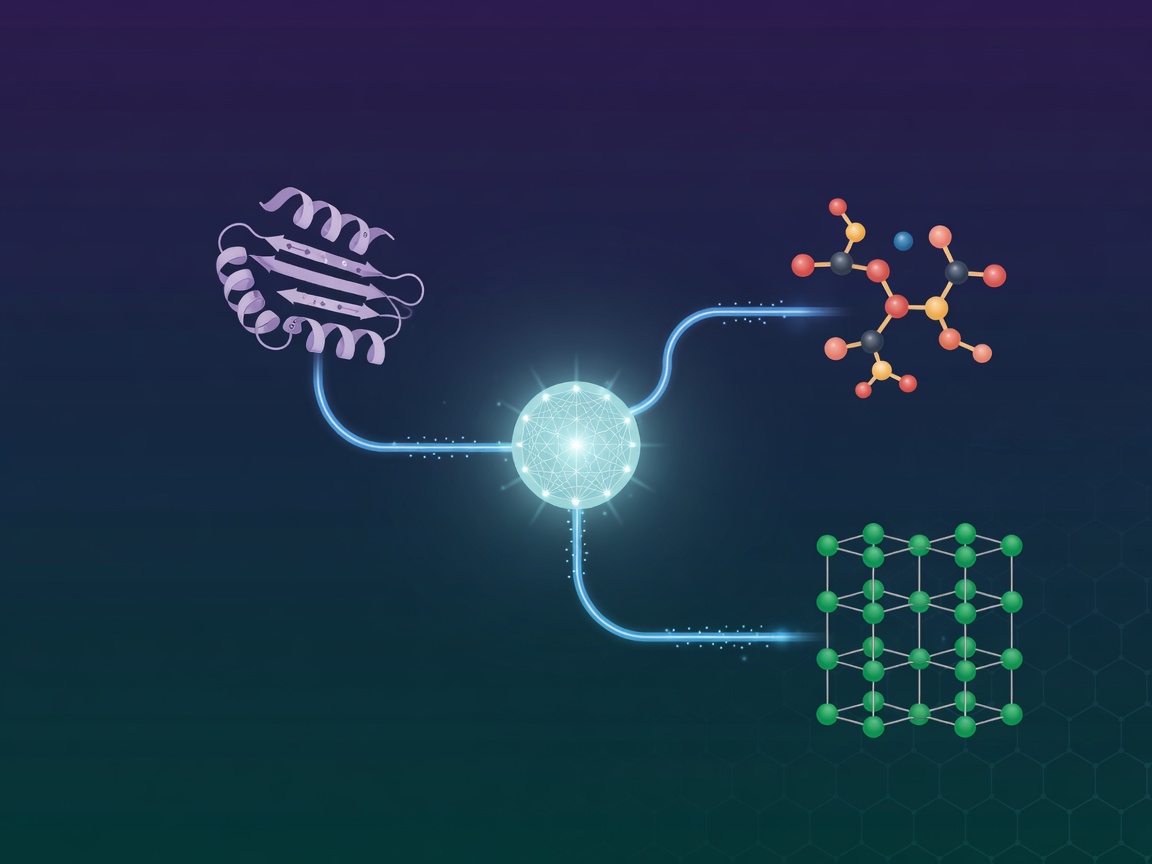
Proteins, molecules, and crystals share almost nothing on the surface - different representations, different tools, different vocabularies entirely. What if one model could reason natively across all three? That's the pr
Automation needs a narrow first win
The best first AI workflow is usually a repeated task with a clear input, clear output, and a human approval step.
Proteins, molecules, and crystals share almost nothing on the surface - different representations, different tools, different vocabularies entirely. What if one model could reason natively across all three? That's the premise behind SciReasoner, a multimodal scientific foundation model described in a recent arXiv paper, and the mechanism is genuinely clever: it discretizes coordinates, topologies, and periodic connectivities into a unified structure-aware vocabulary, preserving each domain's native structural information while making it all legible to a single system.
The Numbers Across 86 Benchmarks
The headline result: across 86 benchmarks, SciReasoner achieves state-of-the-art performance on 67 tasks. That's not a niche win - that's breadth across proteins, small molecules, and inorganic crystals at once.
Drill in and the individual jumps are just as interesting. For low-homology and orphan-like proteins - the ones hardest to annotate precisely because nothing similar exists in the databases - it improves Cellular Component annotation, raising F_max from 0.42 to 0.55. In chemistry, single-step retrosynthesis accuracy climbs from 0.63 to 0.72, and the model doesn't just spit out an answer: it generates fragment-level disconnection and precursor-verification traces you can actually inspect. In materials science, its representations separate elemental and compound phases and resolve high- and low-band-gap regimes.
Worth a look
Phugialy Picks

The Claude AI Bible: The Complete and Easy-to-Follow Guide to Mastering Claude – Build Practical Workflows, Automate Repetitive Tasks, and 10x Your Productivity

AI Engineering: Building Applications with Foundation Models
A practical guide to building real-world applications with foundation models and LLMs.

SunFounder AI Fusion Lab Kit for Raspberry Pi 5/4/3B+/Zero 2w, LLMs ChatGPT/Gemini/Grok, YOLO&OpenCV & MediaPipe, Python, Video Courses for Beginners Engineers
Some Phugialy Picks use affiliate links. If you buy through one, Phugialy may earn a commission. It doesn't change what we recommend. Full disclosure →
Reasoning Traces You Can Actually Check
Here's the result that might matter most long-term: in double-blind expert evaluation, SciReasoner's reasoning traces were rated preferred or at least comparable to those of a frontier large language model in 98% of cases.
That's the part I keep coming back to. Scientific inference that can't be inspected isn't all that useful to scientists - you need to see the disconnection, verify the precursor, follow the logic. A model that produces interpretable traces at that consistency rate isn't just predicting; it's showing its work in a form experts judged on merit, blind.
What This Actually Unlocks
The real story here isn't any single benchmark - it's the shared vocabulary. My read (and this is interpretation, not a claim from the paper): once coordinates, topologies, and periodic connectivities live in one structure-aware representation, the walls between disciplines get thinner. A team working on an orphan protein, a synthetic route, and a candidate crystal material for the same problem is, in principle, working in one space instead of three.
And the orphan-protein result quietly solves an adjacent problem people don't talk about enough: the proteins with no close homologs are exactly the ones where progress has been slowest, because every homology-based method runs out of road. A 0.42-to-0.55 jump on the hardest slice of the problem is the kind of thing that opens up entirely new annotation territory.
Give this a year, the plausible follow-on is less 'one model replaces domain tools' and more 'one structural reasoning layer that domain specialists can query across boundaries they used to treat as separate.' That's a genuinely exciting direction - and the paper's 98% trace-quality result suggests it's a direction being taken seriously, with interpretability built in from the start rather than bolted on.
Got a question about how this applies to you? →
Keep reading
Follow the thread
Compositional Visual Reasoning: The 5-Stage Shift Explained
A new survey of 100+ studies maps five stages of compositional visual reasoning - and explains why end-to-end models give plausible but wrong answers on multi-hop visual questions. The benchmark catalog alone is worth the read.
Read this noteSame lane, different angle
Training-Free Multimodal Attribution: What Holds Up
A training-free method locates source evidence using only attention heads during prefill — at one-seventh of prompting's latency. The benchmark behind it is also new territory.
Poverty Mapping With Multimodal AI: What Actually Works
Fusing satellite imagery with LLM text lifts household wealth prediction from R²=0.63 to 0.77 - but one part of that pipeline didn't earn its keep.