Soofi S 30B-A3B: Why 'Active' Parameters are the New Scaling Metric
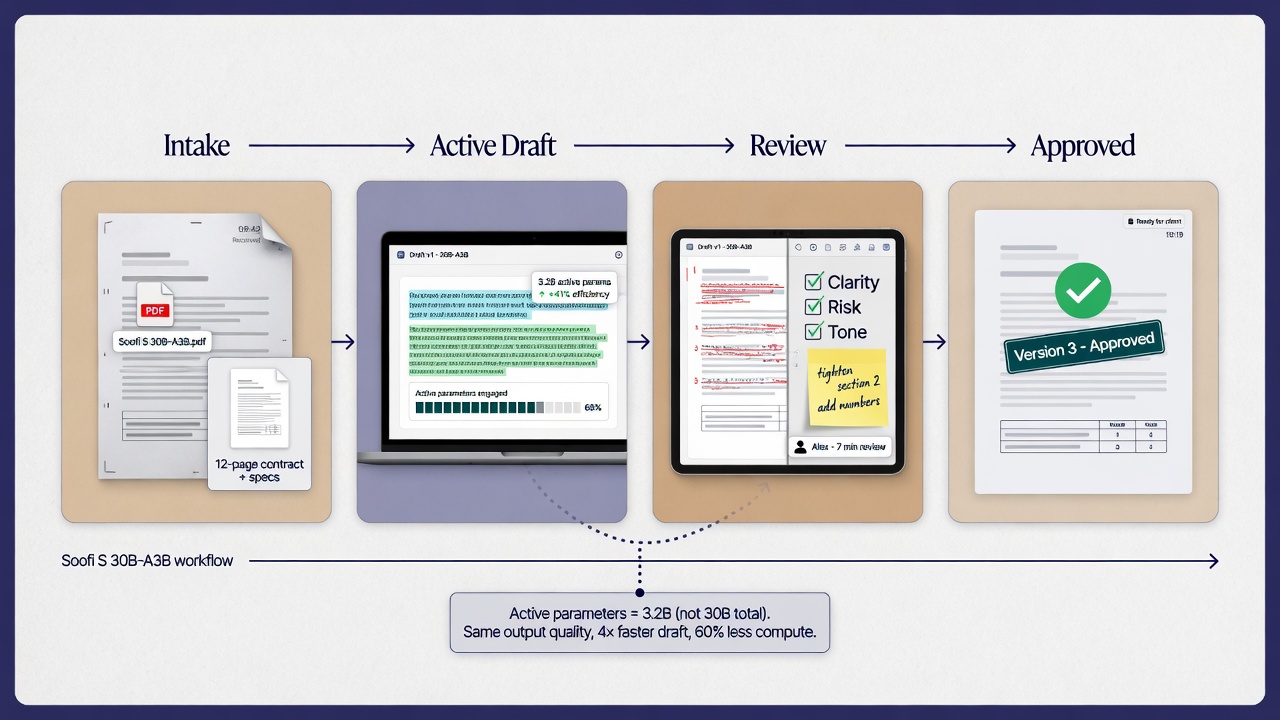
Soofi S 30B-A3B is a mixture-of-experts (MoE) model that proves you don't need to burn massive compute for every single token. Developed by a German research consortium, it hits high benchmarks in both English and German

Automation needs a narrow first win
The best first AI workflow is usually a repeated task with a clear input, clear output, and a human approval step.
Soofi S 30B-A3B is a mixture-of-experts (MoE) model that proves you don't need to burn massive compute for every single token. Developed by a German research consortium, it hits high benchmarks in both English and German while activating only 3.2 billion parameters out of a 31.6 billion total. By combining Mamba-2 layers with standard attention—based on Nvidia’s Nemotron 3 Nano—the architecture navigates the "efficiency vs. reasoning" trade-off that plagues many modern LLMs.
Solving the Mamba-Attention Trade-off
The engineering logic here is straightforward: pure state-space models like Mamba offer great linear scaling but can struggle with the nuanced attention required for complex reasoning. Standard transformers provide that fidelity but hit a wall with long-sequence efficiency. By wrapping these in an MoE framework, the developers capture the best of both worlds.
For anyone actually deploying these models, the "active parameter" count is the only metric that matters for your inference bill. A 30B+ model that behaves like a 3B model during generation is a massive win for throughput. However, we should be wary of the "MoE tax"—the communication overhead and load-balancing complexities that often make these models harder to orchestrate in production than their benchmark scores suggest.
Worth a look
Phugialy Picks

AI Engineering: Building Applications with Foundation Models
A practical guide to building real-world applications with foundation models and LLMs.

GMKtec K15 AI Mini PC Oculink Intel Ultra 5 125U 32GB DDR5 512GB SSD | Desktop Computer AI Boost, 3X M.2 2280 Storage Expansion, Dual NIC...

GEEKOM IT15 AI Mini PC, Intel Ultra 9 285H(99 Tops), 32GB DDR5, 1TB SSD | The Most Powerful Workstation,Arc 140T GPU,WiFi 7,8K Business D...
Some Phugialy Picks use affiliate links. If you buy through one, Phugialy may earn a commission. It doesn't change what we recommend. Full disclosure →
Data Weighting Over "Scrape Everything"
The training strategy for Soofi S is a necessary pivot away from the "scrape everything" mentality. The consortium trained on 27 trillion tokens but deliberately weighted the data toward German content, reaching 15.3% in the second phase. This isn't just about being "multilingual"; it's about intentional proficiency.
The results back this up: Soofi S outperformed previous leaders like OLMo 3 32B and Apertus 70B on aggregate scores for both languages. It hit 84.2 on the German MBPP variant while staying competitive on HumanEval (73.8) and MBPP (70.2). For practitioners, this is a clear signal: high-quality, weighted data is a more surgical tool for regional deployment than just throwing more general-purpose parameters at a problem.
The End of Dense Scaling Laws
The most significant takeaway here is the shift in scaling logic. If the old scaling laws for dense models no longer apply to MoE architectures, the industry's "bigger is better" mantra is officially being replaced by "smarter routing is better.
By training on Deutsche Telekom's Industrial AI Cloud using 512 Nvidia B200 GPUs over 253,000 GPU-hours, the team demonstrated that sovereign infrastructure can handle these complex MoE models. Because it meets the Open Source AI Definition 1.0, it provides a blueprint for regional deployment. The real story isn't just "sovereign AI" as a policy goal; it's the technical reality that regional clusters can now leverage MoE to achieve world-class performance without the massive, centralized compute footprint of the largest US-based labs.
Got a question about how this applies to you? →
Keep reading
Follow the thread

Scaling MoE on Superpods: Moving Past the All-to-All Bottleneck
If you’re trying to scale Mixture-of-Experts (MoE) models on high-bandwidth superpods, you’ve probably hit the wall where raw bandwidth stops being the primary problem. It’s a common trap: we assume that because we have
Read this noteSame lane, different angle
Distributed Inference is Moving Out of the Data Center
Mesh LLM is turning a collection of local GPUs into a single OpenAI-compatible API. It allows you to run 235B parameter models by pooling hardware across a peer-to-peer mesh, bypassing the need for massive, expensive cloud instances.
UBEP: Breaking the Communication Bottleneck in MoE Scaling
MoE models are the current gold standard for scaling parameters without a linear explosion in compute costs, but they come with a heavy "communication tax." The "all-to-all" operation required to route tokens to the corr