UBEP: Breaking the Communication Bottleneck in MoE Scaling
MoE models are the current gold standard for scaling parameters without a linear explosion in compute costs, but they come with a heavy "communication tax." The "all-to-all" operation required to route tokens to the corr

Automation needs a narrow first win
The best first AI workflow is usually a repeated task with a clear input, clear output, and a human approval step.
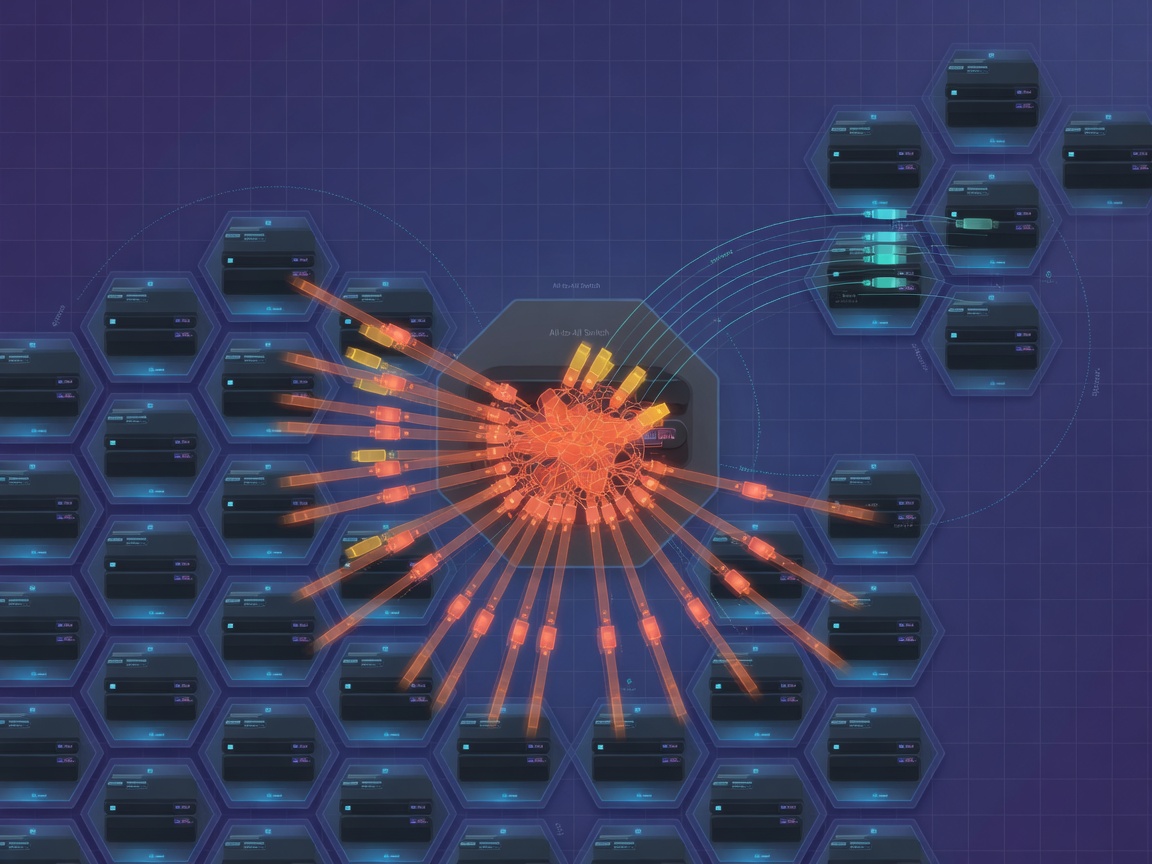
MoE models are the current gold standard for scaling parameters without a linear explosion in compute costs, but they come with a heavy "communication tax." The "all-to-all" operation required to route tokens to the correct experts is frequently the bottleneck that prevents these models from running efficiently at scale. If you are building on high-bandwidth superpods, you need a communication strategy that doesn't leave your interconnect sitting idle. UBEP (Unified-Bus Expert Parallelism) is a production-ready library designed to tackle this exact problem.
Crushing Serialization and Load Imbalance
Sparse MoE communication typically falls victim to three primary performance killers: execution serialization, synchronization overhead, and load imbalance. In many existing implementations, the way data moves between experts is serialized, meaning the system can't fully saturate the available bandwidth of the interconnect. Synchronization overhead compounds this, forcing different parts of the model to wait for one another to finish. Finally, load imbalance occurs when certain "hot" experts are slammed with traffic while others sit idle.
UBEP rethinks the All-to-All primitives to address these three factors simultaneously. Rather than just trying to push data faster, it focuses on keeping the communication bus saturated and the expert units balanced. By rethinking how the primitives interact with modern superpod architectures, UBEP ensures that the hardware is actually doing the heavy lifting it was designed for, rather than waiting on a serialized queue.
Worth a look
Phugialy Picks

Logitech G413 SE Full-Size Mechanical Gaming Keyboard - Black | Backlit, anti-ghosting, compatible with Windows and macOS, aluminum material

AI Engineering: Building Applications with Foundation Models
A practical guide to building real-world applications with foundation models and LLMs.

GMKtec K15 AI Mini PC Oculink Intel Ultra 5 125U 32GB DDR5 512GB SSD | Desktop Computer AI Boost, 3X M.2 2280 Storage Expansion, Dual NIC...
Some Phugialy Picks use affiliate links. If you buy through one, Phugialy may earn a commission. It doesn't change what we recommend. Full disclosure →
From Research Demos to Production Reality
The performance gains are significant and grounded in real-world hardware. The authors tested UBEP on NVIDIA's NVL72/576 and Huawei's CloudMatrix384 superpods—the high-bandwidth environments where these optimizations are non-negotiable. The results show that UBEP reduces All-to-All latency by up to 52.4%. More importantly for production workloads, this translates to a reduction in MoE inference Time Per Output Token (TPOT) by up to 11.1%. For a developer deploying large-scale MoE models, an 11% improvement in TPOT is a massive margin that directly impacts both operational costs and end-user latency.
However, the real story here is the transition from "making the demo work" to "making the model production-ready." While the latency numbers are impressive, the practical value for a builder depends on how well the library handles the variance of real-world data. In a production environment, input distributions are rarely uniform; if your queries consistently favor a specific subset of experts, "load imbalance" remains your primary scaling ceiling. This library is the missing piece for moving MoE from research-scale to production-scale, provided it can handle the messy, unpredictable data distributions of real-world users without falling back to serialized bottlenecks. The true test of a communication library isn't its performance on a balanced synthetic workload—it's how it behaves when your expert selection is lopsided.
Got a question about how this applies to you? →
Keep reading
Follow the thread
Scaling MoE on Superpods: Moving Past the All-to-All Bottleneck
If you’re trying to scale Mixture-of-Experts (MoE) models on high-bandwidth superpods, you’ve probably hit the wall where raw bandwidth stops being the primary problem. It’s a common trap: we assume that because we have
Read this noteSame lane, different angle
Soofi S 30B-A3B: Why 'Active' Parameters are the New Scaling Metric
Soofi S 30B-A3B is a mixture-of-experts (MoE) model that proves you don't need to burn massive compute for every single token. Developed by a German research consortium, it hits high benchmarks in both English and German
AI Tutors Work Only If Students Use Them: Trial
A two-year trial across 18 middle schools found Khan Academy's AI tutor raised math scores modestly - but here's the catch: the gains looked just like those from practice without any AI at all. The real story isn't whether AI tutoring works; it's that 96% of students tried it and almost none used it when they actually needed help.