Scaling MoE on Superpods: Moving Past the All-to-All Bottleneck
If you’re trying to scale Mixture-of-Experts (MoE) models on high-bandwidth superpods, you’ve probably hit the wall where raw bandwidth stops being the primary problem. It’s a common trap: we assume that because we have
Automation needs a narrow first win
The best first AI workflow is usually a repeated task with a clear input, clear output, and a human approval step.
If you’re trying to scale Mixture-of-Experts (MoE) models on high-bandwidth superpods, you’ve probably hit the wall where raw bandwidth stops being the primary problem. It’s a common trap: we assume that because we have the fastest interconnects—like NVIDIA's NVL72/576 or Huawei's CloudMatrix384—the communication will just 'work.' But for sparse MoE architectures, the bottleneck isn't just the size of the pipe; it's how we manage the flow of data across that pipe.
The Three Walls of Sparse MoE Communication
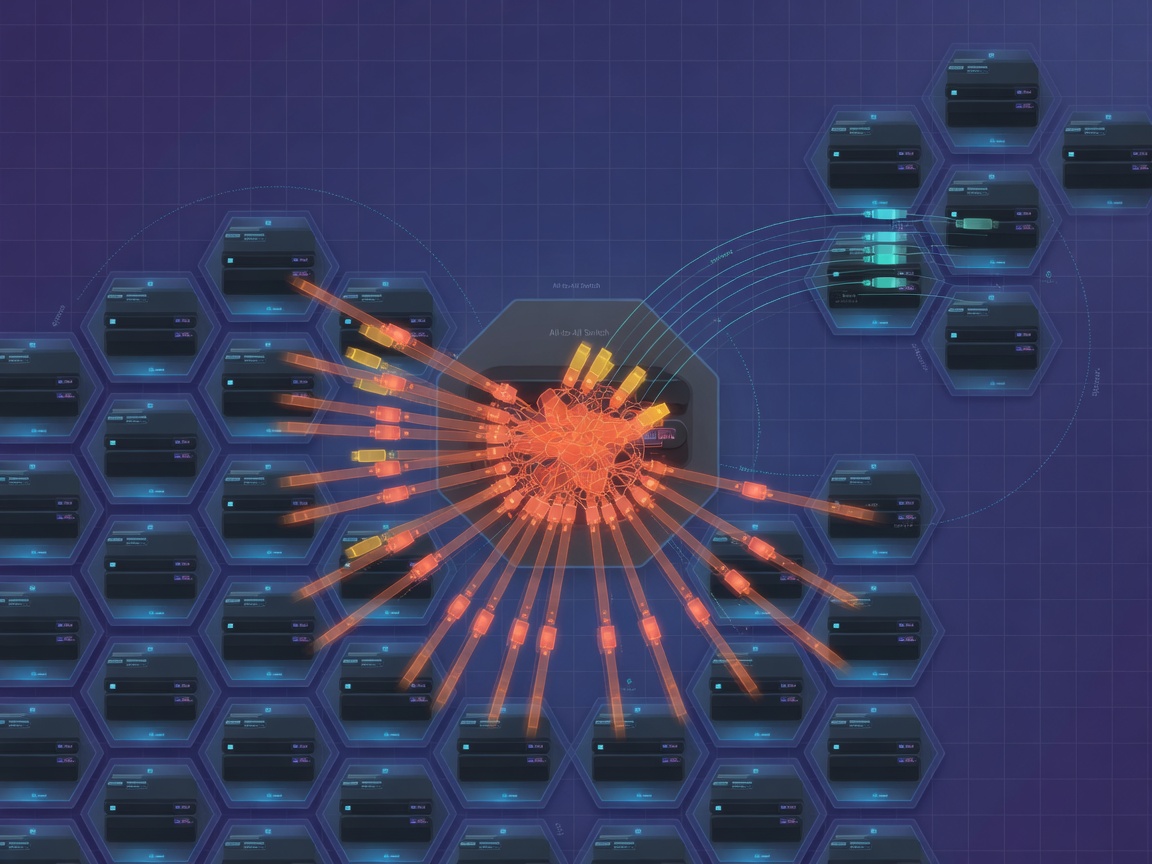
Production-grade superpods provide unified global address spaces and high-bandwidth fabrics, but the full potential of sparse MoE communication is currently hindered by three specific bottlenecks. First is the strict execution serialization caused by coarse-grained Bulk Synchronous Parallel (BSP) orchestration. This forces interdependent communication phases to happen in a sequence that leaves your hardware sitting idle. Second is the prohibitive synchronization overhead; as interconnect speeds increase, the time spent coordinating those communications fails to scale alongside the bandwidth. Finally, there is the issue of severe load imbalance. Because token traffic is inherently irregular, distance-agnostic scheduling often results in some nodes being overwhelmed while others remain idle. You can't just throw more bandwidth at an imbalance problem; you have to solve the scheduling logic.
Worth a look
Phugialy Picks

AI Engineering: Building Applications with Foundation Models
A practical guide to building real-world applications with foundation models and LLMs.

GMKtec K15 AI Mini PC Oculink Intel Ultra 5 125U 32GB DDR5 512GB SSD | Desktop Computer AI Boost, 3X M.2 2280 Storage Expansion, Dual NIC...

GEEKOM IT15 AI Mini PC, Intel Ultra 9 285H(99 Tops), 32GB DDR5, 1TB SSD | The Most Powerful Workstation,Arc 140T GPU,WiFi 7,8K Business D...
Some Phugialy Picks use affiliate links. If you buy through one, Phugialy may earn a commission. It doesn't change what we recommend. Full disclosure →
Quantifying the Communication Bottleneck Reduction
UBEP (Unified-Bus Expert Parallelism) is a production-ready communication library designed to tear down these specific barriers by rethinking MoE's All-to-All primitives. Rather than accepting the limitations of standard BSP orchestration, UBEP optimizes how data moves across modern superpod architectures. The results are tangible and significant for production environments: UBEP reduces All-to-All latency by up to 52.4% and reduces the MoE inference Time Per Output Token (TPOT) by up to 11.1%. For anyone moving from a clean research environment to a production superpod, that 11.1% reduction in TPOT is the metric that translates directly to better user experience and lower operational costs.
The Gap Between Benchmarks and Production Traffic
The real challenge for production engineers isn't just hitting a benchmark; it's maintaining those gains under the messy, non-uniform traffic of real-world data. The paper highlights that load imbalance stems from distance-agnostic scheduling of irregular token traffic. This is where you need to get hands-on: how does the library handle "hot" experts? If a specific expert gets slammed because of a surge in certain token types, UBEP’s ability to manage that imbalance across the superpod is the difference between a smooth rollout and a system crash. If the scheduling remains too distance-agnostic, you might see great average latency but terrible tail latency (P99) when traffic isn't perfectly distributed. For developers shipping MoE models, UBEP is the tool to watch for stabilizing that communication layer as we move toward larger, more complex superpod deployments.
Got a question about how this applies to you? →
Keep reading
Follow the thread

UBEP: Breaking the Communication Bottleneck in MoE Scaling
MoE models are the current gold standard for scaling parameters without a linear explosion in compute costs, but they come with a heavy "communication tax." The "all-to-all" operation required to route tokens to the corr
Read this noteSame lane, different angle
Soofi S 30B-A3B: Why 'Active' Parameters are the New Scaling Metric
Soofi S 30B-A3B is a mixture-of-experts (MoE) model that proves you don't need to burn massive compute for every single token. Developed by a German research consortium, it hits high benchmarks in both English and German
AI Tutors Work Only If Students Use Them: Trial
A two-year trial across 18 middle schools found Khan Academy's AI tutor raised math scores modestly - but here's the catch: the gains looked just like those from practice without any AI at all. The real story isn't whether AI tutoring works; it's that 96% of students tried it and almost none used it when they actually needed help.