Shortcut Learning Hides Behind Good Accuracy Metrics
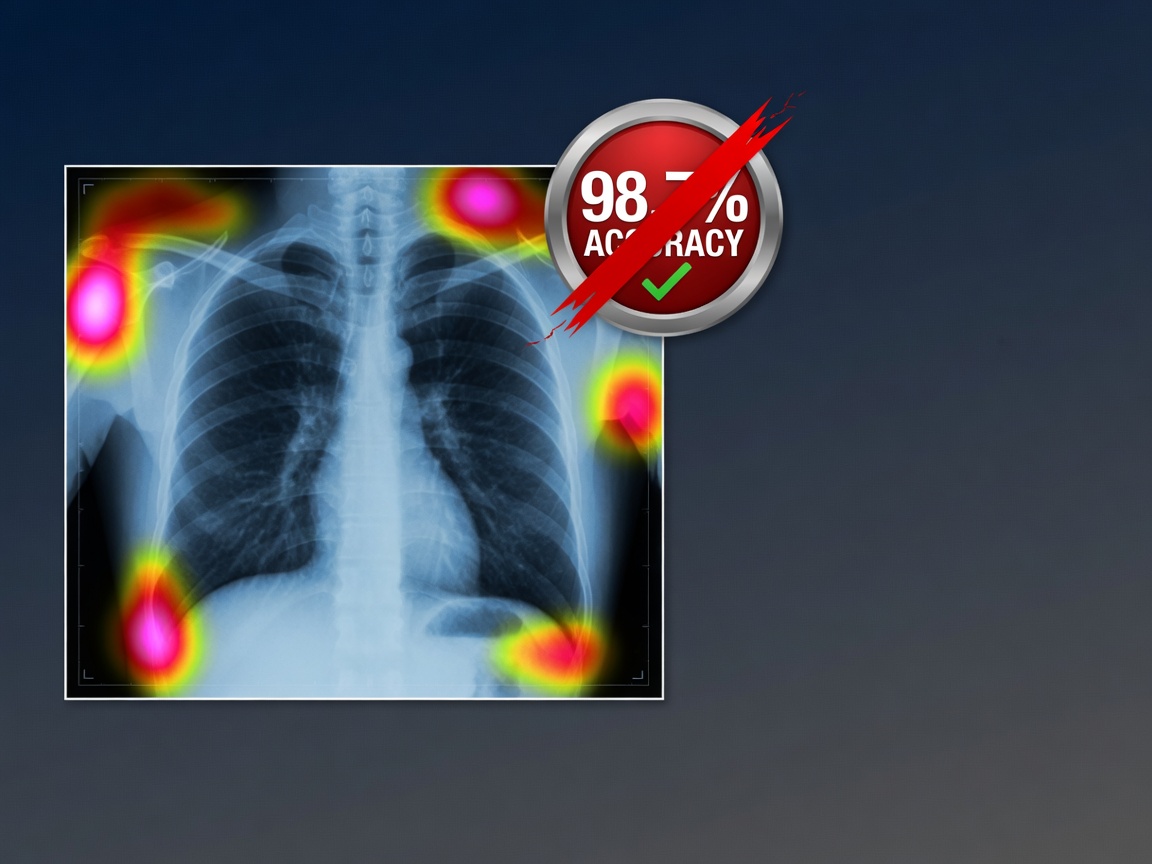
A chest X-ray classifier hit 86% accuracy and passed every conventional metric — while consistently using border/corner artifacts as decision evidence alongside actual lung tissue. A new framework called ReMoDEx found it automatically.
Automation needs a narrow first win
The best first AI workflow is usually a repeated task with a clear input, clear output, and a human approval step.
A classifier can hit 86% accuracy and still be looking at the wrong part of the image. That's the core finding behind ReMoDEx, a new framework for systematic, dataset-scale assessment of model decision behavior in image classification — and the shortcut learning it surfaced is exactly the kind of thing that slips through every conventional evaluation pipeline.
The setup is familiar to anyone who has shipped a deep learning image classifier: strong predictive performance, opaque decisions. A model may predict correctly while relying on irrelevant cues — shortcut associations, peripheral structures, or device-level artifacts — instead of task-relevant regions. The standard response is to eyeball heatmaps one prediction at a time, which works fine for ten images and falls apart completely at dataset scale. Nobody sane inspects thousands of relevance maps by hand.
What ReMoDEx Actually Does Differently
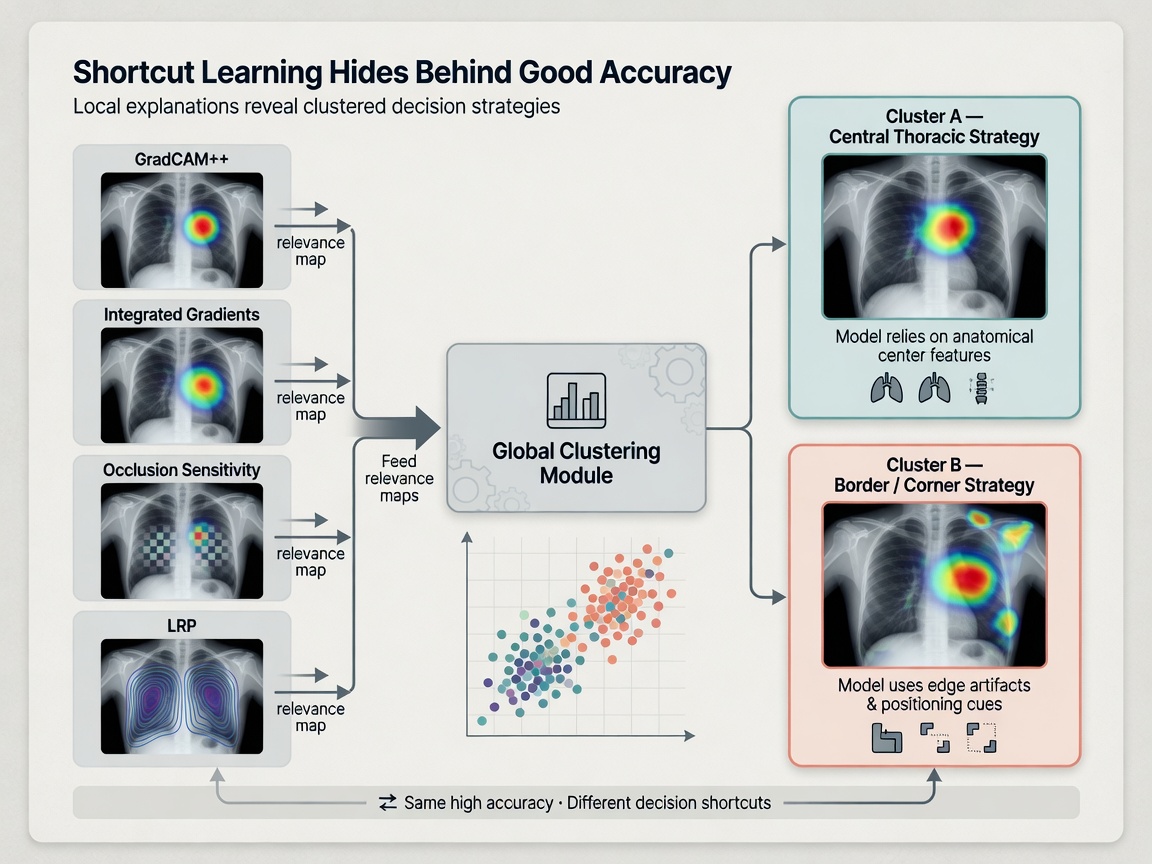
ReMoDEx replaces sample-by-sample inspection with an automatic, scalable summary of decision strategies. The pipeline is stepwise: model inference, target class selection, relevance map generation, heatmap standardization, similarity-based grouping of patterns into clusters, cluster-level interpretation, and spatial relevance assessment.
The design choice worth noting is how it handles explainability methods. Local methods — GradCAM++, Integrated Gradients, Occlusion Sensitivity, and Layerwise Relevance Propagation — are each combined independently with a single global module that summarizes an entire set of relevance maps into a few decision strategy clusters. So instead of trusting any one explainer's output on any one image, you get an aggregate view of what strategies the model actually uses across the whole dataset.
The validation step matters too: masked image testing confirmed that model confidence and predicted class changed when central or peripheral regions were occluded. That's the difference between a framework that just clusters pretty pictures and one that checks whether the highlighted regions actually drive predictions.
Phugialy Picks

AI Engineering: Building Applications with Foundation Models
A practical guide to building real-world applications with foundation models and LLMs.

GMKtec K15 AI Mini PC Oculink Intel Ultra 5 125U 32GB DDR5 512GB SSD | Desktop Computer AI Boost, 3X M.2 2280 Storage Expansion, Dual NIC...

AI: Understand the Revolution: From Basics and Buzzwords to Tech Giants, Governments, and Your Future
Some Phugialy Picks use affiliate links. If you buy through one, Phugialy may earn a commission. It doesn't change what we recommend. Full disclosure →
The COVID-19 Chest X-Ray Case: Shortcut Learning That Accuracy Metrics Miss
The proof case is a VGG16-based classifier distinguishing COVID-19, Normal, Lung Opacity, and Viral Pneumonia from chest X-rays. The numbers look solid on paper — 86.27% test accuracy and a 0.9624 test AUC. By conventional metrics, this model ships.
Then ReMoDEx runs on it. Each explainer combined with the global module consistently produced two recurring strategies: decisions based on the central thoracic region — which is what you want — and decisions sensitive to borders and corners of the image — which very much is not. Border/corner sensitivity in medical imaging is a classic artifact signature; it suggests possible shortcut learning that conventional metrics could not reveal.
This is my read as interpretation rather than established fact from the paper itself: border-sensitive decisions in radiology datasets usually mean something about how images were acquired or cropped leaks class information — different scanner protocols per site, inconsistent padding, whatever it happens to be. The framework doesn't tell you which artifact; it tells you there's one worth hunting for before this model meets a patient or a production pipeline.
Why This Matters Beyond One Paper
The real story here isn't one VGG16 model with questionable habits. It's that accuracy-based evaluation has a structural blind spot, and this paper makes the case for relevance-based decision assessment as an essential complement to it — not a nice-to-have research exercise.
What I find underappreciated is how cheaply this slots into an existing workflow. You're already running inference; you're already generating GradCAM or Integrated Gradients maps for spot checks. ReMoDEx wraps those same local explainers with clustering so the inspection scales to thousands of predictions instead of the twenty you screenshot for a slide deck. The tradeoff is real but modest: you still have to pick target classes and interpret clusters yourself, so it's a triage tool for humans rather than an automated auditor.
The part worth being skeptical of is generalization beyond this single benchmark setup — one classifier architecture on one medical imaging task doesn't prove every explainer-plus-clustering combination will surface shortcuts this cleanly elsewhere. But even with that caveat, the directional claim holds up under scrutiny: if your evaluation only measures whether predictions are correct and never where the model looked to get there, you will deploy shortcut learners with excellent test metrics. That failure mode predates this paper by years; what's new here is making dataset-scale detection routine instead of heroic.
Got a question about how this applies to you? →
Keep reading
Follow the thread
LoCA Fixes Parameter-Efficient Fine-Tuning for Convolutional Models
LoRA was built for transformers - apply it naively to convolutional layers and it quietly destroys the spatial structure that made your vision model good in the first place. LoCA untangles the mess, and it changes which foundation models are actually worth adapting.
Read this noteSame lane, different angle
Baking Social Intuition into Robots: The Power of Knowledge Distillation
HumAIN is trying to solve the "stop-and-go" problem in social robotics by distilling human skeletal cues into a lightweight model. It skips the heavy lifting of real-time pose tracking while keeping the nuance of human intent.
VERA-MH Benchmark: Validating AI Chatbot Safety Testing
An LLM judge matched clinician consensus at 0.81 on mental health chatbot safety ratings — but only for one narrow domain. What VERA-MH validates is real; what people will assume it covers isn't.