Shortcut Learning Found Where Accuracy Metrics Can't Look
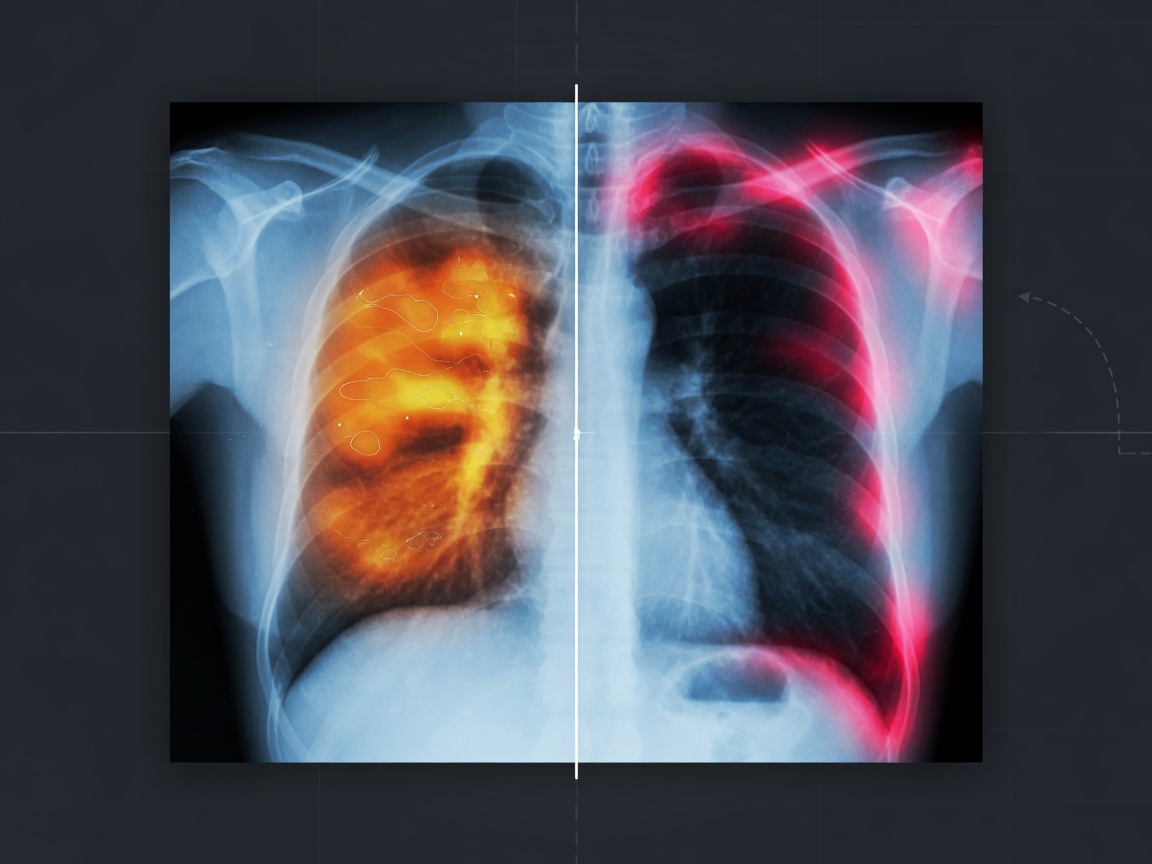
A chest X-ray classifier scored 86.27% accuracy — and ReMoDEx found it was partly making decisions off image borders instead of lungs. The framework behind that finding might change how we evaluate models before they ship.
Automation needs a narrow first win
The best first AI workflow is usually a repeated task with a clear input, clear output, and a human approval step.
Accuracy told us a VGG16 classifier hit 86.27% on chest X-ray classification with a 0.9624 AUC. It told us nothing about whether the model was actually looking at lungs. A new framework called ReMoDEx (Relevance Based Model Decision Explainability) is built to close exactly that gap, and the way it does it is more interesting than the number.
What Shortcut Learning Looks Like at Dataset Scale
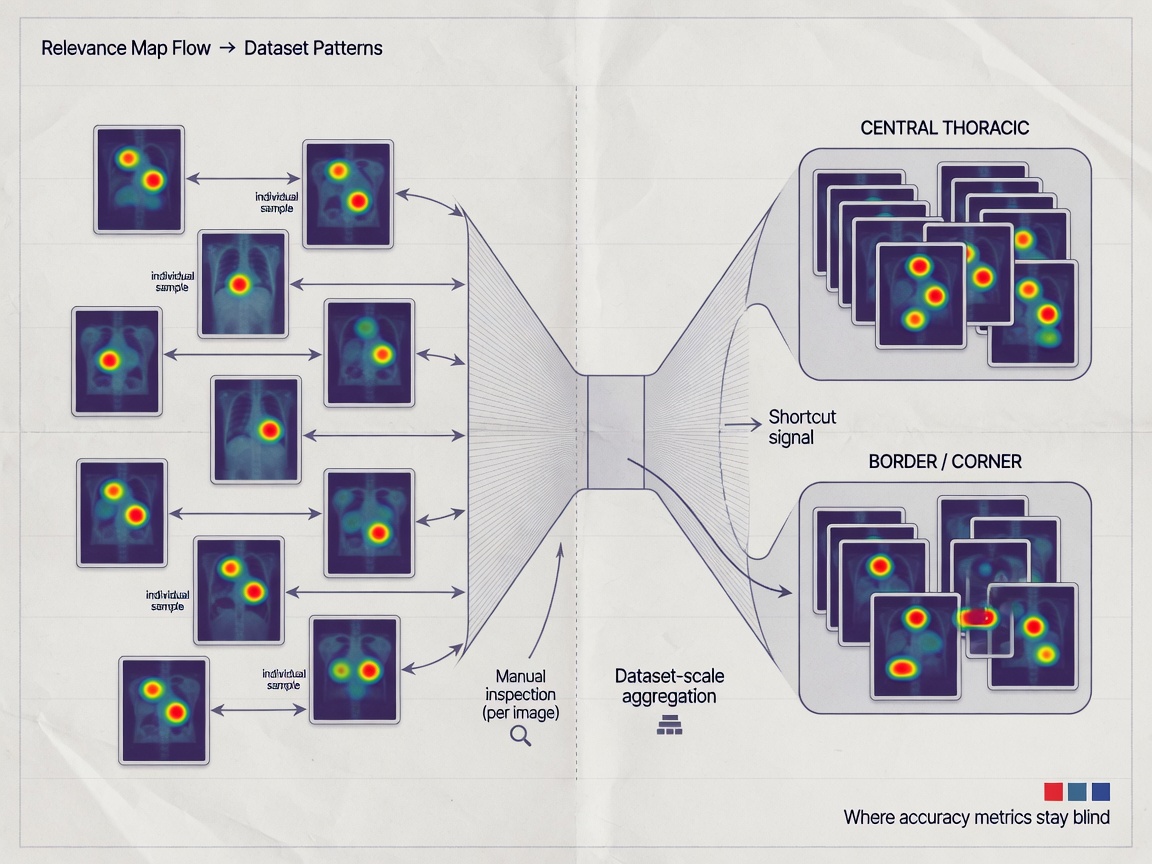
The core idea: instead of inspecting relevance maps one sample at a time — which never scales — ReMoDEx aggregates them systematically across the whole dataset to find recurring decision strategies. Applied to a VGG16 model classifying COVID-19, Normal, Lung Opacity, and Viral Pneumonia cases, it surfaced two distinct patterns: decisions anchored in the central thoracic region (the medically sensible strategy), and decisions sensitive to borders and corners of the image (the classic shortcut-learning signature, where a model latches onto artifacts instead of anatomy).
That second pattern is the one that matters. Border sensitivity in medical imaging usually means the model is keying on acquisition artifacts or collimation marks — things that correlate with labels in your dataset but vanish or shift in production. A high AUC won't warn you about that; only looking at how decisions are made will.
Worth a look
Phugialy Picks

AI Engineering: Building Applications with Foundation Models
A practical guide to building real-world applications with foundation models and LLMs.

GMKtec K15 AI Mini PC Oculink Intel Ultra 5 125U 32GB DDR5 512GB SSD | Desktop Computer AI Boost, 3X M.2 2280 Storage Expansion, Dual NIC...

AI: Understand the Revolution: From Basics and Buzzwords to Tech Giants, Governments, and Your Future
Some Phugialy Picks use affiliate links. If you buy through one, Phugialy may earn a commission. It doesn't change what we recommend. Full disclosure →
The Part Worth Being Skeptical Of
The honest caveats: this was demonstrated on one architecture (VGG16) and one imaging domain. Whether the aggregation approach generalizes cleanly to transformers, other modalities, or messier label distributions isn't shown here. And identifying that a shortcut exists is not the same as fixing it — you still need retraining, dataset curation, or augmentation work afterward.
Also worth noting: relevance-map methods themselves carry known limitations as explanations. ReMoDEx doesn't eliminate that uncertainty; it makes the patterns legible at scale so humans can judge them. That's a real improvement over manual inspection, but it's a diagnostic tool, not an audit seal.
Why This Actually Matters Outside Medical Imaging
In my read, the real story here isn't the medical use case — it's the workflow shift. The framework replaces sample-by-sample explanation review with an automatic summary of decision behavior across an entire dataset. Anyone who has shipped a model that tested beautifully and then behaved strangely in production knows exactly where conventional evaluation fails: aggregate metrics average away exactly the failure modes you care about most.
What this actually points to is evaluation pipelines that treat decision behavior as a first-class metric alongside accuracy — something you check before deployment, not after an incident. For high-stakes domains that's overdue; for everyday classification work it's probably still overkill until tooling gets cheaper to run.
The source article frames ReMoDEx as "an essential complement to accuracy based evaluation," and I'd mostly agree — with the practical caveat that its value depends on someone on your team actually reading what it surfaces and acting on it.
Got a question about how this applies to you? →
Keep reading
Follow the thread
Shortcut Learning Hides Behind Good Accuracy Metrics
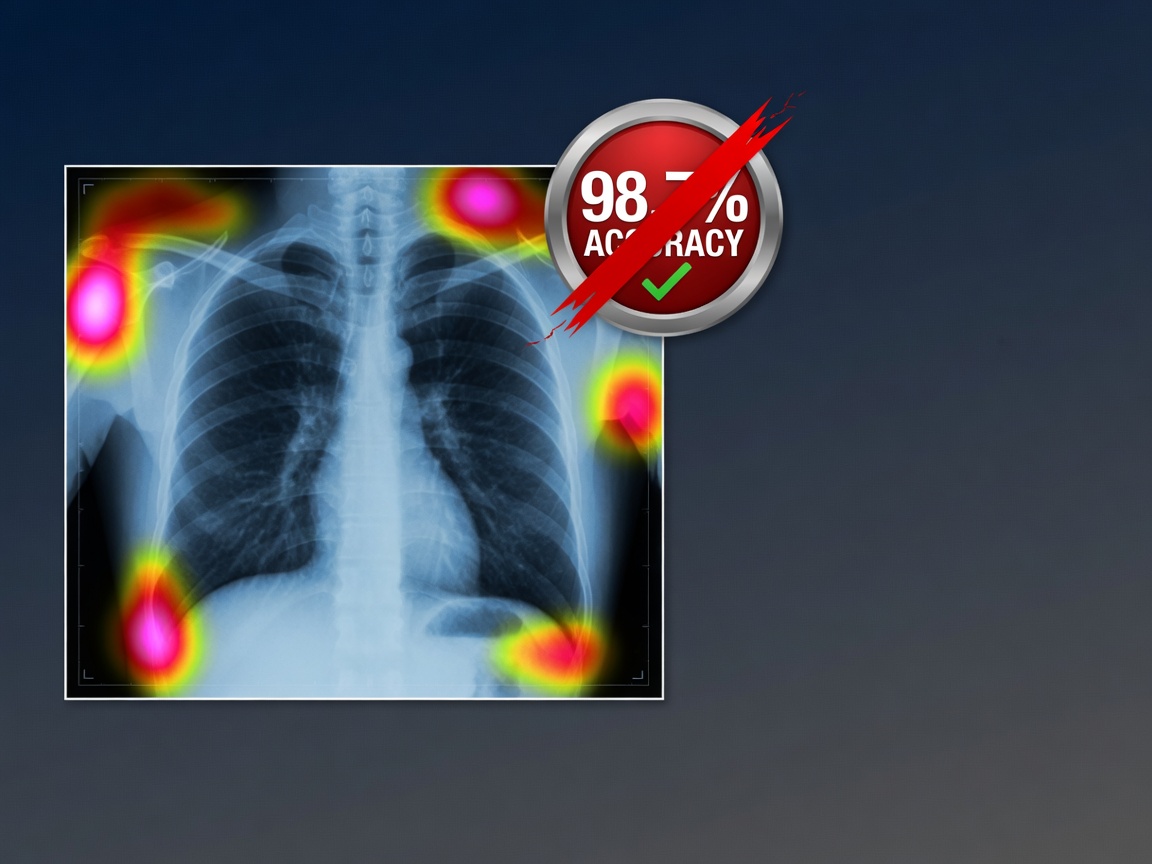
A chest X-ray classifier hit 86% accuracy and passed every conventional metric — while consistently using border/corner artifacts as decision evidence alongside actual lung tissue. A new framework called ReMoDEx found it automatically.
Read this noteSame lane, different angle
MADB: Where Music AI Actually Stands on Human Judgment
Models asked to judge music like humans do fall substantially short — and for once we know because someone built the benchmark first instead of shipping demos.
Knowledge Distillation For Time Series Classification: What Holds Up
A study across three architectures found knowledge distillation helps time series models most at intermediate sizes — not at maximum compression. One distilled FCN student dropped parameters by a factor of 38.