LoCA Fixes Parameter-Efficient Fine-Tuning for Convolutional Models
LoRA was built for transformers - apply it naively to convolutional layers and it quietly destroys the spatial structure that made your vision model good in the first place. LoCA untangles the mess, and it changes which foundation models are actually worth adapting.
Automation needs a narrow first win
The best first AI workflow is usually a repeated task with a clear input, clear output, and a human approval step.
Fine-tune a vision foundation model on your own data without retraining the whole thing - that's the promise of parameter-efficient fine-tuning, and a new framework called LoCA just made it work properly for convolutional models, which until now have been the awkward cousin of the PEFT world.
Why LoRA Stumbles on Convolutional Layers
LoRA - low-rank adaptation - is everywhere in the transformer world. It was designed for linear projections in transformer self-attention layers, and it does that job beautifully. But here's the catch the source article highlights: convolutional operators in vision foundation model backbones remain relatively underexplored by PEFT methods.
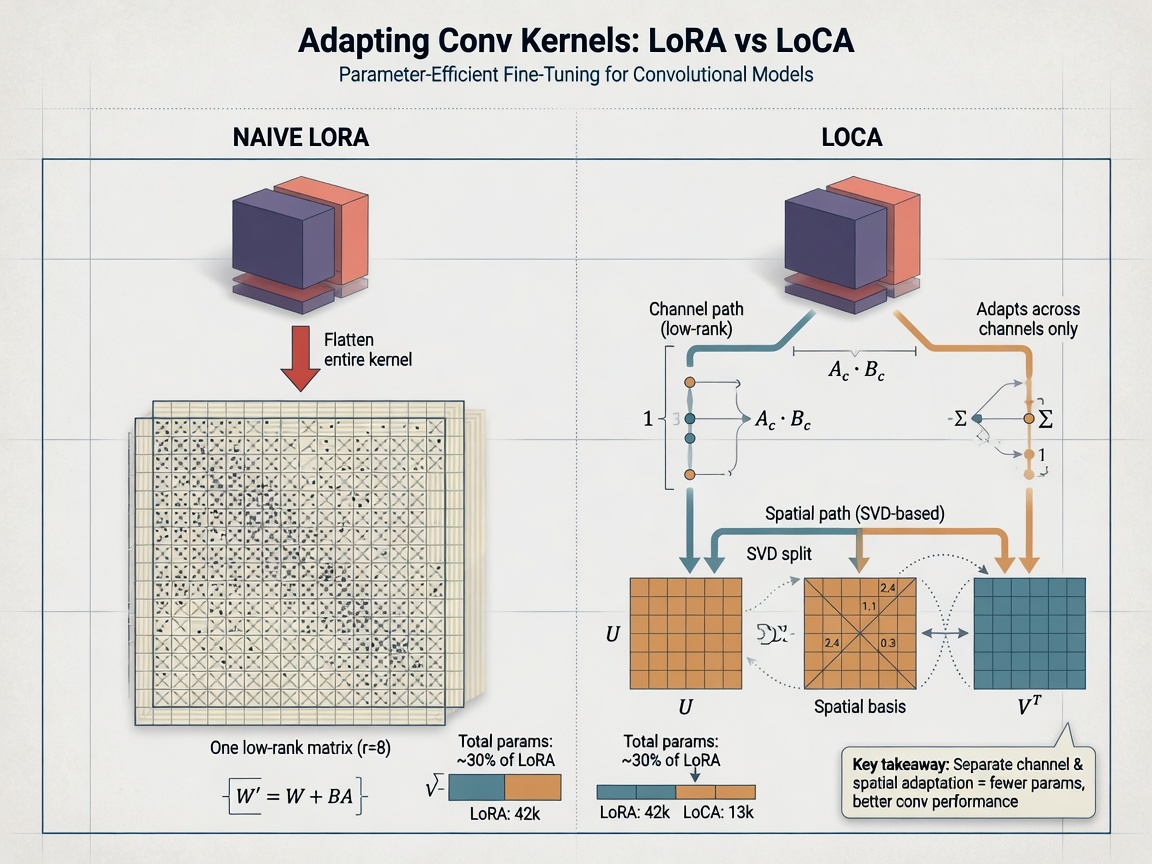
The problem shows up the moment someone applies LoRA naively to a convolution. A convolutional kernel is a 4D tensor, and the standard trick is to flatten it into a two-dimensional matrix so low-rank updates can be applied. That flattening sounds harmless, but the article points out it collapses the kernel's inherent spatial topology by enforcing cross-channel mixing within a single low-rank parameterization. In plain terms: the spatial structure that made the pre-trained model good at vision gets mashed together with the channel structure, and you can't adapt one without corrupting the other. The paper calls this spatial-channel entanglement, and it's the core problem LoCA was built to solve.
Phugialy Picks

AI Engineering: Building Applications with Foundation Models
A practical guide to building real-world applications with foundation models and LLMs.

GMKtec K15 AI Mini PC Oculink Intel Ultra 5 125U 32GB DDR5 512GB SSD | Desktop Computer AI Boost, 3X M.2 2280 Storage Expansion, Dual NIC...

AI: Understand the Revolution: From Basics and Buzzwords to Tech Giants, Governments, and Your Future
Some Phugialy Picks use affiliate links. If you buy through one, Phugialy may earn a commission. It doesn't change what we recommend. Full disclosure →
How LoCA Untangles the Two
LoCA - Low-Rank Convolutional Adaptation - decouples channel adaptation from spatial adaptation. It introduces a low-rank channel adaptation process paired with SVD-based spatial basis refinement, so channel mixing and spatial basis refinement each get their own clean treatment instead of sharing one flattened parameterization. The framework also proposes hierarchical rank scheduling tailored specifically to convolutional foundation models.
The payoff: LoCA preserves the pre-trained spatial priors that naive flattening destroys, and it achieves competitive or state-of-the-art performance across fine-grained classification, domain-generalized semantic segmentation, and generative benchmarks.
The Quietly Bigger Story Here
The real story isn't just one more PEFT paper - it's what this opens up. Most fine-tuning research implicitly assumes transformers are the whole world, but plenty of deployed vision systems run on convolutional backbones. When adapting those models meant wrecking their spatial inductive biases, the practical answer was often 'don't adapt them, retrain something.' LoCA quietly removes that excuse: the convolutional foundation models teams already have in production become genuinely adaptable with small parameter budgets.
What this actually points to, in my reading, is a maturing PEFT ecosystem where the adaptation method matches the architecture instead of forcing every architecture through a transformer-shaped hole. Give this approach a year, and I'd expect convolution-aware adaptation to become a standard checkbox in vision fine-tuning toolkits - the same way LoRA became the default for language models. For anyone sitting on convolutional vision models they've been afraid to fine-tune, that's genuinely good news.
Got a question about how this applies to you? →
Keep reading
Follow the thread

Shortcut Learning Hides Behind Good Accuracy Metrics
A chest X-ray classifier hit 86% accuracy and passed every conventional metric — while consistently using border/corner artifacts as decision evidence alongside actual lung tissue. A new framework called ReMoDEx found it automatically.
Read this noteSame lane, different angle
Baking Social Intuition into Robots: The Power of Knowledge Distillation
HumAIN is trying to solve the "stop-and-go" problem in social robotics by distilling human skeletal cues into a lightweight model. It skips the heavy lifting of real-time pose tracking while keeping the nuance of human intent.
VERA-MH Benchmark: Validating AI Chatbot Safety Testing
An LLM judge matched clinician consensus at 0.81 on mental health chatbot safety ratings — but only for one narrow domain. What VERA-MH validates is real; what people will assume it covers isn't.