Soft Robot Policy Learning Gets Up To 40x Faster
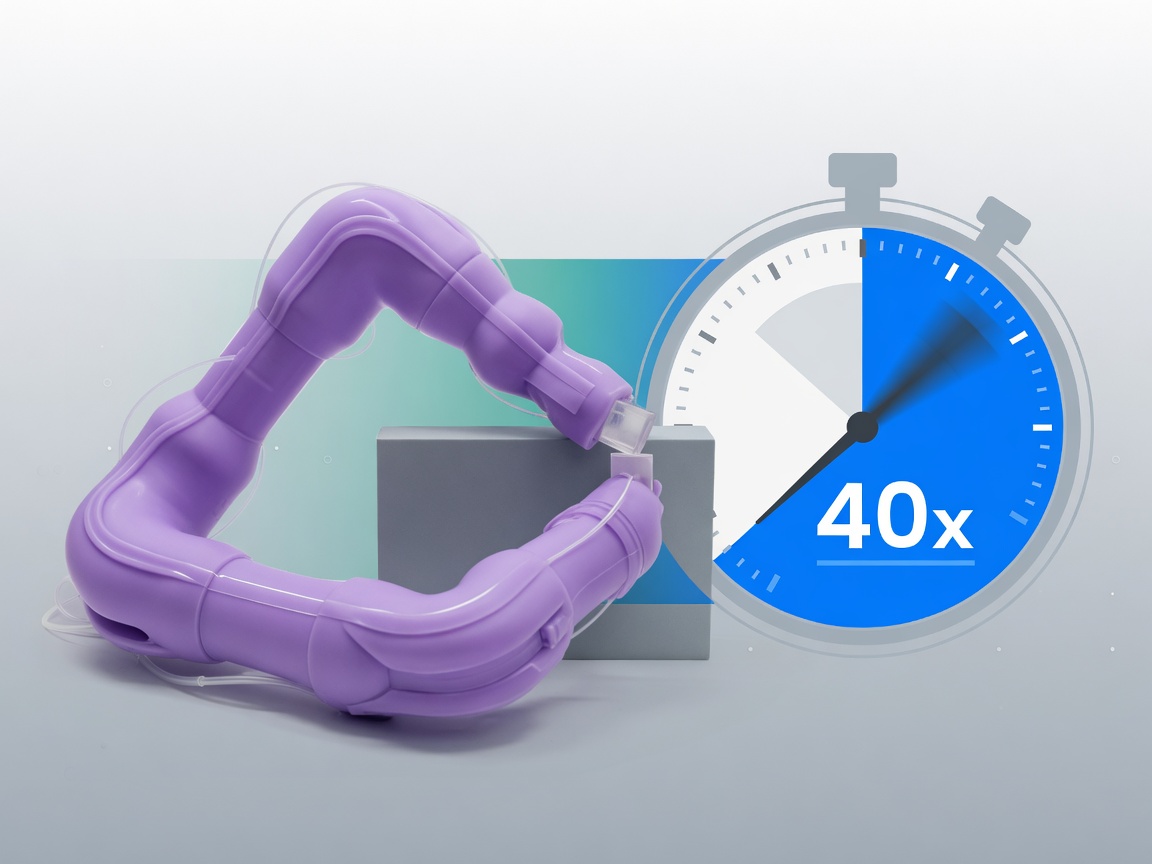
Soft robot policies just trained up to 40x faster in contact-heavy tasks - no new hardware required. The fix was making each simulation step structurally cheaper instead of buying more compute.
Automation needs a narrow first win
The best first AI workflow is usually a repeated task with a clear input, clear output, and a human approval step.
Training a soft robot policy just got up to 40x faster in contact-heavy scenarios - not through new hardware or a clever reward trick, but by fixing how the simulation itself steps through time. That's the core result from a new study on rapid soft robot policy learning using implicit time-stepping, and it matters because throughput is exactly what has kept soft-body simulation out of most teams' training pipelines.
Why Soft Robot Policy Learning Has Been So Expensive
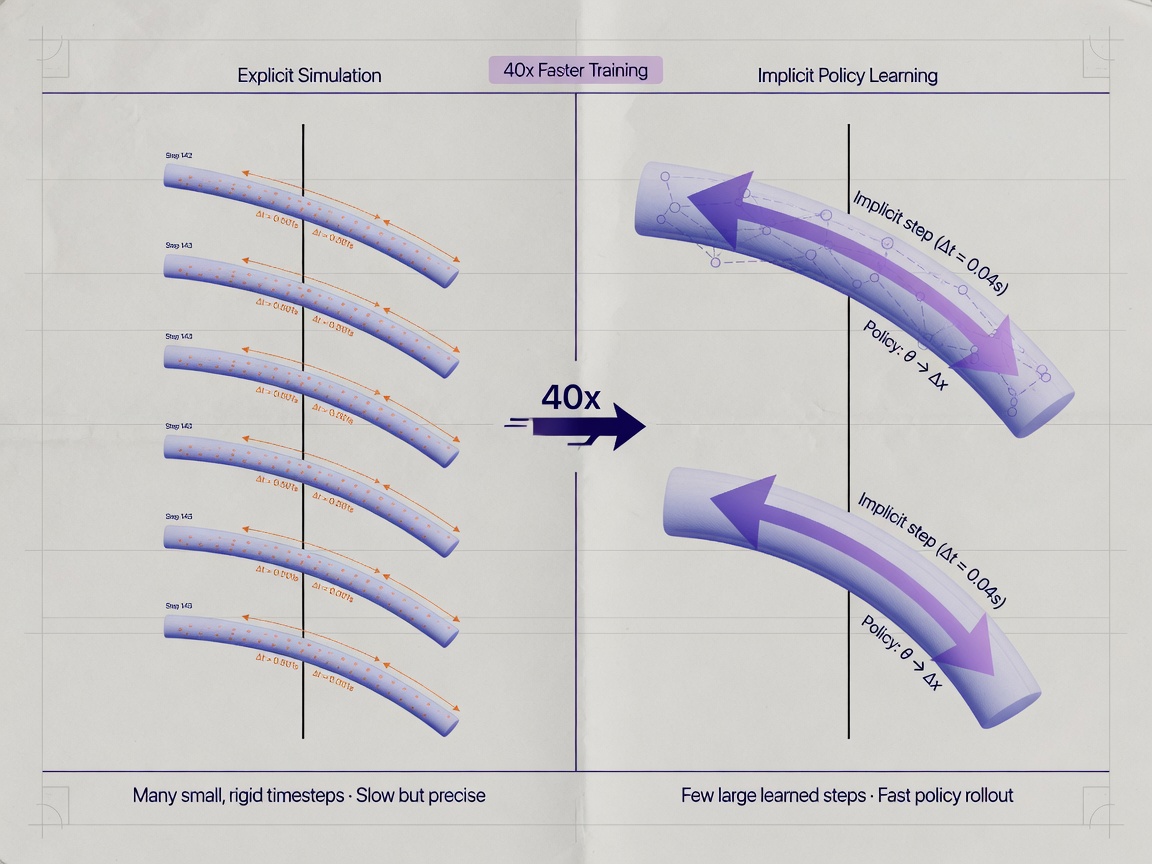
Policy learning in simulation is already the standard playbook for rigid robots. Rigid-body simulators are cheap enough to run at scale, so teams iterate: train, transfer, refine. Soft robots break that model. A soft manipulator is a continuum system - its dynamics have to be approximated by discretizing it into many degrees of freedom, and capturing elasticity, large deformation, and frictional contact typically forces severe timestep restrictions in explicit simulation. Every expensive environment step directly limits training throughput.
The result is a practical bottleneck: general-purpose soft-body frameworks are scarce, and the computational cost of accurately simulating continuum mechanics has often made soft-body policy learning infeasible outright. Existing options each carry trade-offs - early approaches approximated soft arms as rigid-body chains with compliant spring-damper elements but struggle with coupled deformation modes like twist, shear, and buckling; finite element platforms like SOFA can model soft robots but demand high-resolution volumetric meshes and high compute; reduced-order rod models such as Cosserat rods balance fidelity and efficiency better. Elastica, a widely used simulator built on that rod formulation, has been coupled with standard RL algorithms for compliant-arm control.
Worth a look
Phugialy Picks

AI Engineering: Building Applications with Foundation Models
A practical guide to building real-world applications with foundation models and LLMs.

GMKtec K15 AI Mini PC Oculink Intel Ultra 5 125U 32GB DDR5 512GB SSD | Desktop Computer AI Boost, 3X M.2 2280 Storage Expansion, Dual NIC...

AI: Understand the Revolution: From Basics and Buzzwords to Tech Giants, Governments, and Your Future
Some Phugialy Picks use affiliate links. If you buy through one, Phugialy may earn a commission. It doesn't change what we recommend. Full disclosure →
What DisMech Changes: Implicit Stepping and Delta Curvature Control
The researchers behind this study built their pipeline on DisMech, a fully implicit soft-body simulator that combines discrete elastic rod methods with implicit contact handling - stable under large deformation and frictional contact. The key efficiency trick is structural: the discrete centerline representation keeps the elastic force Jacobian banded, which makes the implicit solve significantly cheaper per step.
The second piece is a control interface. The authors introduce delta natural curvature control - analogous to delta joint position control on a rigid manipulator - giving learning algorithms an intuitive way to command a soft arm without wrestling the low-level continuum state directly. That's an unglamorous but consequential design decision: if your action space fights the policy learner, you pay for it in sample efficiency regardless of how fast the simulator runs.
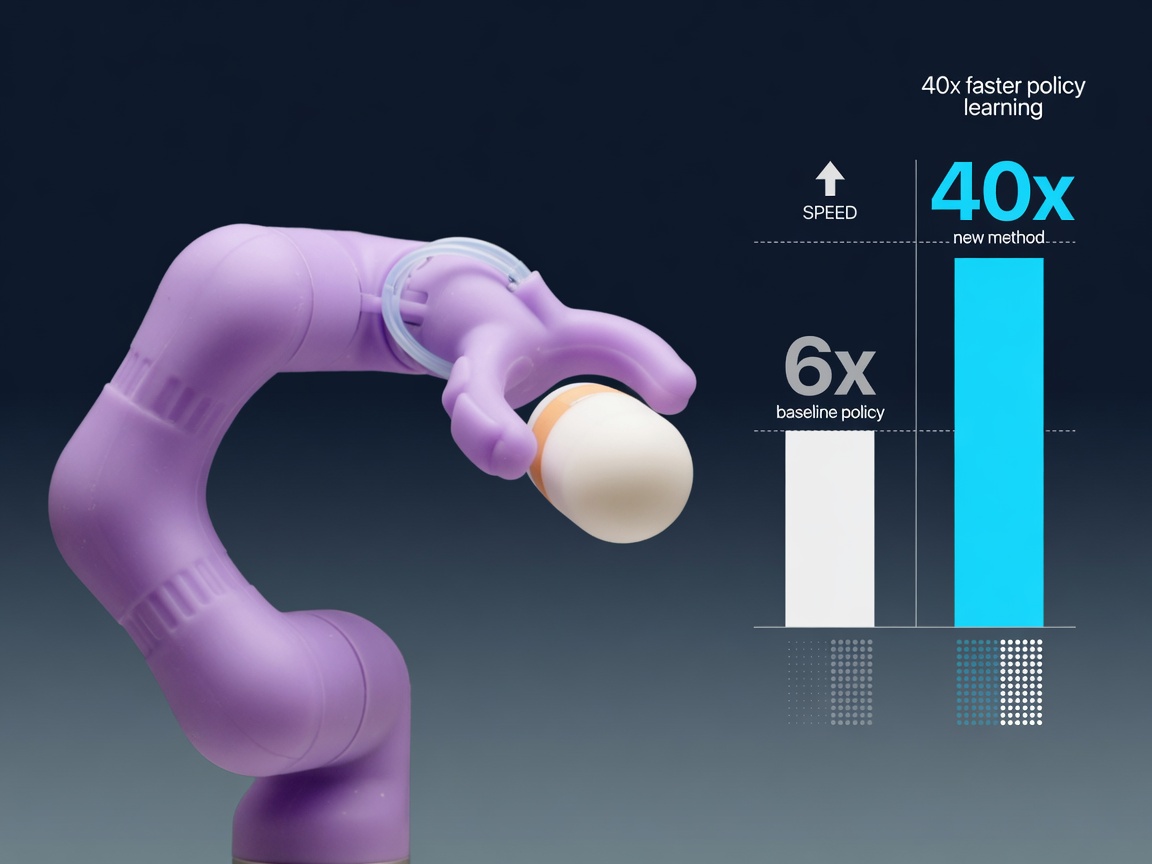
The evidence is concrete. Parallel stepping of 500 environments achieved up to 6x faster speeds over Elastica for non-contact cases and up to 40x faster for contact-rich scenarios across four representative soft-manipulator tasks. Cross-simulator evaluation showed these speed gains come while maintaining comparable task-level performance - meaning policies trained in DisMech didn't just train fast; they performed at parity when evaluated through another simulator.
The Adoption Math for Teams Working on Soft Robots
The real cost of adopting something like this isn't licensing - it's operational. If your team works on rigid arms today and wants to move into soft manipulation, the bottleneck you'd hit isn't algorithm talent or GPU budget; it's that every environment step costs too much to train anything meaningful in reasonable wall-clock time. A 6-40x throughput improvement changes that equation from 'infeasible' to 'a scheduling problem.'
My read on who this actually helps: not the big robotics labs already running massive rigid-body training farms - they can afford Elastica's overhead or work around it. It's smaller teams doing grasping or manipulation research with compliant grippers and slender manipulators - deformable linear objects are exactly the abstraction this representation targets - who suddenly get a viable path to learned policies without dedicating a cluster to one experiment.
What has to be true before switching: your task needs physical fidelity that reduced-order rod models capture (elasticity along slender structures), not full volumetric deformation where FEM still earns its cost. And you need someone willing to validate against your existing pipeline - the cross-simulator parity result is encouraging evidence that transfer holds up at task level, but every deployment should verify on its own tasks.
What this actually points to is a gap closing. Rigid-robot learning scaled because simulation got cheap enough; soft robots have been waiting for their version of that moment. Implicit time-stepping plus an efficient solve structure looks like the first credible candidate for it - worth watching not as an academic benchmark result but as infrastructure that determines whether learned soft-robot policies become something companies can budget for.
Got a question about how this applies to you? →
Keep reading
Follow the thread
Soft Robot Policy Learning Just Got Up To 40x Faster
A 40x speedup in simulation training sounds like a lab curiosity until you price what simulation time actually costs. New research on soft robot policy learning reports that switching to implicit time-stepping cuts train
Read this noteSame lane, different angle
SPEAR Turns Any Unreal Project Into an Embodied AI Simulator
A new open-source library exposes over 14,000 Unreal Engine functions to Python at no wrapper cost — turning any UE project into candidate training infrastructure for embodied AI at 73 fps photorealistic rendering.
Agon: Two Models Grading Each Other Replace Process Labels
Two models grade each other's work and double GRPO's pass@1 on math and coding benchmarks — with zero process labels and no reward model. The catch shows up when you try to ship it.