Knowledge Distillation For Time Series Classification: What Holds Up
A study across three architectures found knowledge distillation helps time series models most at intermediate sizes — not at maximum compression. One distilled FCN student dropped parameters by a factor of 38.
Automation needs a narrow first win
The best first AI workflow is usually a repeated task with a clear input, clear output, and a human approval step.
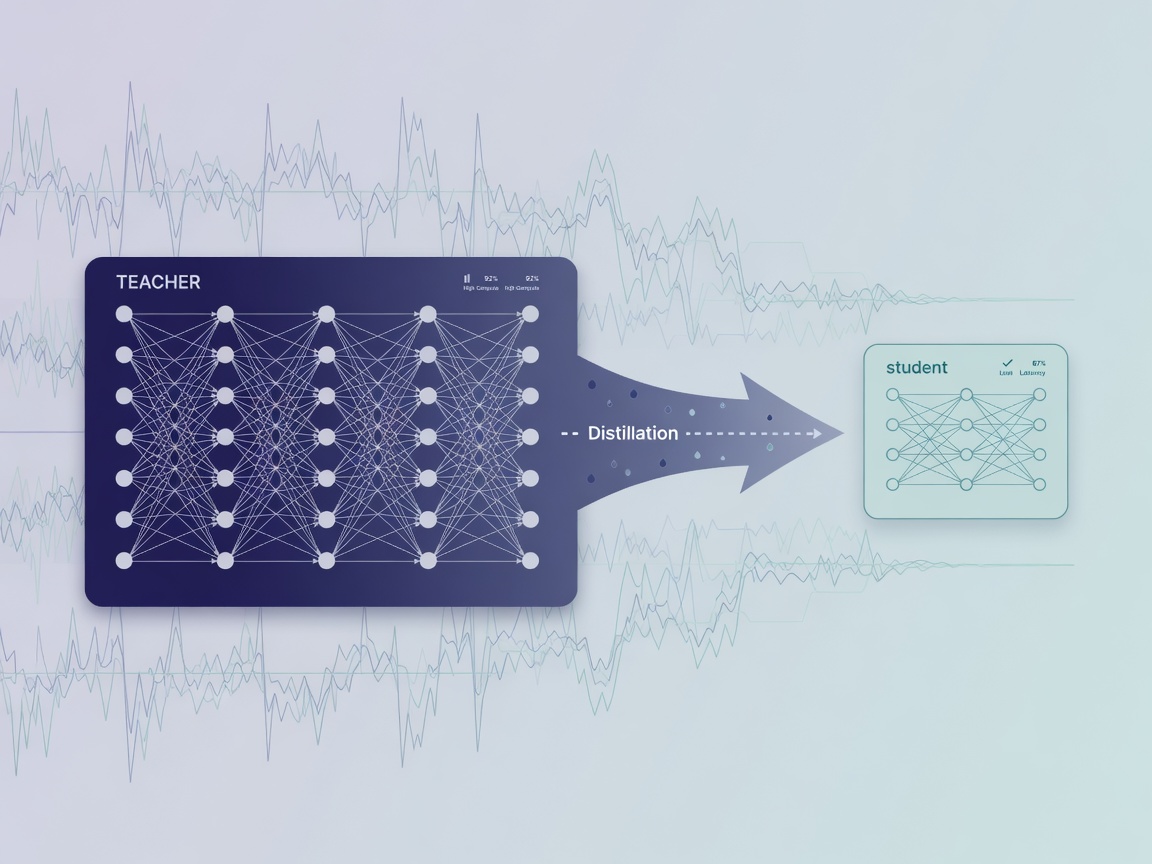
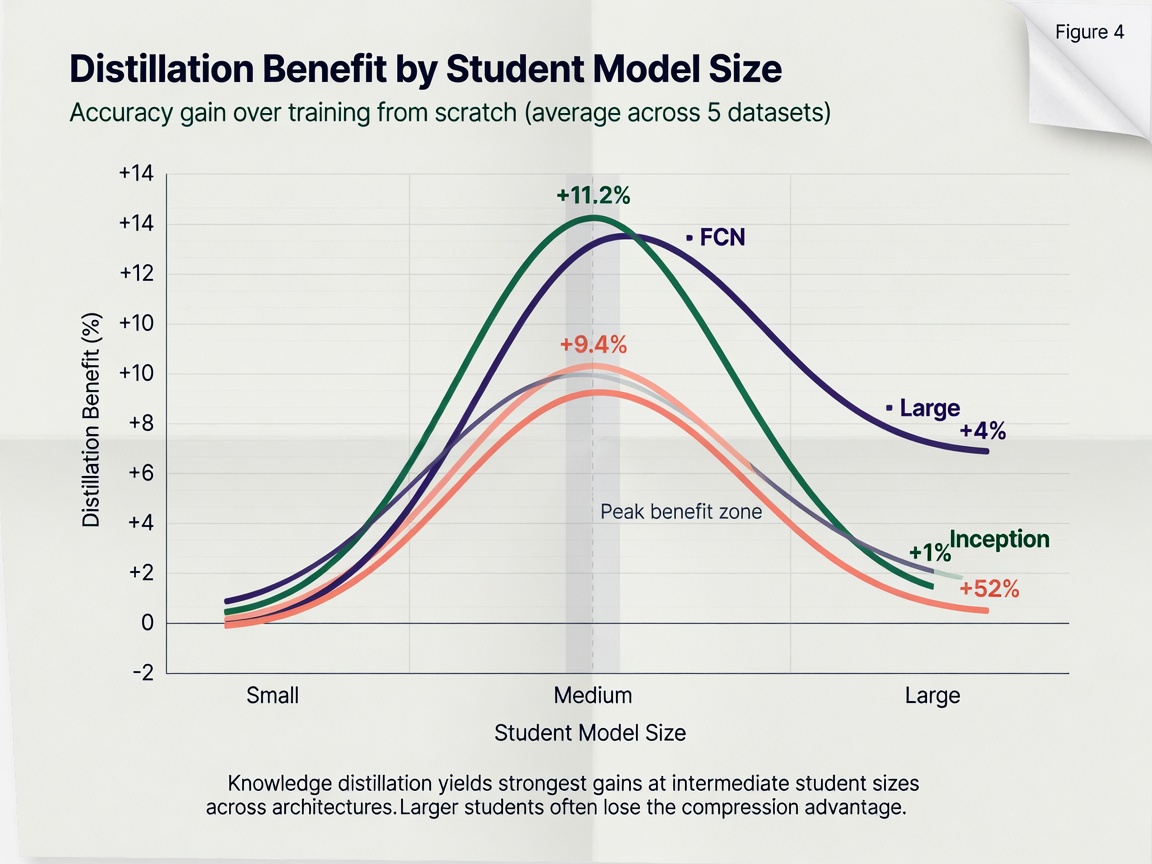
Knowledge distillation works for time series classification, and the interesting part isn't that it works — it's where it works best. A new study on arXiv evaluated the technique across three very different architectures (a classical Fully Convolutional Network, an Inception-style convolutional model, and the transformer-based ConvTran) on the UCR Archive, the largest benchmark repository of time series datasets. The headline result: students of intermediate complexity benefit most from distillation, consistently, across all three architectures.
That's a more useful finding than "distillation works," because it gives you a design rule instead of a vibe. If you're compressing a time series model for deployment on something resource-limited — an edge device, an embedded controller, anything without a GPU budget — the study suggests there's a sweet spot in student size where distillation pays off most, and going smaller than that costs you more than you'd expect.
What The Numbers Actually Show
The evidence is concrete per architecture. The distilled FCN student cut parameters by a factor of 38 — that's not trimming, that's a rebuild — while the distilled Inception student got to nearly the same performance as its teacher with 42% fewer parameters. On ConvTran, the transformer in the lineup, the student with just 2 attention heads showed the most significant improvement through distillation.
The researchers got there by modifying architectural components directly: convolutional filters in FCN, Inception modules in the convolutional model, attention heads in ConvTran. That matters methodologically. They didn't just shrink one architecture and generalize; they tested whether the distillation benefit held across fundamentally different design families — pure convolution, multi-scale convolution, and attention. It did.
The UCR Archive is also the right benchmark to take seriously here. It's large and varied enough that a result surviving across it is less likely to be an artifact of one friendly dataset.
Worth a look
Phugialy Picks

AI Engineering: Building Applications with Foundation Models
A practical guide to building real-world applications with foundation models and LLMs.

GMKtec K15 AI Mini PC Oculink Intel Ultra 5 125U 32GB DDR5 512GB SSD | Desktop Computer AI Boost, 3X M.2 2280 Storage Expansion, Dual NIC...

AI: Understand the Revolution: From Basics and Buzzwords to Tech Giants, Governments, and Your Future
Some Phugialy Picks use affiliate links. If you buy through one, Phugialy may earn a commission. It doesn't change what we recommend. Full disclosure →
The Part Worth Being Skeptical Of
Now the caveats, because there are always caveats. Everything here is UCR Archive data — which is to say, mostly univariate, mostly well-curated classification problems. Real production time series is messier: multivariate streams, missing values, drifting distributions, class imbalance. None of that is tested here, and distillation behavior on clean benchmarks doesn't automatically transfer to streams that shift under you.
Second: "intermediate complexity" is a finding about where distillation helps most, which cuts both ways. If you need maximum compression — that FCN at 1/38th the parameters being the extreme case — you're outside the sweet spot by definition. The paper shows that extreme compression was achieved; it doesn't tell you how much accuracy that particular student gave up to get there relative to an intermediate one.
Third: parameter count isn't latency or memory at inference time. A 42% parameter reduction in an Inception model doesn't translate neatly into a 42% speedup on your target hardware. Anyone who has shipped a "smaller" model only to find it wasn't actually faster knows this gap.
Why This One Holds Up Better Than Most Compression Papers
My read — and this is interpretation, not something the paper claims — is that this study earns credibility through breadth rather than depth: three architectures spanning conv nets to transformers is exactly the kind of cross-family validation most distillation papers skip. The consistency of the "intermediate students benefit most" pattern across all three is what makes it worth acting on rather than filing away.
What this actually points to for practitioners: if you're deploying deep learning models for time series analysis in resource-limited environments — which is where most industrial sensor work lives — distillation should be on your shortlist before you reach for architecture search or aggressive manual pruning. And when you do it, don't default to compressing as hard as possible; start with an intermediate student and measure whether going smaller actually buys you anything beyond losing accuracy.
The authors released their implementation publicly for reproducibility, which lowers your cost of testing this against your own data considerably. Run it on one of your real streams before trusting the UCR numbers as predictive of your case — but run it. That's more than most compression results give you.
Got a question about how this applies to you? →
Keep reading
Follow the thread
TimEE: Time Series Classification With Zero Real Training Data
A time series is just a list of numbers measured over time - heartbeats, sensor readings, stock prices - and classifying one usually means training a new model from scratch for every single dataset. TimEE, a new 4.5M-par
Read this noteSame lane, different angle
Shortcut Learning Found Where Accuracy Metrics Can't Look
A chest X-ray classifier scored 86.27% accuracy — and ReMoDEx found it was partly making decisions off image borders instead of lungs. The framework behind that finding might change how we evaluate models before they ship.
The Geometry of Thought: Decoding the AI Black Box
Deep learning often feels like a series of miracles, but at its core, the "black box" of neural networks is actually a problem of geometry. While we know that deep feedforward ReLU networks (Multi-Layer Perceptrons or ML