Poverty Mapping With Multimodal AI: What Actually Works
Fusing satellite imagery with LLM text lifts household wealth prediction from R²=0.63 to 0.77 - but one part of that pipeline didn't earn its keep.
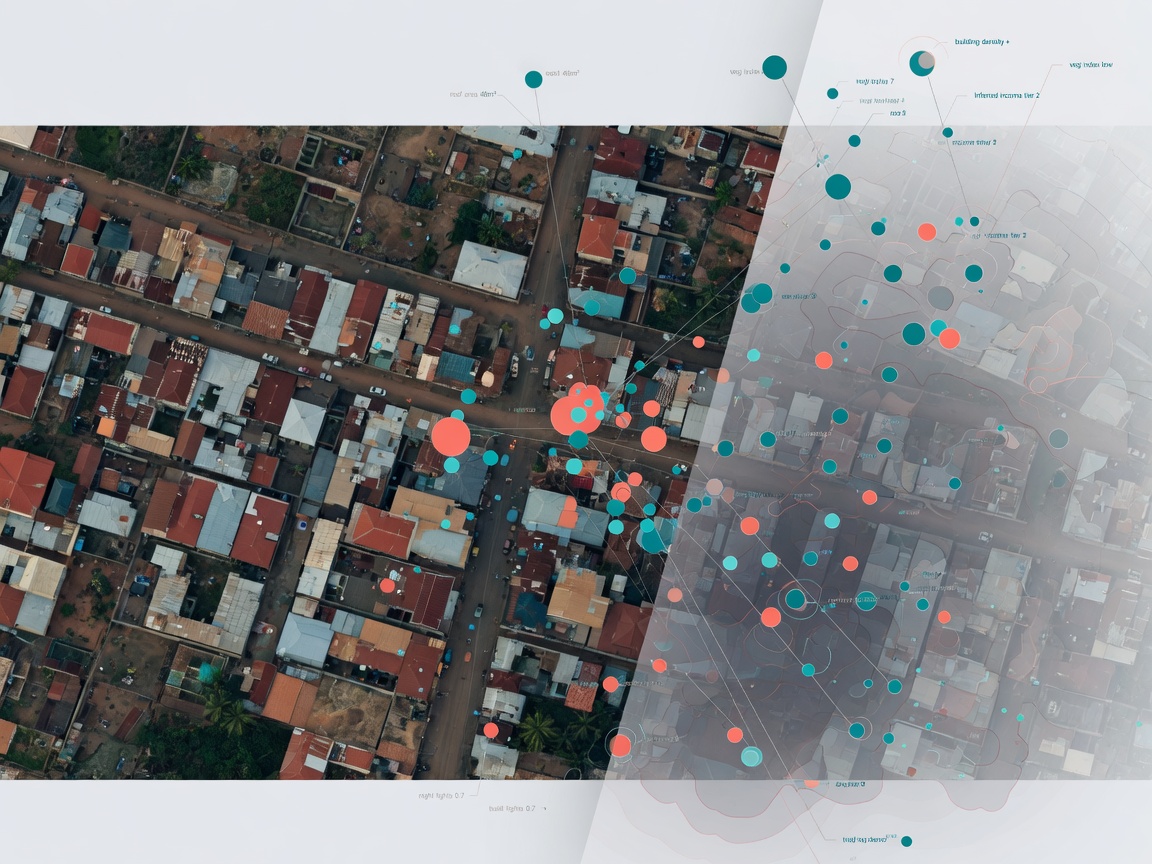
Automation needs a narrow first win
The best first AI workflow is usually a repeated task with a clear input, clear output, and a human approval step.
A household survey that costs thousands of dollars per cluster can now be approximated, in part, by a model that looks at a satellite photo and reads the web. That's the practical core of a new study on poverty mapping, and it's worth understanding even if you'll never run a development NGO - because it shows what multimodal AI is actually good for: replacing expensive ground-truth data collection with cheap signals, when you can validate the gap.
What The Study Actually Built
The researchers formalized poverty mapping as a supervised regression problem: predict the International Wealth Index (IWI) - a composite measure of household assets and living conditions - for each Demographic and Health Surveys (DHS) cluster. DHS surveys are the ground truth here, but they're periodic, expensive, and limited in scale, which is exactly why anyone doing socio-economic work across low- and middle-income countries has been looking for cheaper proxies for years.
The framework tests five signals: a vision model on satellite imagery, an LLM prompted with only a location and year, an AI search agent that retrieves and synthesizes web text, a joint image-text encoder, and an ensemble of all five. The dataset is continent-scale - roughly 60,000 DHS clusters across Africa paired with satellite images, LLM-generated descriptions conditioned on location and year, and text retrieved by the agent.
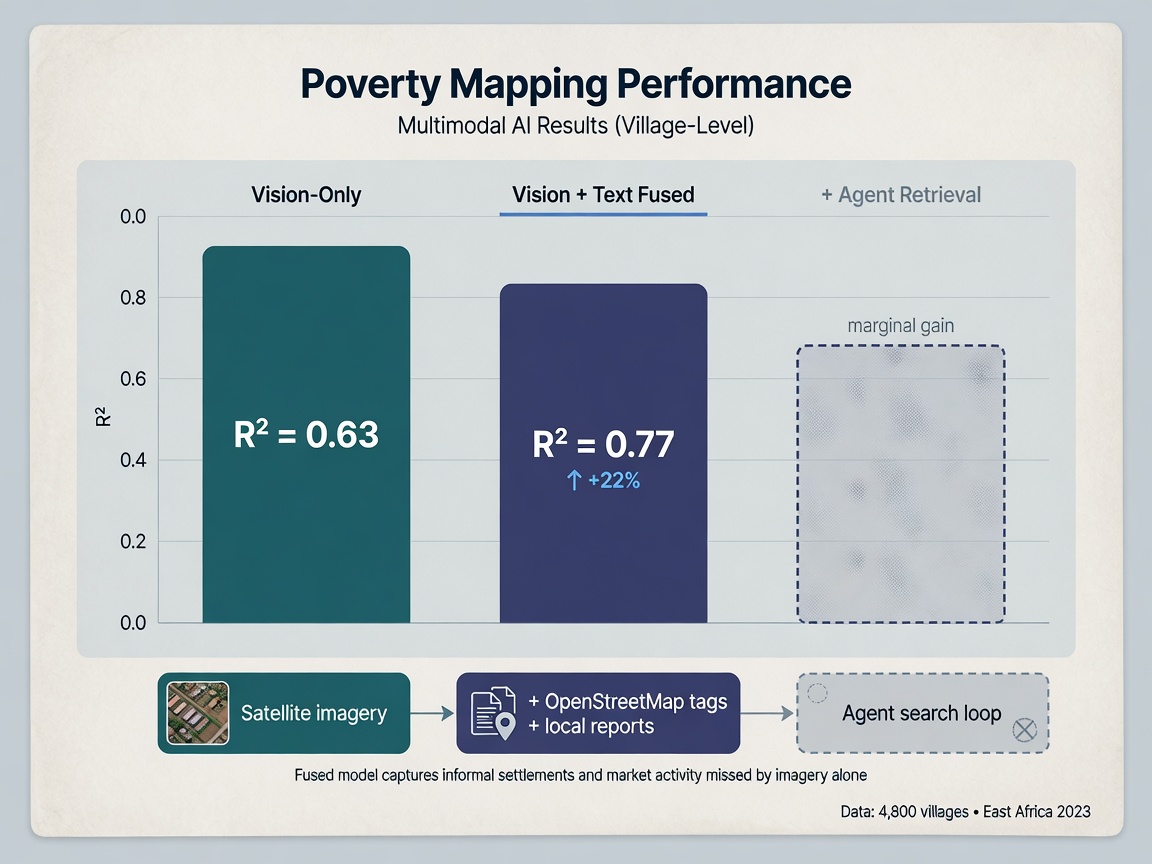
The headline result: fusing vision with agent/LLM-generated text beats vision-only baselines - R² of 0.77 versus 0.63 on out-of-sample splits. That's a real gap, not noise.
Worth a look
Phugialy Picks

AI Engineering: Building Applications with Foundation Models
A practical guide to building real-world applications with foundation models and LLMs.

GMKtec K15 AI Mini PC Oculink Intel Ultra 5 125U 32GB DDR5 512GB SSD | Desktop Computer AI Boost, 3X M.2 2280 Storage Expansion, Dual NIC...

AI: Understand the Revolution: From Basics and Buzzwords to Tech Giants, Governments, and Your Future
Some Phugialy Picks use affiliate links. If you buy through one, Phugialy may earn a commission. It doesn't change what we recommend. Full disclosure →
Where The Cheap Signals Actually Win
Two findings matter more than the headline number if you're thinking about cost.
First, LLM-internal knowledge proved surprisingly predictive for out-of-country and out-of-time generalization. In plain terms: what the model already "knows" from its training data generalizes better than fresh retrieval in some splits. That matters because retrieval infrastructure - agents crawling web sources - is the expensive, fragile part of this stack.
Second, the Agent-Induced Novelty Hypothesis didn't hold up cleanly. Agent-retrieved data yielded only marginal and unstable gains across splits. The researchers couldn't establish that agent-gathered context adds reliable complementary structure beyond what the LLM already knows internally.
The interpretability story is also honest rather than rosy. Fused embeddings from vision and language modalities correlate moderately - median cosine similarity around 0.60 after alignment - which is broadly consistent with the Platonic Representation Hypothesis (the idea that material well-being converges toward a shared latent representation across modalities). But the authors are careful: moderate correlation does not establish convergence to a single shared representation.
What This Changes For Anyone Buying Data
Here's my read on where this lands commercially. The business this actually helps isn't satellite providers or AI labs - it's anyone currently paying for field surveys to measure conditions they could partly infer from imagery plus text: development finance screening, insurance risk assessment in data-sparse markets, infrastructure investment targeting.
But note what has to be true before this is worth adopting. The vision-only approach has known limits - it misses socio-cultural, historical, or contextual factors you simply can't see from above. The text side patches some of that but introduces its own dependency on what an LLM happens to know about a given place and year. So the operational condition isn't "buy access to a multimodal model"; it's "have enough validated ground truth in your specific region to measure whether the R² gap holds there." If you have even one recent survey wave to calibrate against, this becomes testable cheaply. If you don't have any ground truth at all, you have no way to know whether 0.77 or 0.63 describes your market.
What I'd actually watch: whether follow-up work makes agent retrieval stable enough to justify its cost, or whether the field concludes that LLM internal knowledge plus imagery is the right trade-off point - fewer moving parts, similar accuracy. My suspicion is the latter wins on ROI grounds; an unstable pipeline component that adds marginal gains is exactly the kind of thing you cut when budgeting real deployments.
The dataset release itself may be the most immediately useful artifact: roughly 60,000 clusters with linked images and texts lowers everyone else's barrier to testing whether this transfers beyond wealth prediction.
Got a question about how this applies to you? →
Keep reading
Follow the thread
Compositional Visual Reasoning: The 5-Stage Shift Explained
A new survey of 100+ studies maps five stages of compositional visual reasoning - and explains why end-to-end models give plausible but wrong answers on multi-hop visual questions. The benchmark catalog alone is worth the read.
Read this noteSame lane, different angle
Training-Free Multimodal Attribution: What Holds Up
A training-free method locates source evidence using only attention heads during prefill — at one-seventh of prompting's latency. The benchmark behind it is also new territory.
SciReasoner: One Model Reasons Across Proteins, Molecules, Crystals
Proteins, molecules, and crystals share almost nothing on the surface - different representations, different tools, different vocabularies entirely. What if one model could reason natively across all three? That's the pr