Interactive AI Systems for Structural Design Get Friction Right
Generative AI keeps trying to hand creators finished answers - but structural designers need something completely different: a partner that iterates with them. New research shows how interactive systems can erase the tedious modelling work while keeping exactly the friction that makes design thinking work.

Automation needs a narrow first win
The best first AI workflow is usually a repeated task with a clear input, clear output, and a human approval step.
Imagine sketching a bridge concept out loud, pointing at a rough drawing, and having an AI that argues back, iterates, and reshapes the structure with you instead of handing you a finished design you never asked for. That's not a wish list anymore - it's the direction a recent arXiv paper on interactive AI systems for structural design is actively mapping out.
The paper starts from an observation that anyone in a creative field will feel in their bones: generative AI has been optimized to remove friction and deliver final solutions, but creators like structural designers don't actually want that. Design is iterative. You need to externalise half-formed ideas, explore alternatives, and refine partial solutions under real constraints - load paths, materials, geometry. A system that collapses all of that into one polished output doesn't accelerate the work; it skips the work.
What Interactive AI Systems for Structural Design Actually Do
The researchers propose design dimensions for systems built around vision-language models that make structural exploration conversational, multimodal, and responsive to evolving human intent. In practice, that means you can talk through a concept, show the system sketches or images, and keep pushing on partial solutions as your intent shifts mid-conversation. The AI stays in the loop with you rather than closing the loop on its own.
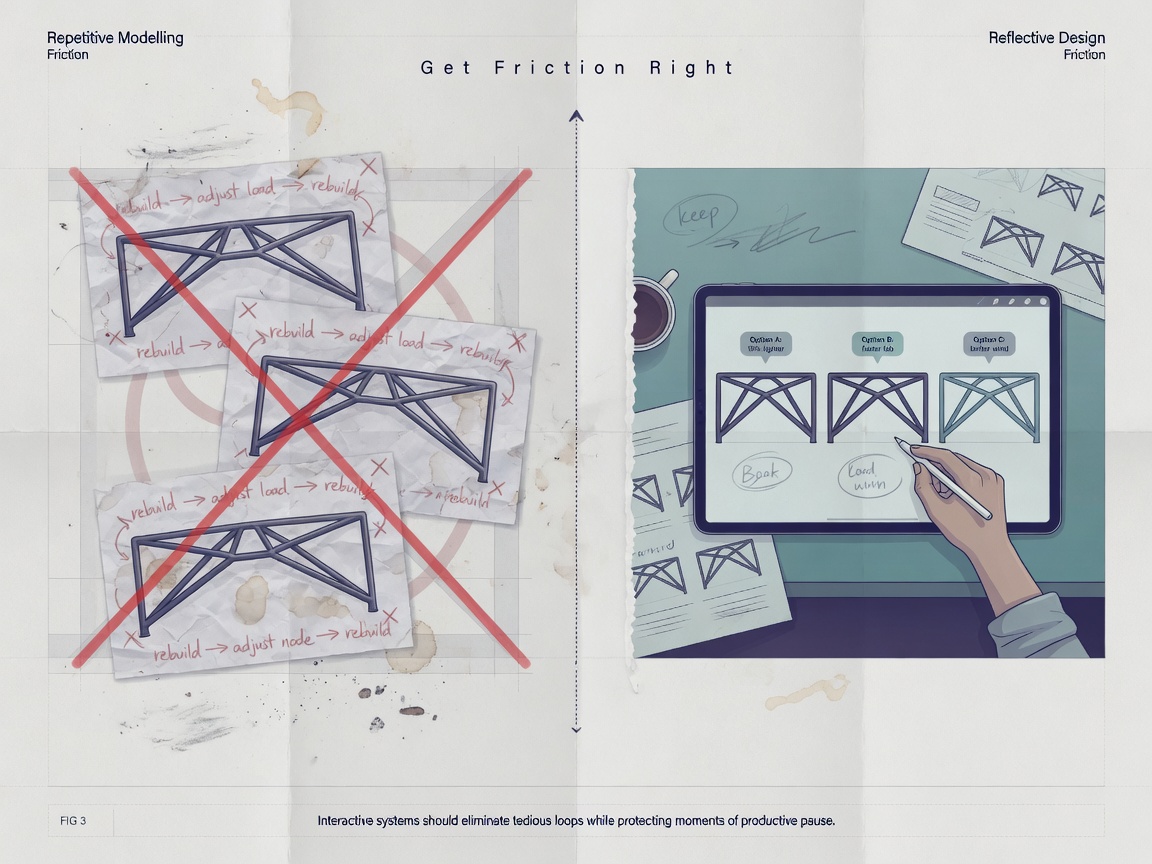
The pilot study behind the paper is the encouraging part: structural designers who tried these interactive systems reported that the AI supported design space exploration by reducing repetitive modelling friction - the tedious rebuild-everything-when-one-parameter-changes work - while preserving what the authors call reflective design friction. That distinction matters enormously. The grunt work gets automated; the thinking doesn't.
Worth a look
Phugialy Picks

AI Engineering: Building Applications with Foundation Models
A practical guide to building real-world applications with foundation models and LLMs.

GMKtec K15 AI Mini PC Oculink Intel Ultra 5 125U 32GB DDR5 512GB SSD | Desktop Computer AI Boost, 3X M.2 2280 Storage Expansion, Dual NIC...

AI: Understand the Revolution: From Basics and Buzzwords to Tech Giants, Governments, and Your Future
Some Phugialy Picks use affiliate links. If you buy through one, Phugialy may earn a commission. It doesn't change what we recommend. Full disclosure →
The Friction Worth Keeping
Here's what I find quietly exciting about this framing: it flips the usual AI-progress metric on its head. For years the goal has been fewer clicks, faster answers, less back-and-forth. But this paper argues - with pilot evidence behind it - that some friction is load-bearing. Reflective friction is where designers test their own assumptions and discover better ideas. A tool that preserves it while erasing only the repetitive parts isn't a compromise; it's a smarter division of labor.
And my read on where this points: give this approach a year or two of iteration beyond structural design, and 'conversational exploration under constraints' could become the template for creative tools across engineering disciplines - anything where intent evolves faster than models can be rebuilt from scratch.
That's not hype; it's following the paper's own logic to its natural next step.
Got a question about how this applies to you? →
Keep reading
Follow the thread

Spectral Attacks Reveal a Hidden Weak Spot in Vision-Language Models
Researchers found a way to attack vision-language models using the model's own internal geometry — aligning representations with the subspaces the model cares about least. It beats existing baselines, and the same insight could make these models tougher.
Read this noteSame lane, different angle
FSU-QA Tests Foresight Intelligence in Vision-Language Models
Small Vision-Language Models fine-tuned on FSU-QA beat much larger frontier models at anticipating future events - but only when measured by FSU-QA itself. That circularity is the part worth thinking about before citing this result.
Compositional Visual Reasoning: The 5-Stage Shift Explained
A new survey of 100+ studies maps five stages of compositional visual reasoning - and explains why end-to-end models give plausible but wrong answers on multi-hop visual questions. The benchmark catalog alone is worth the read.