Polycepta Rethinks Multi-Object Tracking Appearance Modeling
A new tracking framework hits 92.27% MOTA on KITTI while running at 90 Hz - but the claim I'd actually stress-test first isn't the accuracy score.
Automation needs a narrow first win
The best first AI workflow is usually a repeated task with a clear input, clear output, and a human approval step.
Polycepta is a new multi-object tracking framework that treats appearance modeling as a recursive estimation problem instead of frame-by-frame matching, and it posts a MOTA of 92.27% on KITTI while running at 90.57 Hz in a tracking-by-detection pipeline. Those are the headline numbers, and they're worth taking seriously - but the more interesting claim is buried underneath them.
What Recursive Estimation Actually Changes
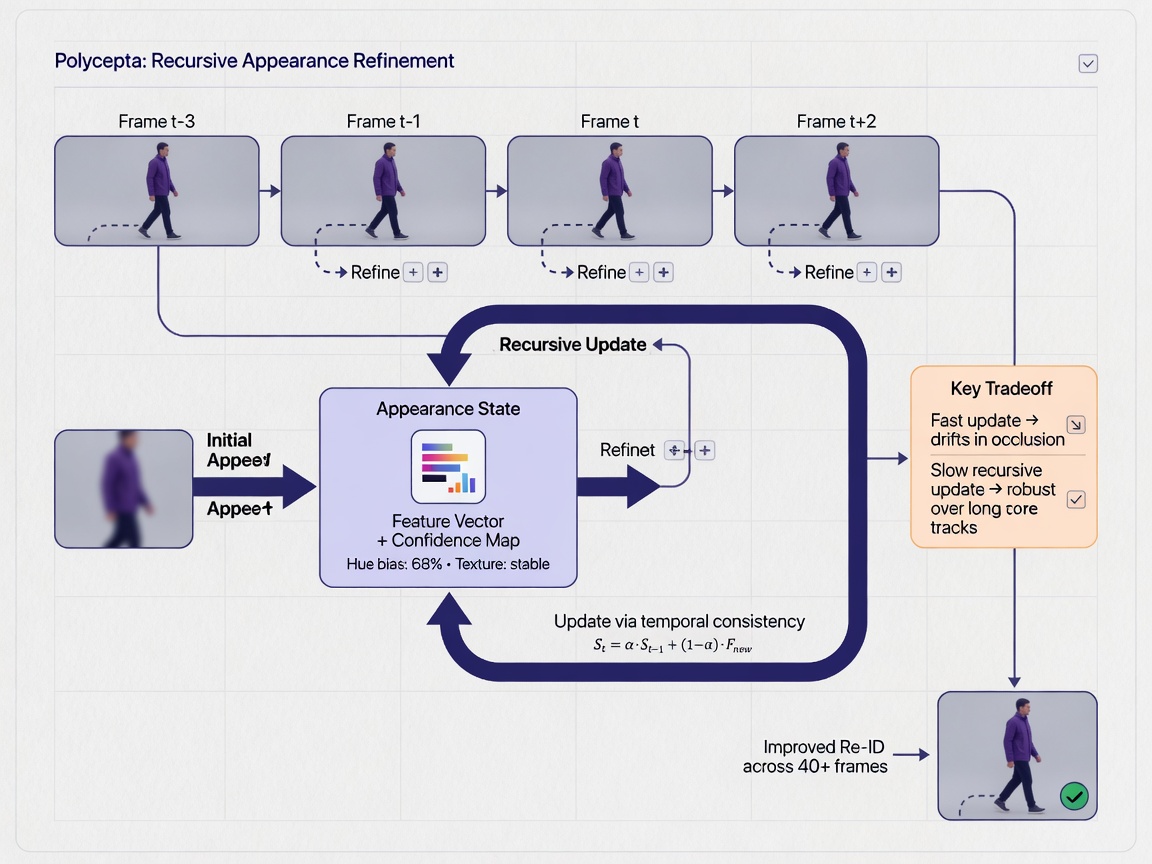
Most trackers build an appearance model for each object from the current frame's match and move on. If that match is wrong, the error compounds: the appearance state drifts, the tracker latches onto the wrong identity, and you get an identity switch. Polycepta instead maintains an independent appearance state per tracked object and continuously updates it as inference proceeds - meaning the model's estimate of what an object looks like gets refined over time rather than frozen at first detection.
The practical consequence is twofold. First, identity switches drop, because a transient bad match doesn't overwrite everything the tracker knows about an object. Second, appearance estimation quality improves as object states evolve during inference - the system gets better at its own task while running, not just during training.
Worth a look
Phugialy Picks

AI Engineering: Building Applications with Foundation Models
A practical guide to building real-world applications with foundation models and LLMs.

GMKtec K15 AI Mini PC Oculink Intel Ultra 5 125U 32GB DDR5 512GB SSD | Desktop Computer AI Boost, 3X M.2 2280 Storage Expansion, Dual NIC...

AI: Understand the Revolution: From Basics and Buzzwords to Tech Giants, Governments, and Your Future
Some Phugialy Picks use affiliate links. If you buy through one, Phugialy may earn a commission. It doesn't change what we recommend. Full disclosure →
The Part Worth Being Skeptical Of
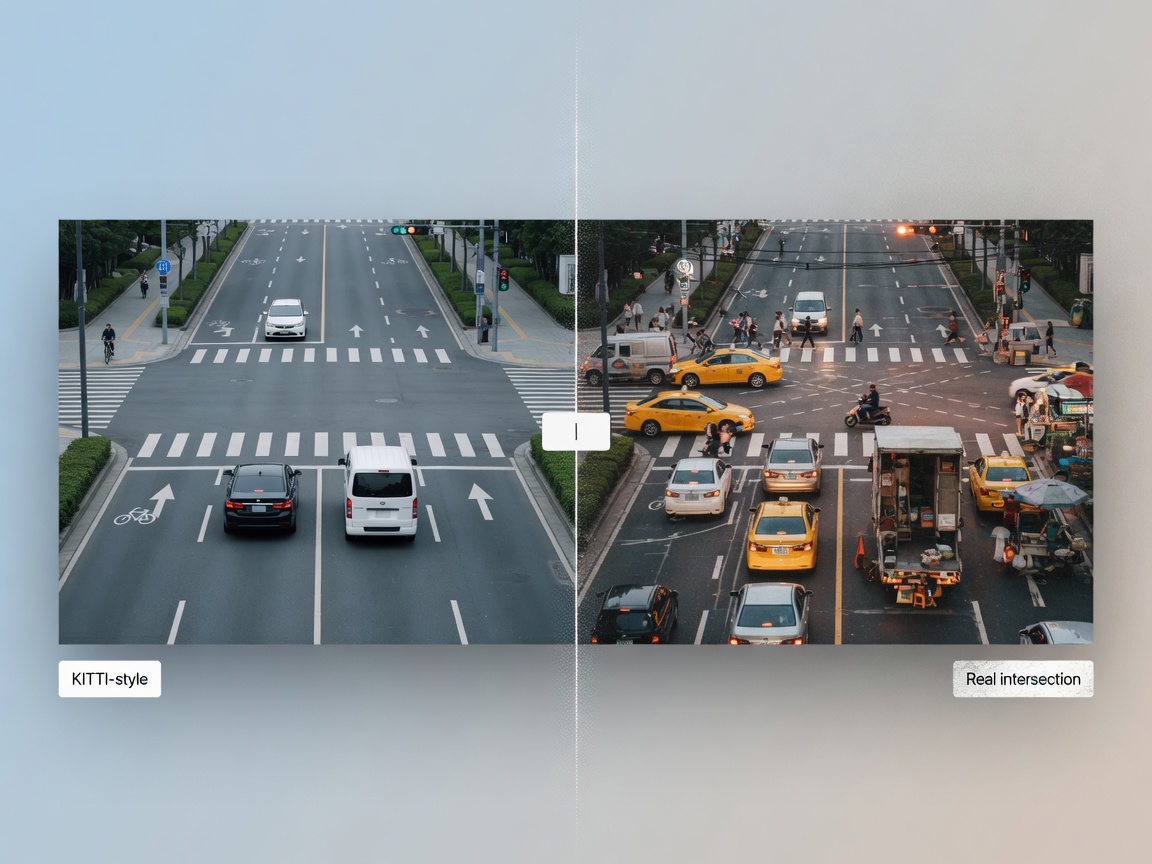
The claim that stands out most to me is generalization: Polycepta enables appearance estimation for unseen classes through its proposed learning strategy. That's the claim I'd want stress-tested before believing it in production. "Unseen classes" in a benchmark context usually means classes held out from training but still reasonably close to the training distribution - cars, pedestrians, cyclists in KITTI's world are visually similar kinds of things. Whether this holds for genuinely out-of-distribution objects - unusual lighting, occlusion-heavy scenes, object categories nothing like the training set - is exactly what the benchmark setup won't tell you.
KITTI is also a well-worn benchmark with its own quirks. A 92.27% MOTA there is real and state-of-the-art, but KITTI scenes are structured: mostly road-bound objects, mostly predictable motion. The gap between benchmark performance and a crowded warehouse floor or a busy intersection with heavy occlusion is where most tracking systems earn or lose their reputation.
The Number That Matters More Than MOTA
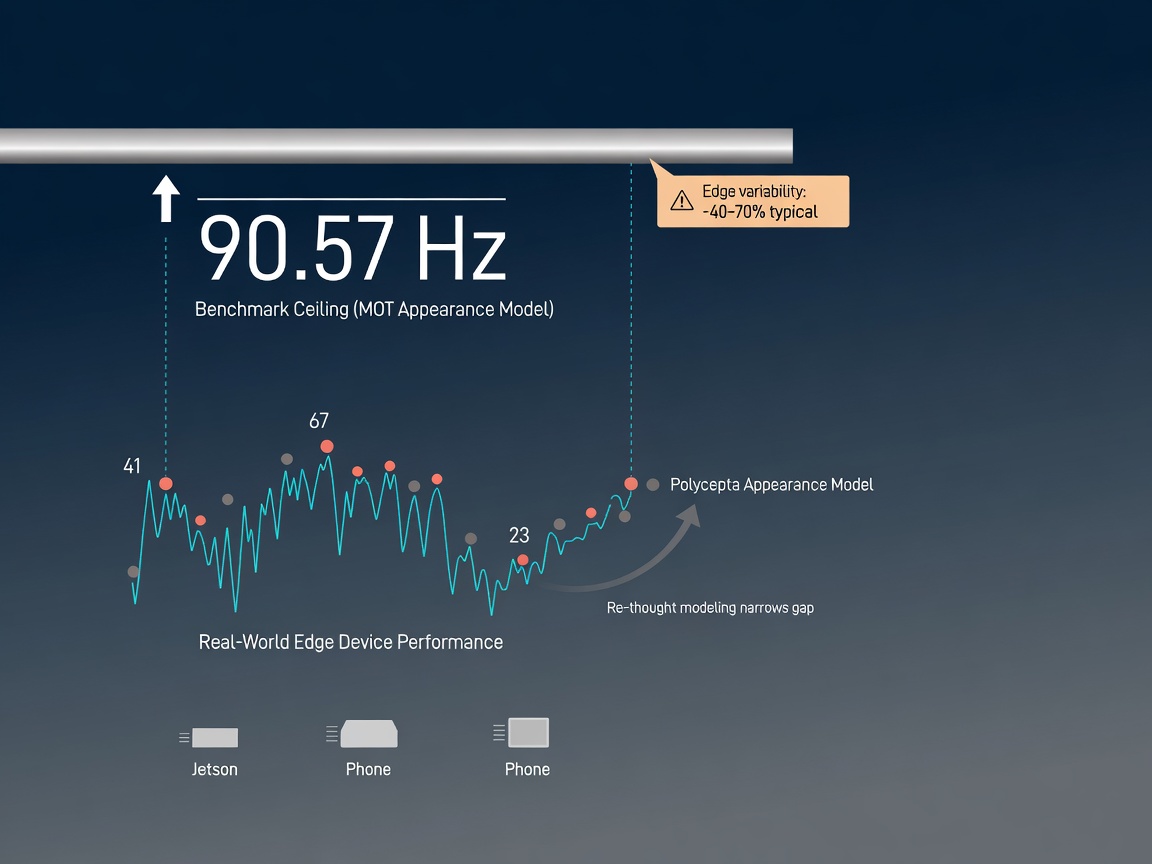
For anyone actually deploying tracking systems, 90.57 Hz is arguably the more important figure than the accuracy score. Tracking-by-detection pipelines are usually bottlenecked by compute on either side - detection and association - and an appearance model that adds heavy per-object state maintenance often forces you to trade accuracy for frame rate or vice versa.
Polycepta reporting both high accuracy and real-time throughput suggests the recursive state approach isn't paying for itself in latency, which is not a given for methods that add persistent per-object memory. That said, throughput on benchmark hardware rarely survives contact with edge devices or shared GPU workloads unchanged, so treat 90.57 Hz as a ceiling under favorable conditions rather than a deployment guarantee.
What This Points To
The real story here isn't one benchmark score - it's a structural shift in how appearance modeling is framed: from matching to estimation. If per-object state that improves during inference generalizes beyond KITTI-style scenes, it changes what you can build on top of trackers: more reliable long-horizon behavior in robotics perception, video analytics where identity persistence actually matters across minutes rather than frames.
My read: this is a methodologically sound direction with claims that deserve independent replication on messier data before anyone rebuilds their perception stack around it. The benchmarks are real; what they don't say anything about yet is how this behaves when the world stops looking like KITTI.
Got a question about how this applies to you? →
Keep reading
Follow the thread

Evaluating Temporal Preservation in Conversational Image Editing
Most image editing models fail when an object is hidden and then revealed in a conversation. OCCUR-Bench is a new diagnostic tool designed to expose these specific failures in temporal consistency.
Read this noteSame lane, different angle
Measuring Heart Rate With Just A Webcam
A laptop webcam can apparently measure your heart rate without touching you — face detection plus signal cleanup plus periodicity math beats strapping on a sensor. Whether that holds up outside controlled conditions is where this gets interesting.
3D Spatial Reasoning From RGB Alone: SpaR3D-MoE Delivers
Give a multimodal AI model nothing but a few sparse RGB frames, and ask it how far away the table is or which direction to walk — and now imagine it actually answers correctly. That's the promise behind SpaR3D-MoE, a new