Measuring Heart Rate With Just A Webcam
A laptop webcam can apparently measure your heart rate without touching you — face detection plus signal cleanup plus periodicity math beats strapping on a sensor. Whether that holds up outside controlled conditions is where this gets interesting.
Automation needs a narrow first win
The best first AI workflow is usually a repeated task with a clear input, clear output, and a human approval step.
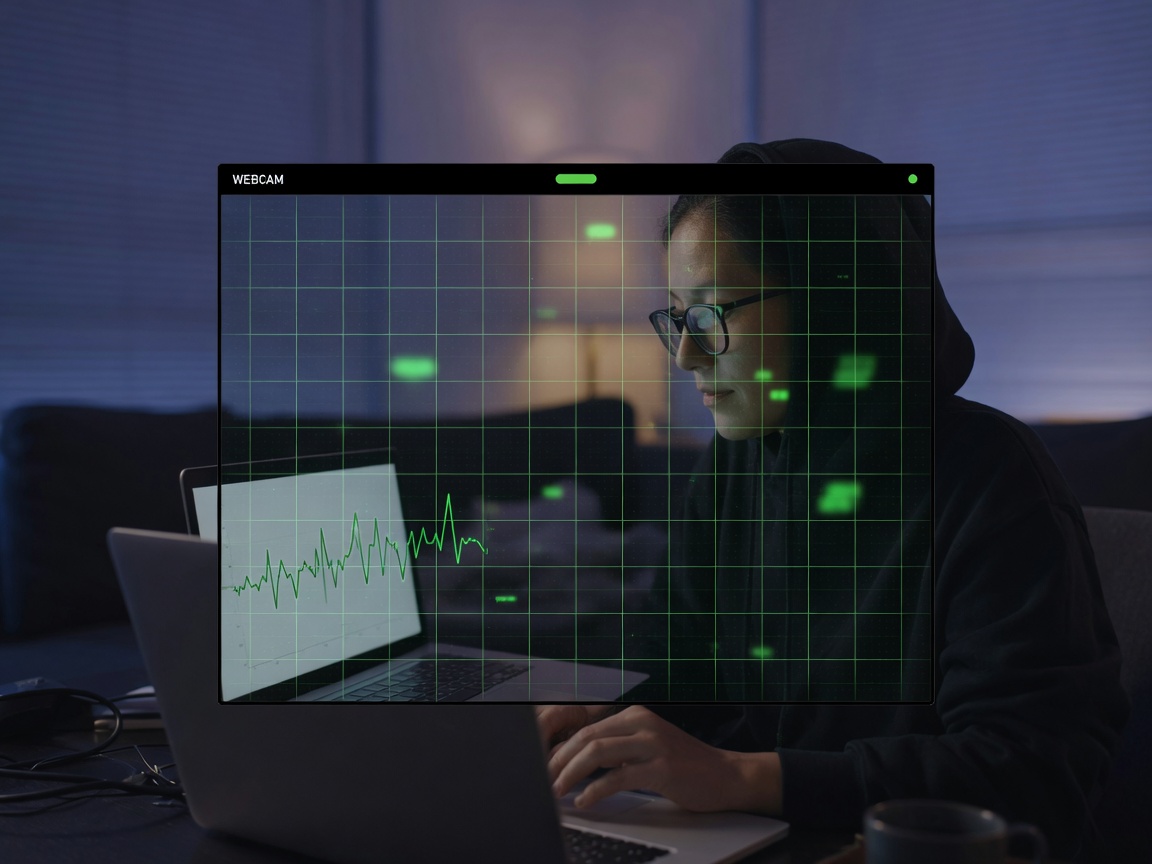
A laptop webcam can measure your heart rate without touching you — that's the claim in a recent paper describing a real-time, non-contact heart rate measurement system built entirely around commodity cameras and image processing. No chest strap, no finger sensor, no wearable at all. The pipeline runs face detection on the camera feed, extracts a signal from what it sees, cleans it up, and computes heart rate from the signal's periodicity. It's the kind of system that sounds like a demo trick until you look at how it's actually put together — and where it still falls short.
How The Pipeline Actually Works
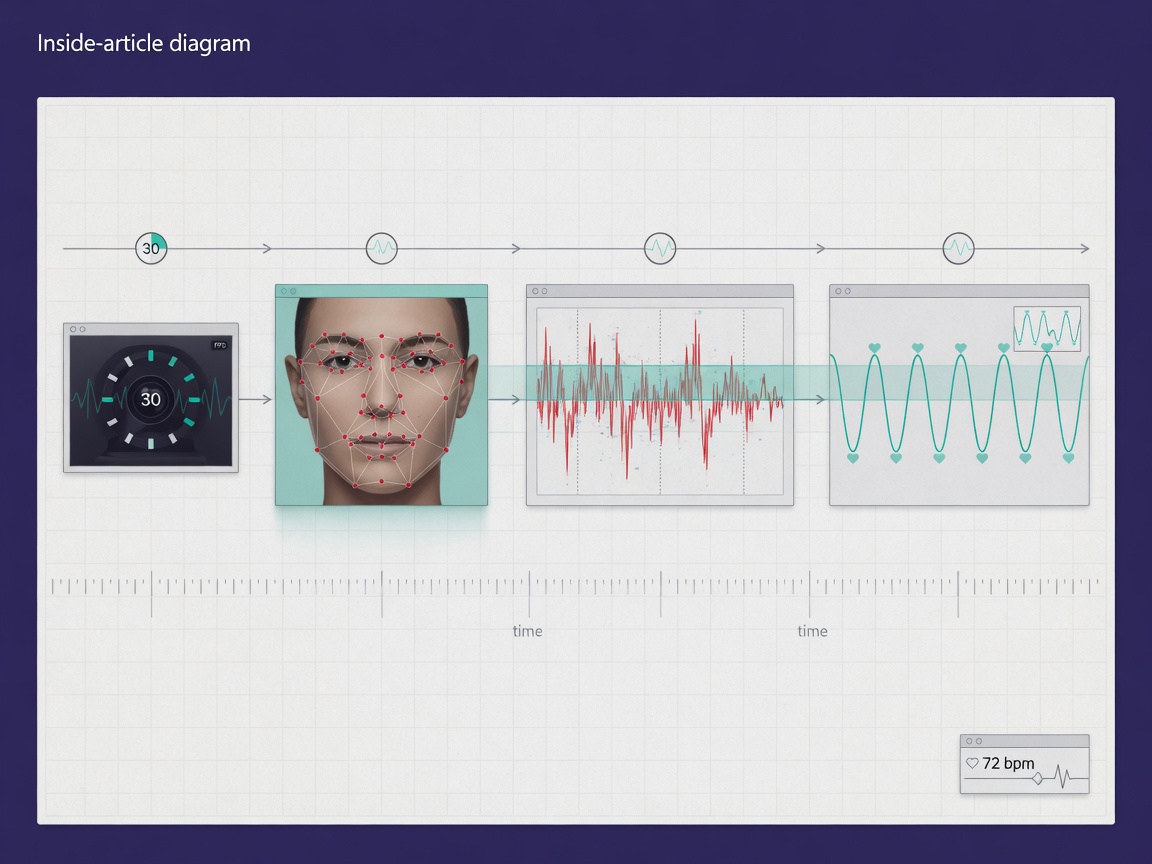
The system follows four steps, and none of them are exotic. First, it identifies the camera's frame rate — say 30 frames per second — which anchors everything else in time. Second, it detects the face using a deep learning method with a 68-face landmark shape predictor, so it knows exactly which pixels belong to facial skin rather than background or hair. Third, a time sliding window (TSW) algorithm de-noises the signal by smoothing out noise across rolling windows of frames. Fourth, it computes heart rate based on the periodicity of that cleaned-up signal.
If you've worked with video-based physiological measurement before, this will sound familiar: the core idea is that subtle changes in facial appearance track blood flow, and if you sample those changes over time you can recover a pulse. The interesting engineering here isn't any single step — it's making the whole chain hold together in real-life environments with ordinary hardware like an embedded laptop camera, rather than controlled lab lighting and a research-grade sensor.
Worth a look
Phugialy Picks

AI Engineering: Building Applications with Foundation Models
A practical guide to building real-world applications with foundation models and LLMs.

GMKtec K15 AI Mini PC Oculink Intel Ultra 5 125U 32GB DDR5 512GB SSD | Desktop Computer AI Boost, 3X M.2 2280 Storage Expansion, Dual NIC...

AI: Understand the Revolution: From Basics and Buzzwords to Tech Giants, Governments, and Your Future
Some Phugialy Picks use affiliate links. If you buy through one, Phugialy may earn a commission. It doesn't change what we recommend. Full disclosure →
What The Validation Does And Doesn't Show
The researchers tested their prototypes against an Apple Watch, comparing the difference range and the mean of the difference between measurements taken from the same person at the same time. That's a reasonable sanity check: wearables are imperfect reference devices themselves, but for a consumer-oriented system they're arguably the right benchmark, since "as good as your watch" is the practical bar people will apply.
Here's what I'd want to know before trusting this outside a demo: how many people were in that comparison, under what lighting conditions, with what skin tones and motion levels? None of that detail is spelled out in what we have. Remote photoplethysmography-style systems have a long history of working well on still subjects in even lighting and degrading badly once someone moves around or sits near a window. The authors state they'll perform further tuning and optimization of these methods in the future — which is their own signal that this is early-stage work, not a validated product.
That matters because non-contact measurement has one huge potential advantage over contact devices: elderly people who won't reliably wear or charge a watch could still get monitored passively by whatever camera is already in their room. Real-time health monitoring for older adults is one of the clearest use cases for this kind of system — but it's also exactly the population where lighting varies wildly between homes and where validation gaps hurt most.
Where This Actually Lands
The real story here isn't "cameras can replace wearables." It's more specific: continuous health monitoring may not need dedicated hardware at all if software on commodity cameras gets good enough. The researchers frame their end goal as deploying this as a personal AI agent for health monitoring — passive observation layered onto devices people already own.
My read is that this is directionally right but chronically undersold on difficulty. The pipeline itself is honest engineering; nothing here overclaims about architecture or method. The gap between "our prototype tracks an Apple Watch" and "this works reliably in my dim living room while I'm watching TV" is where most systems like this die quietly. Contact sensors sidestep lighting variance entirely; video-based measurement never does.
So treat this as worth watching rather than worth adopting today. If follow-up work reports results across varied environments — different rooms, different light levels, moving subjects — that's when non-contact heart rate measurement via image processing stops being a promising prototype and starts being infrastructure.
Got a question about how this applies to you? →
Keep reading
Follow the thread

Evaluating Temporal Preservation in Conversational Image Editing
Most image editing models fail when an object is hidden and then revealed in a conversation. OCCUR-Bench is a new diagnostic tool designed to expose these specific failures in temporal consistency.
Read this noteSame lane, different angle
Polycepta Rethinks Multi-Object Tracking Appearance Modeling
A new tracking framework hits 92.27% MOTA on KITTI while running at 90 Hz - but the claim I'd actually stress-test first isn't the accuracy score.
3D Spatial Reasoning From RGB Alone: SpaR3D-MoE Delivers
Give a multimodal AI model nothing but a few sparse RGB frames, and ask it how far away the table is or which direction to walk — and now imagine it actually answers correctly. That's the promise behind SpaR3D-MoE, a new