3D Spatial Reasoning From RGB Alone: SpaR3D-MoE Delivers
Give a multimodal AI model nothing but a few sparse RGB frames, and ask it how far away the table is or which direction to walk — and now imagine it actually answers correctly. That's the promise behind SpaR3D-MoE, a new
Automation needs a narrow first win
The best first AI workflow is usually a repeated task with a clear input, clear output, and a human approval step.
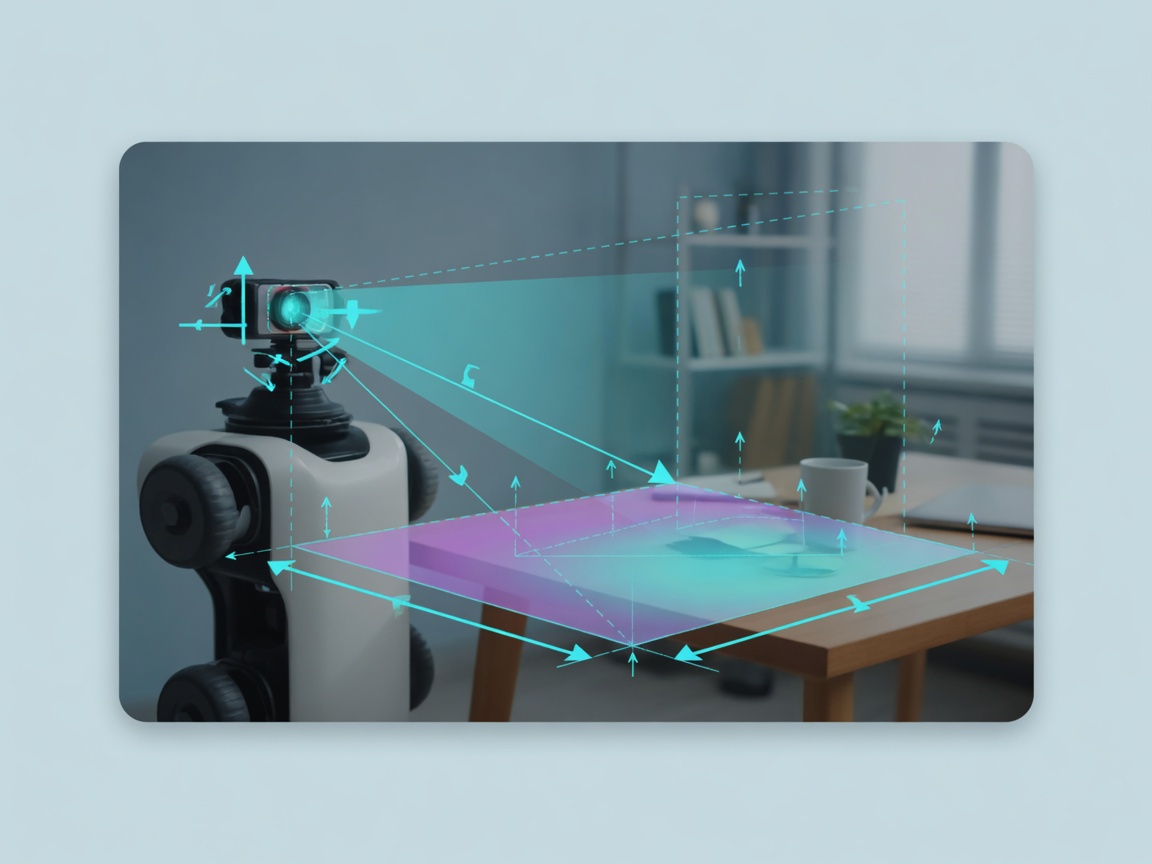
Give a multimodal AI model nothing but a few sparse RGB frames, and ask it how far away the table is or which direction to walk — and now imagine it actually answers correctly. That's the promise behind SpaR3D-MoE, a new end-to-end framework that equips Multimodal Large Language Models (MLLMs) with genuine geometry-aware 3D spatial reasoning, all from sparse RGB inputs alone.
The problem it tackles is one anyone following embodied AI knows well: MLLMs have gotten impressively good at understanding images and video, but they struggle to ground any of that in the physical 3D world. Ask a model to estimate a metric distance or navigate a spatial gap, and the gap between 2D semantic understanding and 3D spatial geometry shows up fast. SpaR3D-MoE is an attempt to close that gap without the usual crutches — no depth sensors, no reconstructed 3D assets, no costly 3D-specific data.
Why 3D Spatial Reasoning Has Been Stuck in a Trade-Off
Until now, researchers trying to give MLLMs 3D awareness have split into two camps, and each pays a price. The first paradigm explicitly injects 3D structures — point clouds, depth maps, reconstructed meshes — into the language model. That helps with physical grounding, but it's fundamentally constrained by the rigid need to acquire explicit 3D geometric proxies. Depth sensors and reconstructed assets don't scale to RGB-only scenarios, and the intrinsic sparsity of point clouds often strips away rich visual detail, compromising fine-grained semantic understanding.
The second paradigm sticks to RGB sequences alone, which is far more scalable — but current RGB-based methods lean on heuristic sampling and static, monolithic fusion. Rigid uniform sampling or discrete voxel maximization ignores the intrinsic spatiotemporal manifold of the 3D scene, introducing redundancy. Worse, monolithic fusion indiscriminately projects heterogeneous semantic textures and geometric structures into one shared latent space, inducing cross-modal contention. And standard 2D visual encoders compress spatial details for semantic alignment, which is a recipe for hallucinations on complex spatial tasks.
In other words: the scalable option was shallow, and the deep option didn't scale. SpaR3D-MoE's bet is that you don't have to choose.
Worth a look
Phugialy Picks

AI Engineering: Building Applications with Foundation Models
A practical guide to building real-world applications with foundation models and LLMs.

GMKtec K15 AI Mini PC Oculink Intel Ultra 5 125U 32GB DDR5 512GB SSD | Desktop Computer AI Boost, 3X M.2 2280 Storage Expansion, Dual NIC...

AI: Understand the Revolution: From Basics and Buzzwords to Tech Giants, Governments, and Your Future
Some Phugialy Picks use affiliate links. If you buy through one, Phugialy may earn a commission. It doesn't change what we recommend. Full disclosure →
Two Clever Mechanisms Doing the Heavy Lifting
The framework's first pillar is Adaptive Spatiotemporal Manifold Sampling (ASMS). Instead of heuristically picking frames, ASMS constructs a geometry-aware spatiotemporal graph from viewpoint-dependent geometry and camera ego-motion, regulated by a motion-aware quality gate. The result: it extracts informative keyframes while preserving the scene's topological connectivity — mitigating sequence redundancy without breaking the spatiotemporal threads that make a scene coherent.
The second pillar is where things get genuinely novel. The Heterogeneous Geometry-Inductive Mixture-of-Experts (HGI-MoE) is, per the paper, the first work to bring MoE architectures into 3D spatial reasoning. An Instruction-Pose Aware Router (IPAR) routes multimodal tokens to specialized experts based on linguistic intent and camera ego-motion — meaning the model decides how deeply to fuse visual and geometric information depending on what you actually asked and where the camera was moving. The experts show emergent specialization, performing varying levels of cross-modal fusion to match different spatial reasoning demands, with a load-balancing loss keeping expert assignment from collapsing.
That's the design insight worth pausing on: instead of forcing every token through the same fusion pipeline, the model adapts its fusion depth to the task. Estimating a distance and describing a relative direction are different jobs — and now they can take different computational paths.
What The Numbers Say — And What They Point Toward
The results back the design. SpaR3D-MoE achieves state-of-the-art performance on VSI-Bench, ScanQA, and SQA3D. On VSI-Bench it posts the highest average score of 63.5, outperforming the strongest baseline by 7.8 absolute points. The relative gains are even more striking: 35.4% on Route Plan tasks and 51.4% on Relative Direction tasks — precisely the navigation-adjacent capabilities that matter for embodied agents.
Here's the real story, as I see it: the headline is the benchmark wins, but the quietly bigger implication is the removal of the hardware dependency. If a model can do metric distance estimation and route planning from sparse RGB alone, then every camera-equipped robot, drone, or phone becomes a candidate spatial reasoner — no depth sensor retrofit required. The MoE routing angle matters too: it suggests spatial reasoning doesn't need one monolithic geometric module, but a routing layer that adapts fusion to intent. Give this approach a year, and I'd expect the routing-for-fusion idea to show up well beyond 3D benchmarks, anywhere multimodal models juggle heterogeneous signal types. That's the direction worth watching — not just better scores, but a blueprint for how MLLMs stop describing the world and start moving through it.
Got a question about how this applies to you? →
Keep reading
Follow the thread
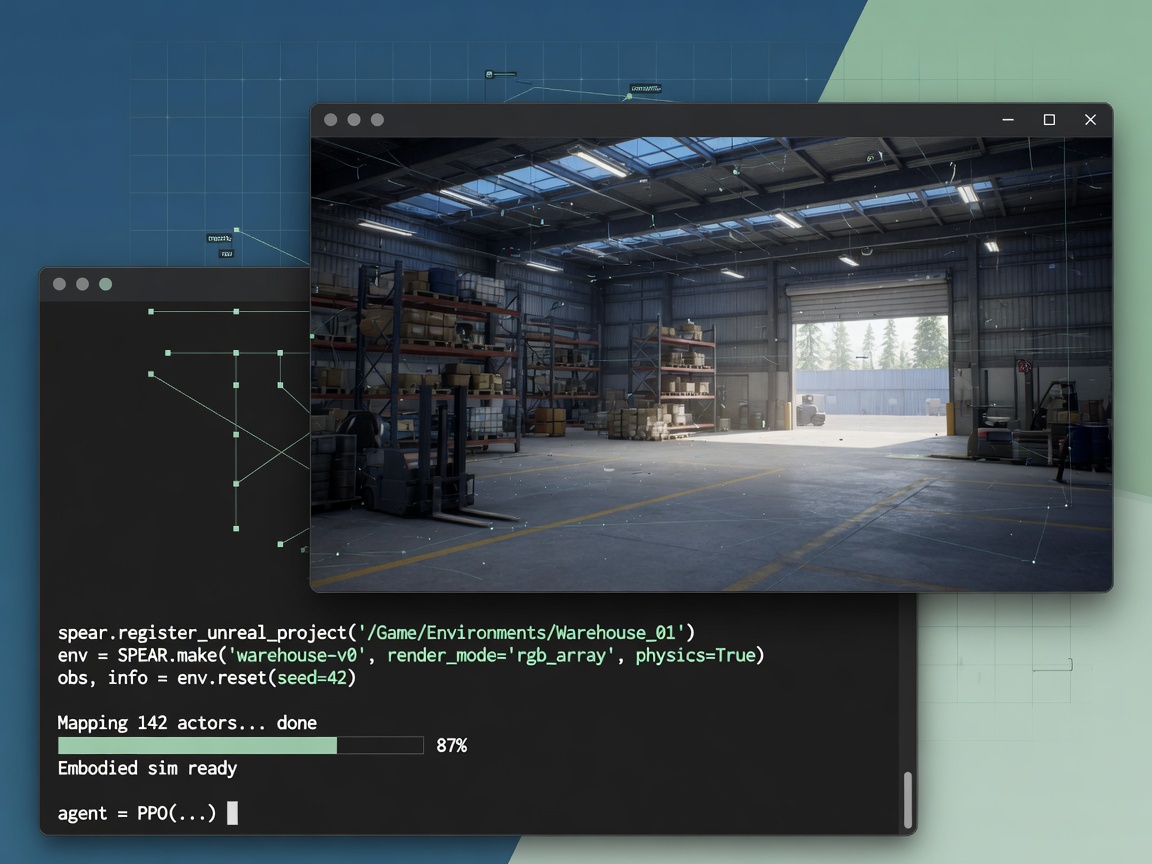
SPEAR Turns Any Unreal Project Into an Embodied AI Simulator
A new open-source library exposes over 14,000 Unreal Engine functions to Python at no wrapper cost — turning any UE project into candidate training infrastructure for embodied AI at 73 fps photorealistic rendering.
Read this noteSame lane, different angle
Evaluating Temporal Preservation in Conversational Image Editing
Most image editing models fail when an object is hidden and then revealed in a conversation. OCCUR-Bench is a new diagnostic tool designed to expose these specific failures in temporal consistency.
Polycepta Rethinks Multi-Object Tracking Appearance Modeling
A new tracking framework hits 92.27% MOTA on KITTI while running at 90 Hz - but the claim I'd actually stress-test first isn't the accuracy score.