Toyota's $6.4B Factory Automation Bet: What It Really Costs
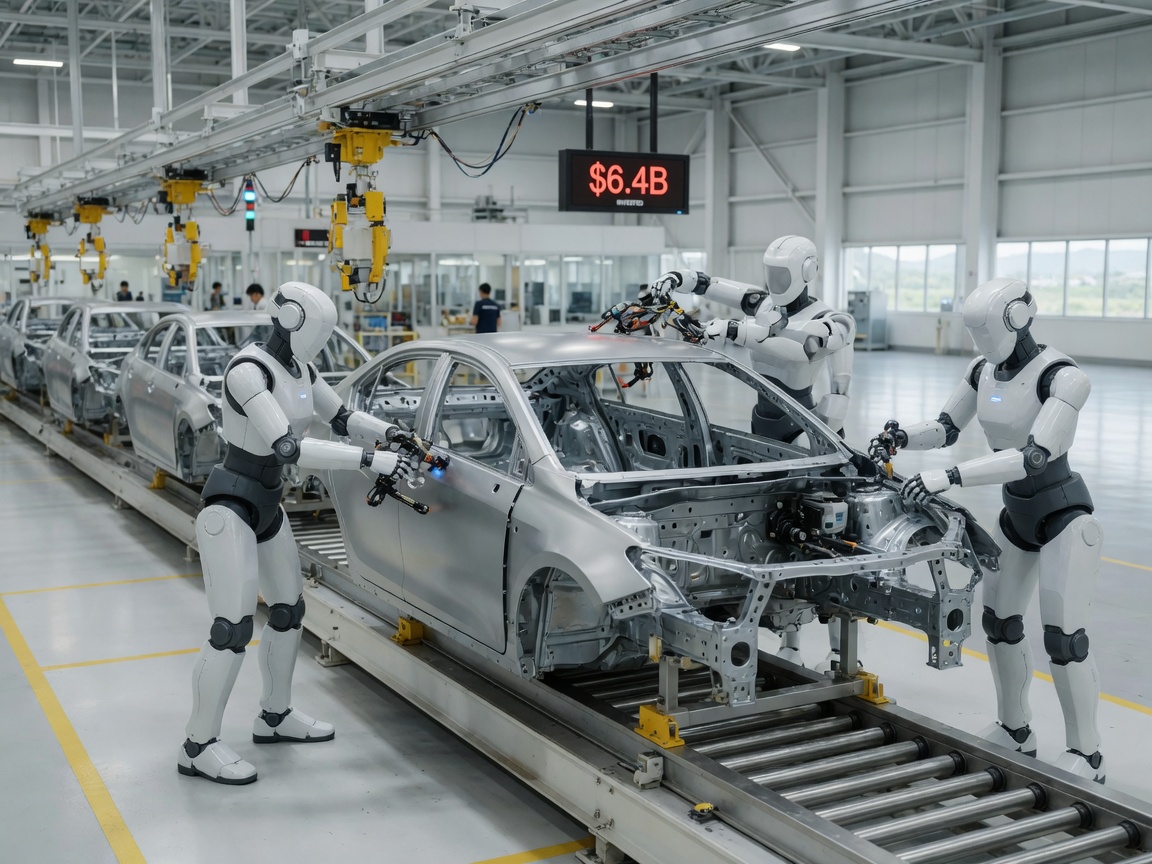
Toyota estimates automating its factories will take around 400,000 robots and $6.4 billion every year from 2028 - roughly an entire year of Japan's national robot deployments for one company. But its piston assembly line already went from three operators to zero since January.
Automation needs a narrow first win
The best first AI workflow is usually a repeated task with a clear input, clear output, and a human approval step.
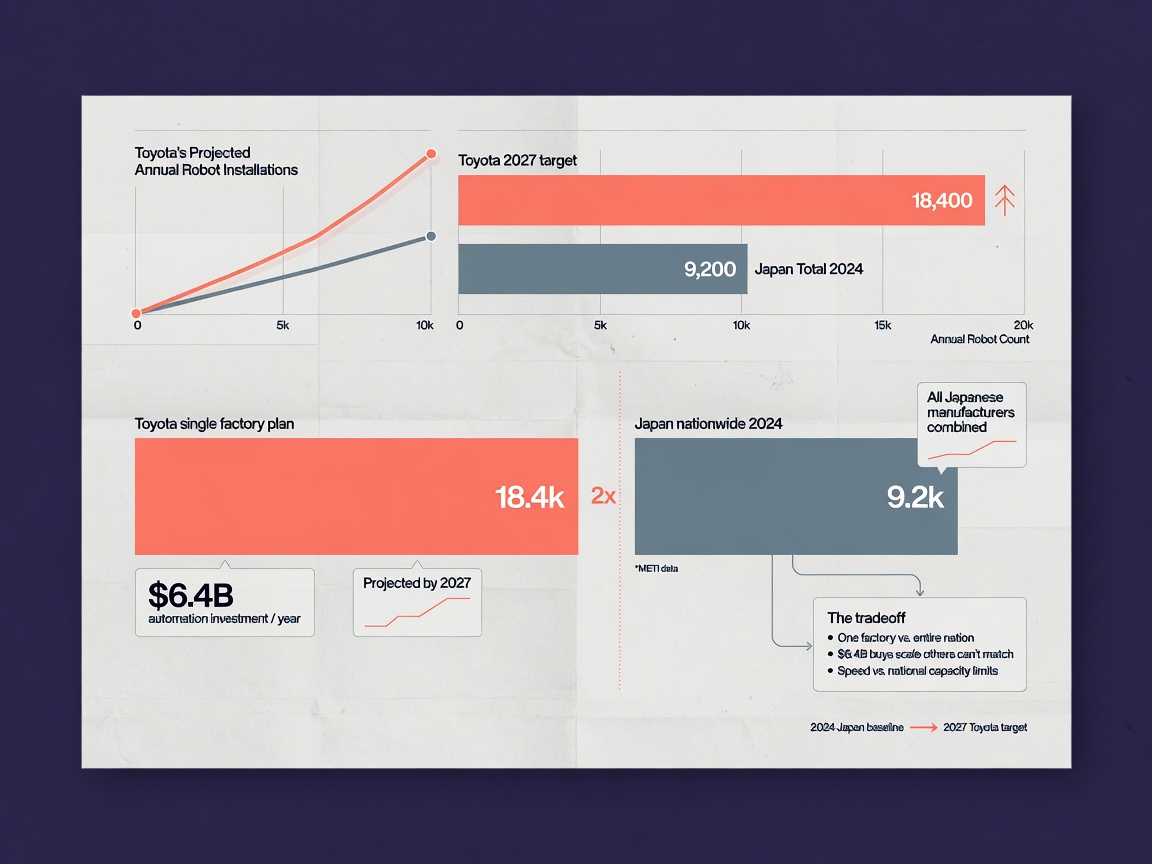
Toyota's own estimate for automating its factories is roughly 400,000 robots and about 1 trillion yen - $6.4 billion - every year from 2028. That number is the clearest signal yet of what full-scale factory automation actually costs at the top end, and it should reset how mid-sized manufacturers think about their own robotics budgets.
What The Numbers Actually Show
Toyota discussed the potential annual investment with investors in September, covering its own factories, group companies, and major suppliers. The scale matters: Japan had around 450,500 robots in operation in 2024 - the world's second-largest market - and roughly 44,500 new installations that year, with the automotive industry accounting for about 13,000 of them, up 11% and the highest since 2020.
So Toyota's plan alone approaches the size of an entire year of national robot deployments. This isn't a pilot program or a press-release concept; it's a company pricing out what it believes full automation requires across a supply chain.
Worth a look
Phugialy Picks

AI Engineering: Building Applications with Foundation Models
A practical guide to building real-world applications with foundation models and LLMs.

GMKtec K15 AI Mini PC Oculink Intel Ultra 5 125U 32GB DDR5 512GB SSD | Desktop Computer AI Boost, 3X M.2 2280 Storage Expansion, Dual NIC...

AI: Understand the Revolution: From Basics and Buzzwords to Tech Giants, Governments, and Your Future
Some Phugialy Picks use affiliate links. If you buy through one, Phugialy may earn a commission. It doesn't change what we recommend. Full disclosure →
What Toyota Is Actually Building
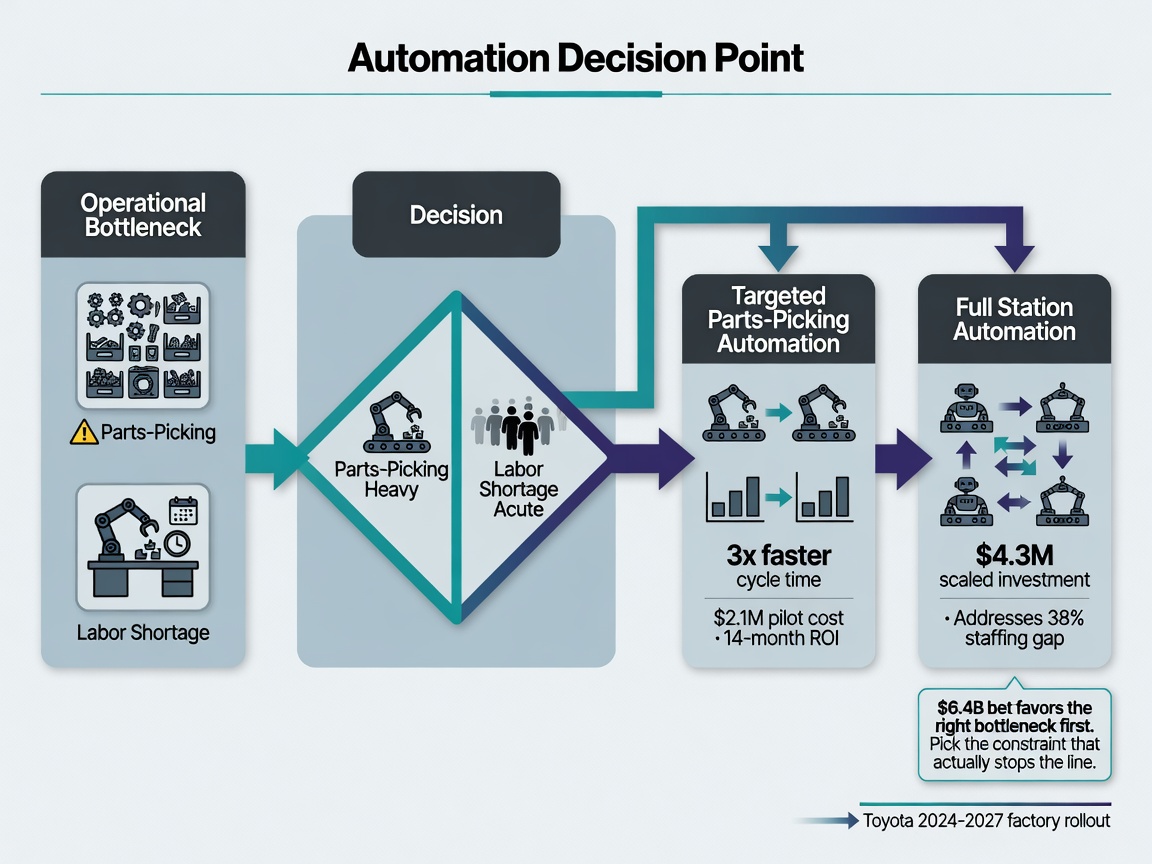
The hardware is more specific than headlines suggest. The KumiPro parts-picking robot uses cameras to handle loosely positioned components and already operates at Toyota Motor East Japan - the kind of unstructured picking task that used to resist automation. The ELEY robot uses two human-like arms on an omnidirectional mobile base for tasks involving physical contact.
On the software side, Toyota's Frontier Research Center is addressing labour shortages through robotics, using reinforcement learning with thousands of parallel simulated robot instances to narrow the Sim2Real gap - training in simulation faster than physics allows, then transferring to real hardware. Separately, Toyota Research Institute is partnering with Boston Dynamics on AI control systems for the Atlas humanoid robot, which they demonstrated completing tasks with a single Large Behavior Model. Hyundai plans to deploy Atlas at its Metaplant in Savannah, Georgia from 2028.
The Proof Point That Matters Most
The most quietly significant detail: Toyota's Kamigo Plant moved its piston assembly line from three operators to full automation since January 2025. That's a real line, running today, not a demo.
What This Means For Your Budget
Here's my read: the headline number will get quoted as evidence that automation is only for giants with $6.4 billion a year to spend. I think that misses what Toyota is actually demonstrating - that the expensive part isn't any single robot, it's building the simulation infrastructure and AI control systems that make each deployment repeatable across hundreds of sites and suppliers.
For a mid-sized manufacturer watching this from outside, the honest math is different from Toyota's but not unrelated. You don't need 400,000 robots or humanoids; you need to identify whether your bottleneck is a parts-picking problem like KumiPro solves or a labour-shortage problem like ELEY targets - because those are becoming purchasable products rather than research projects. The realistic adoption condition: this becomes worth piloting once your labour shortage is chronic enough that overtime costs exceed integration costs on one specific line - not before.
The companies that should worry aren't carmakers; they're tier-two suppliers who'll face automation expectations from customers like Toyota flowing down through procurement requirements they didn't budget for.
Got a question about how this applies to you? →
"The Physicality Pivot: Why AI’s Next Frontier is Hardware, Not Just Hype" covers why AI investment is shifting toward physical systems like these.
Keep reading
Follow the thread
Responsible Industrial AI: Where Human Oversight Actually Ends
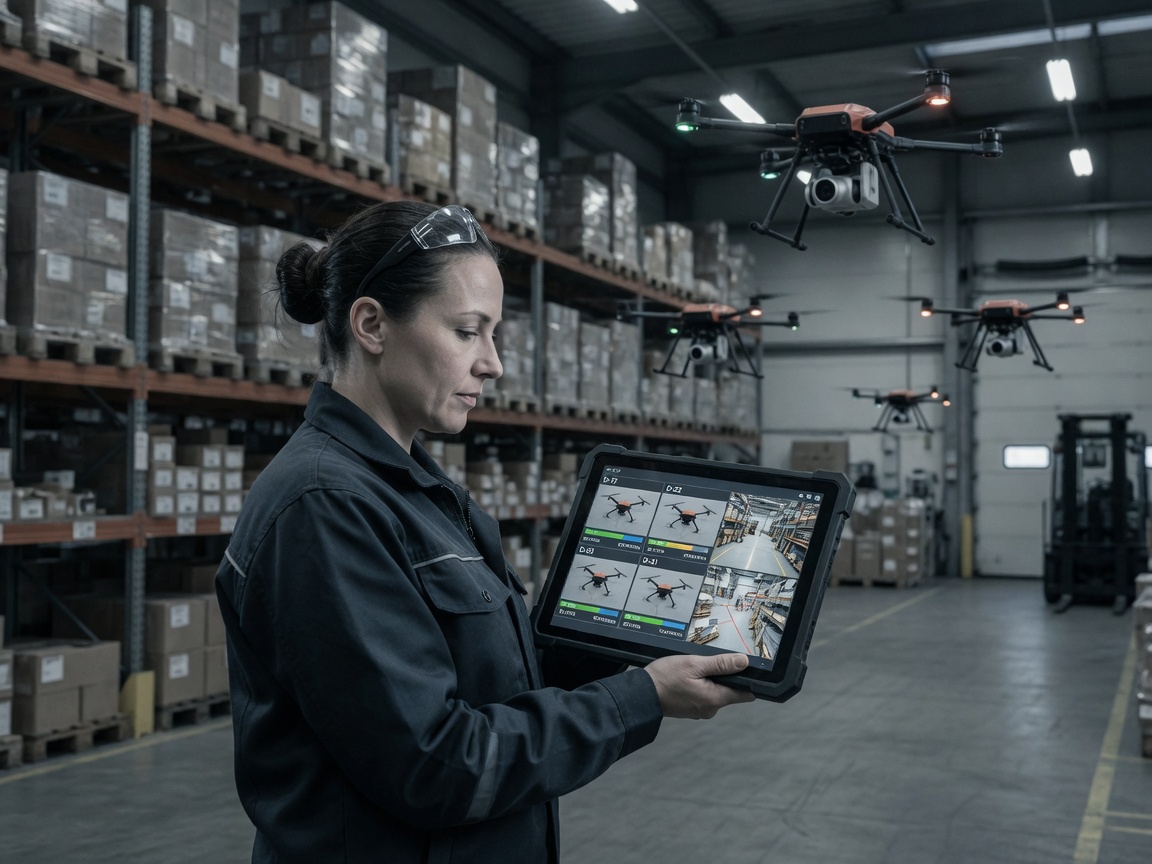
AVEVA says AI should augment rather than replace people in critical decision loops - while predicting autonomous robots and drones across plants and mining sites. Both can only be true if someone quietly reclassifies which decisions count as critical.
Read this noteSame lane, different angle
AI Incident Response Works — So Why Are Engineers Losing the Skill?
AI incident response is getting good enough to handle the routine cases on its own — and that's precisely what makes it a problem. A recent article on the rise of 'AI SREs' makes an argument that deserves more attention
Triage as a Filter: New Orleans’ Move to AI-Managed 911 Routing
New Orleans is moving past the 'cool demo' phase of municipal AI by deploying Carbyne’s AI Emergency Call Triage to manage 911 call volumes. The system is designed to solve a high-frequency, high-friction problem: the "e