Multimodal Federated Learning Just Got Better at Missing Data
Hospitals could train shared diagnostic models without patient data ever leaving their walls — even when one site's imaging setup can't capture everything. A new framework called ProMoE-FL synthesizes the missing pieces on the fly.

Automation needs a narrow first win
The best first AI workflow is usually a repeated task with a clear input, clear output, and a human approval step.
Hospitals could train a shared diagnostic model without any patient data ever leaving their walls — and now, even when one hospital's imaging equipment can't capture everything the model needs, the missing pieces can be synthesized on the fly. That's the promise of multimodal federated learning, and a new framework called ProMoE-FL is making it genuinely robust to one of its messiest real-world problems: missing modalities.
Why Missing Modalities Break Federated Learning
Federated learning lets institutions collaborate on a model without sharing raw data, which is exactly what healthcare needs. But multimodal systems — models that combine X-rays with clinical text, for example — hit a wall: not every client has every modality. One hospital's records are complete; another's are missing key features entirely. In practice, that heterogeneity degrades performance for everyone.
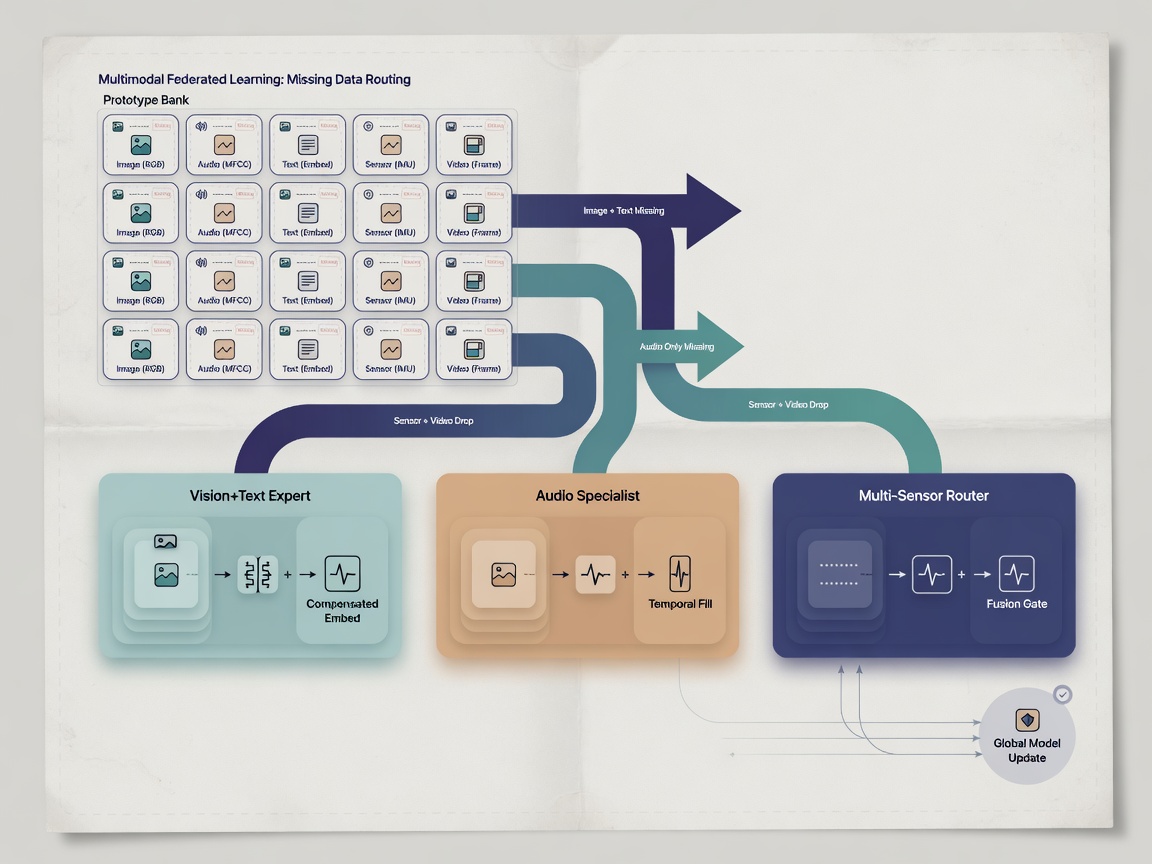
ProMoE-FL tackles this with missing-modality feature synthesis — dynamically generating the features a client can't provide. Instead of dropping incomplete samples or letting gaps poison the shared model, it fills them in intelligently.
Phugialy Picks

Screen Mom Screen Cleaner Spray (16oz)
We'd buy this if: You've been wiping your monitor with your shirt sleeve.
We'd skip this if: You already have a cleaning routine sorted.
Anker USB-C to USB-C 60W Fast Charging Cable (2-Pack)
We'd buy this if: You need a reliable spare charging cable that won't fray in a month.
We'd skip this if: You already have enough cables lying around.
Stanley Quencher H2.0 Tumbler 30oz
We'd buy this if: You want a large, well-reviewed insulated tumbler and don't mind it having nothing to do with AI.
We'd skip this if: You'd rather every Pick on this site stay strictly on-topic.
Some Phugialy Picks use affiliate links. If you buy through one, Phugialy may earn a commission. It doesn't change what we recommend. Full disclosure →
A Prototype Bank and Direction-Aware Experts
The mechanism is where it gets interesting. The framework builds a global client-aware prototype bank — essentially a shared library of modality priors that captures clinically meaningful patterns across participating institutions. Then it uses a Mixture-of-Experts architecture conditioned on those prototypes and modality indices, with direction-aware expert routing deciding which experts handle which synthesis task.
In plain terms: the system learns what different kinds of clinical data tend to look like across the whole network, then routes each missing-feature problem to specialists suited to reconstructing it.
What the Evaluations Actually Show
The researchers behind this evaluated ProMoE-FL on four public chest X-ray datasets: MIMIC-CXR, NIH Open-I, PadChest, and CheXpert. Across all four, it consistently outperformed state-of-the-art methods — in both homogeneous settings, where clients look alike, and heterogeneous ones, where they don't.
That consistency matters more than any single benchmark win. Heterogeneity is the scenario real deployments actually face; labs are rarely uniform.
The Quietly Bigger Thing This Unlocks
Here's what I find genuinely exciting — and this is my read, not a claim from the paper itself. The headline feature is missing-modality synthesis, but the downstream implication is bigger: smaller clinics with thinner data infrastructure can participate in collaborative medical AI as full partners rather than second-class clients. A rural hospital that can't afford every imaging modality stops being excluded from the network's collective intelligence.
That reframes federated learning's equity problem as partly an engineering problem — solvable with better synthesis rather than expensive equipment upgrades everywhere. And because it was validated across four independent public datasets spanning different populations, there's real evidence this isn't just an elegant idea that collapses outside one benchmark.
Give this line of work a couple of years, and I suspect participation breadth — not model size — becomes one of the differentiators for federated medical AI systems. The networks that can gracefully absorb imperfect, incomplete contributors are the ones that actually get deployed.
Got a question about how this applies to you? →
Keep reading
Follow the thread
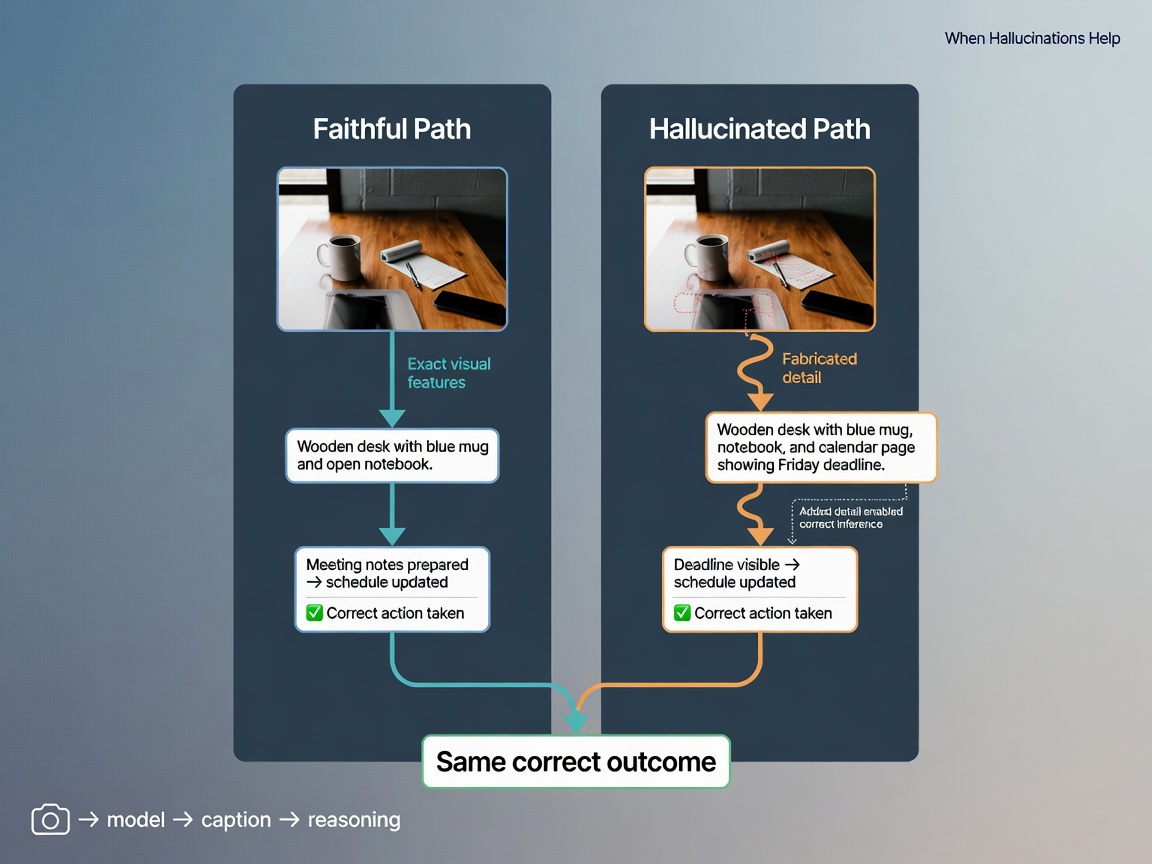
When Hallucinations Help: Rethinking Vision Model Accuracy
Hallucinated captions made vision language models *more* accurate across nine tasks in a new evaluation study - and the practical question isn't whether that's weird, it's whether you can trust any multimodal output you'
Read this noteSame lane, different angle
AnchorPrune: Training-Free Token Pruning That Almost Holds Up
A training-free framework called AnchorPrune keeps 97.6% of full-token performance in a vision-language model using only 160 of 2,880 visual tokens - no retraining required. The interesting part isn't the compression ratio; it's what gets protected first.
China's AI Companion Rules: Why Doubao and Qwen Shut Down
When China's AI companion rules took effect July 15, ByteDance's Doubao and Alibaba's Qwen didn't comply - they shut their agent features down entirely. The reason why says more about companion AI than any clause in the regulation.