Mamba-Based Deep Clustering for Time Series: Real or Hype?
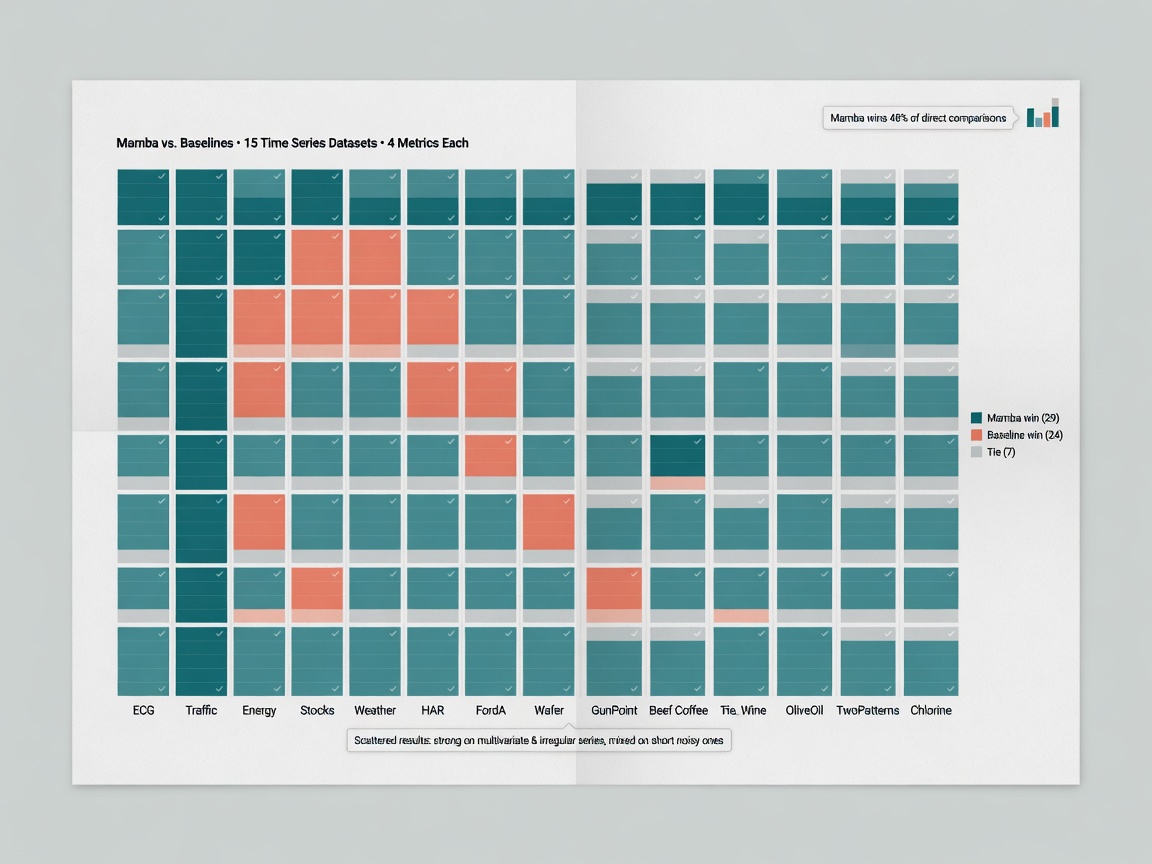
A new Mamba-based framework claims linear-complexity deep clustering for time series, winning 29 of 60 metric evaluations across 15 benchmarks. The architecture is genuinely well-aimed at the unlabeled-data problem — but benchmark wins aren't production evidence.

Automation needs a narrow first win
The best first AI workflow is usually a repeated task with a clear input, clear output, and a human approval step.
FMMVCC is a new Mamba-based deep clustering framework for time series, and its headline claim is efficiency: it uses state space sequence modeling to learn temporal representations with linear complexity, then beats state-of-the-art baselines on most of the benchmark evaluations it ran. The paper reports evaluation across 15 benchmark datasets, with FMMVCC achieving the best overall performance in 29 of 60 metric evaluations and the highest average rank in all tested scenarios.
What the Numbers Actually Show
The evaluation design is broader than most clustering papers bother with — 15 datasets and 60 metric evaluations is a real spread, not a cherry-picked trio. But "best overall performance in 29 of 60" deserves a careful read: that's under half of the individual metric evaluations. The researchers frame it as best overall performance plus the highest average rank everywhere tested, which is a more defensible claim than winning every cell — consistency across datasets matters more than dominating any single benchmark.
What I can't tell from the summary is which metrics those 29 wins came from, or how the losses distributed. Clustering quality metrics can disagree with each other in ways that matter a lot in practice — a method that wins on one internal coherence measure can lose on another that better matches what you actually care about downstream. The aggregate rank smooths that over; your specific use case might not.
Phugialy Picks

Anker USB-C to USB-C 60W Fast Charging Cable (2-Pack)
We'd buy this if: You need a reliable spare charging cable that won't fray in a month.
We'd skip this if: You already have enough cables lying around.
Stanley Quencher H2.0 Tumbler 30oz
We'd buy this if: You want a large, well-reviewed insulated tumbler and don't mind it having nothing to do with AI.
We'd skip this if: You'd rather every Pick on this site stay strictly on-topic.
livho Blue Light Blocking Computer Glasses
We'd buy this if: You spend most of your day staring at a screen and haven't tried blue light glasses yet.
We'd skip this if: You already wear prescription glasses with a blue light coating, or don't notice eye strain.
Some Phugialy Picks use affiliate links. If you buy through one, Phugialy may earn a commission. It doesn't change what we recommend. Full disclosure →
Why Linear Complexity Is the Part That Matters
The genuinely interesting technical move here is architectural. Time series clustering has historically been squeezed between two bad options: transformer-style attention that captures long-range temporal structure but scales quadratically, and cheaper recurrent approaches that lose signal over long horizons. Mamba's state space modeling offers linear complexity while still, in principle, holding temporal context — which is exactly what you want when you're learning representations from raw, unlabeled sequences rather than short annotated windows.
The framework pairs this with multi-view self-supervised learning, using temporal masking and augmentations to pull structure out of data with limited or no annotations. That combination — linear-cost sequence modeling plus self-supervised multi-view training — is aimed squarely at the real bottleneck in industrial time series work: you almost never have labels, and your sequences are long.
What I'd Want Tested Before Trusting It
Here's the part worth being skeptical of. Benchmark datasets are clean by construction; production time series are not. Nothing in the material speaks to how FMMVCC handles irregular sampling, missing values, drift, or streaming data — all of which break representation-learning pipelines that look great on curated benchmarks. Linear complexity also describes training-time scaling, not deployment cost; a state space model still carries state you have to manage.
My read — and this is interpretation, not something the paper claims — is that this matters less as an immediately deployable system and more as evidence that Mamba-style architectures are eating into territory transformers held by default. The same pattern showed up in genomics with Evo 2 applying sequence modeling at scale to biological sequences: when linear-complexity sequence models prove out on one domain, adjacent domains get tried quickly. Time series clustering was an obvious next candidate.
If you work with unlabeled time series, this is worth tracking but not rearchitecting around yet. Wait for someone to reproduce these results outside the paper's own benchmark suite — ideally on messy real-world data — before betting a pipeline on it.
Got a question about how this applies to you? →
Keep reading
Follow the thread

Multimodal Federated Learning Just Got Better at Missing Data
Hospitals could train shared diagnostic models without patient data ever leaving their walls — even when one site's imaging setup can't capture everything. A new framework called ProMoE-FL synthesizes the missing pieces on the fly.
Read this noteSame lane, different angle
AnchorPrune: Training-Free Token Pruning That Almost Holds Up
A training-free framework called AnchorPrune keeps 97.6% of full-token performance in a vision-language model using only 160 of 2,880 visual tokens - no retraining required. The interesting part isn't the compression ratio; it's what gets protected first.
When Hallucinations Help: Rethinking Vision Model Accuracy
Hallucinated captions made vision language models *more* accurate across nine tasks in a new evaluation study - and the practical question isn't whether that's weird, it's whether you can trust any multimodal output you'