AnchorPrune: Training-Free Token Pruning That Almost Holds Up
A training-free framework called AnchorPrune keeps 97.6% of full-token performance in a vision-language model using only 160 of 2,880 visual tokens - no retraining required. The interesting part isn't the compression ratio; it's what gets protected first.

Automation needs a narrow first win
The best first AI workflow is usually a repeated task with a clear input, clear output, and a human approval step.
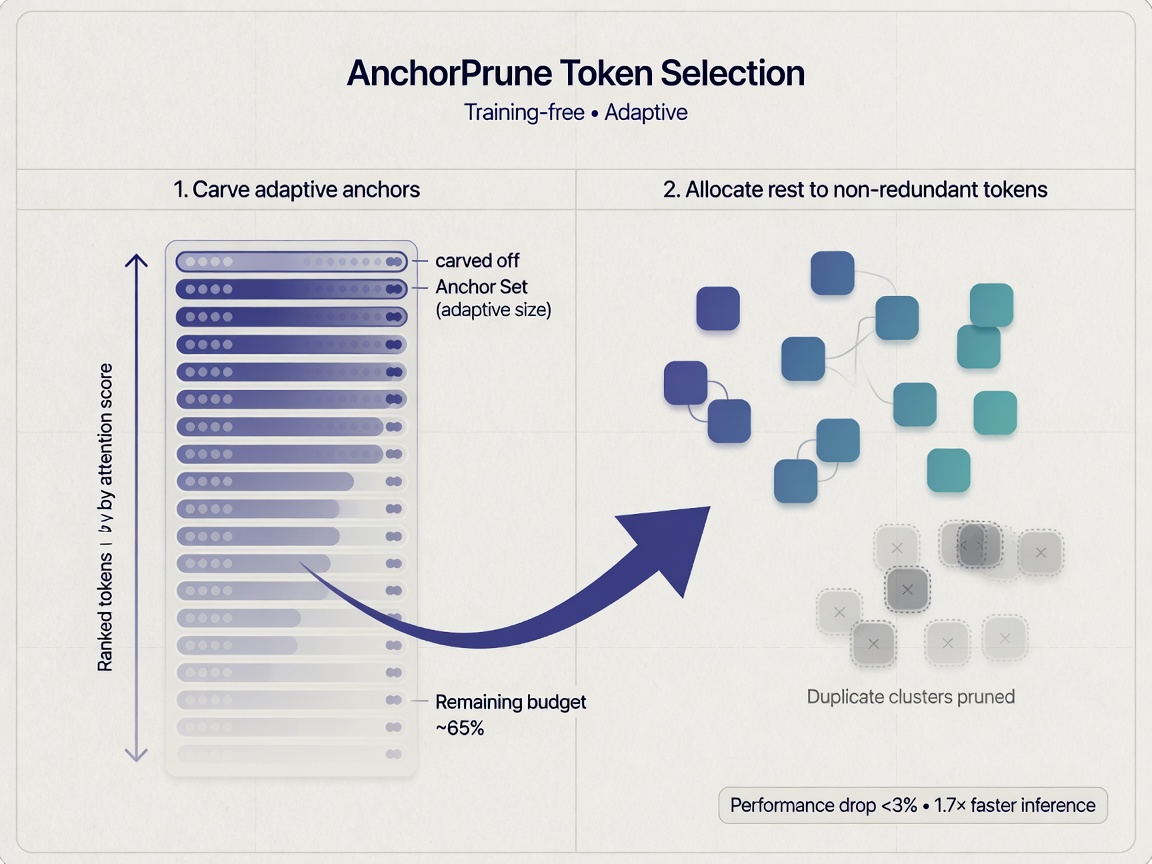
AnchorPrune gets 97.6% of full-token performance from a vision-language model using just 160 of 2,880 visual tokens - no retraining, no architecture changes. That's the headline number from a new training-free framework for efficient multimodal inference, and it's a strong one. But the number alone isn't the interesting part; what the method does with its token budget is.
How The Anchor Actually Works
Most visual token pruning approaches rank tokens by relevance to the query and keep the top ones. AnchorPrune starts from a similar place but treats it differently: it builds a protected relevance anchor - tokens that are indispensable query cues - and then deliberately expands around that anchor with complementary visual context. The protected set can't be displaced by the expansion, which is what the source describes as preventing contextual expansion from crowding out the cues that actually answer the question.
Two design choices stand out as practical rather than clever-for-the-paper's-sake. First, anchor size is set adaptively from the novelty profile of relevance-ranked tokens, so it isn't a fixed hyperparameter you'd have to retune per model or task. Second, the remaining token budget is allocated through importance-weighted novelty - meaning it goes toward informative, non-redundant context rather than just more high-scoring near-duplicates. Anyone who has looked at what vision-language models actually attend to knows redundancy is most of what's in there; recovering non-redundant context is where real information lives.
Phugialy Picks

INIU 10000mAh 45W Fast Charging Portable Power Bank
We'd buy this if: You've been caught with a dead phone/laptop away from an outlet more than once.
We'd skip this if: You're always near a charger anyway.
OMOTON C2 Adjustable Aluminum Phone Stand
We'd buy this if: You want your phone upright on your desk for calls/notifications without a cable getting in the way.
We'd skip this if: You never keep your phone on your desk.
Screen Mom Screen Cleaner Spray (16oz)
We'd buy this if: You've been wiping your monitor with your shirt sleeve.
We'd skip this if: You already have a cleaning routine sorted.
Some Phugialy Picks use affiliate links. If you buy through one, Phugialy may earn a commission. It doesn't change what we recommend. Full disclosure →
What The Benchmarks Cover And What They Don't
The framework was evaluated on image and video benchmarks across models including LLaVA-NeXT-7B, and consistently improves the accuracy-efficiency trade-off over training-free baselines under severe compression. That last qualifier matters - "under severe compression" is exactly where most pruning methods fall apart, so testing there rather than at gentle 20% reductions is a point in this paper's favor.
What we don't see in the source material: latency or wall-clock numbers beyond token counts, behavior on tasks outside image/video benchmarks (document understanding, fine-grained OCR-style work where dropped tokens are disproportionately costly), or how sensitive results are to the novelty-profile estimation itself. Those are standard gaps for an arXiv-stage framework and not reasons to dismiss anything - but they're where production surprises usually hide.
From Trick To Principle
The authors' own claim is that these results establish "relevance-anchored contextual expansion" as an effective principle for efficient multimodal inference - not just a technique tuned to one benchmark suite. That framing holds up better than most paper-level claims do, because cross-benchmark image and video results under aggressive budgets are precisely what separates a generalizable design rule from an overfitted trick.
The real story here, in my view: training-free methods like this matter because they're deployable today on models you already run. AnchorPrune requires neither retraining nor model modification and is architecture-aware - meaning you can drop it onto an existing LLaVA-class deployment without touching weights or serving infrastructure. The gap between "97.6% of performance at 5.5% of tokens" on paper and that same figure inside your actual pipeline is where skepticism belongs; long-tail queries with unusual visual demands are where any relevance-ranked pruning will shed its least-attended-to tokens first, and those are exactly the cases nobody notices until users complain.
Still, if even half this trade-off holds in practice, running full-token inference on vision-language models starts looking like paying full price for context you didn't need.
Got a question about how this applies to you? →
For why anchor-based approaches matter at high resolution specifically, see "Why AnchorPrune Matters for High-Resolution Multimodal Inference."
Keep reading
Follow the thread
When Hallucinations Help: Rethinking Vision Model Accuracy
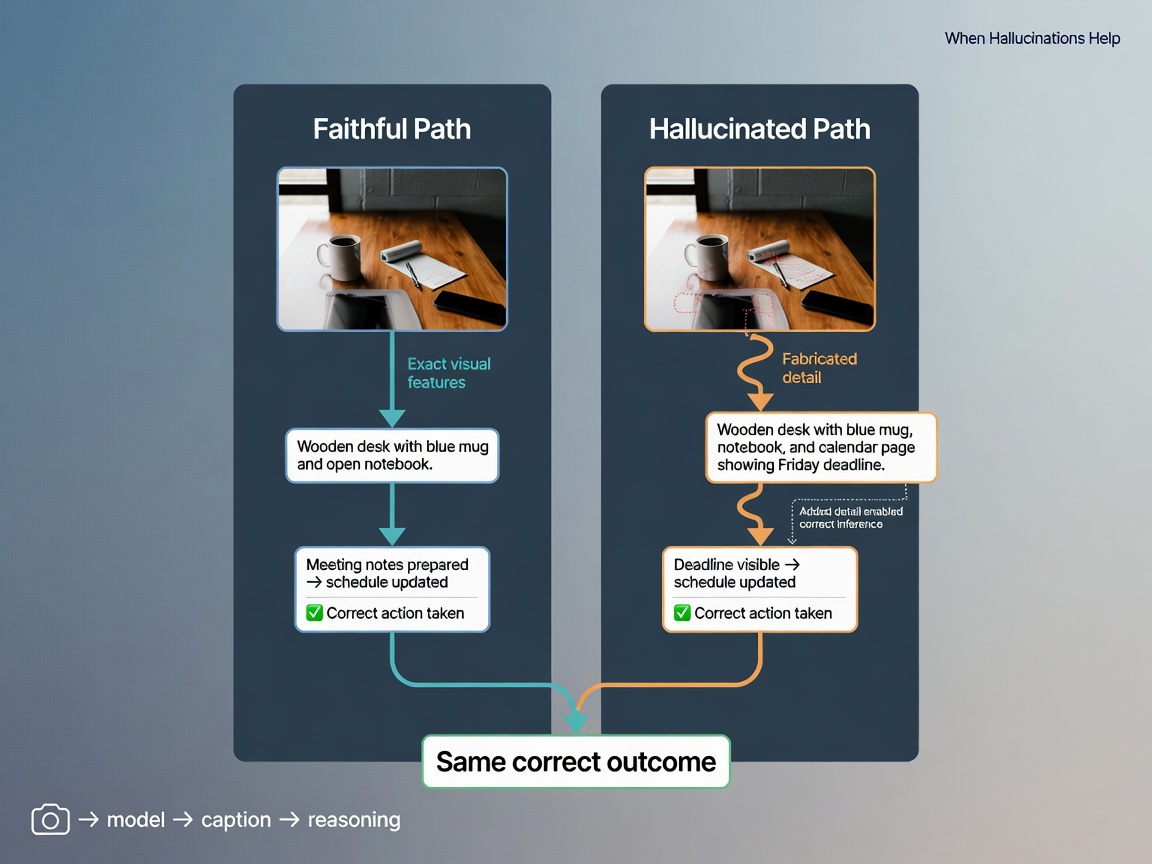
Hallucinated captions made vision language models *more* accurate across nine tasks in a new evaluation study - and the practical question isn't whether that's weird, it's whether you can trust any multimodal output you'
Read this noteSame lane, different angle
China's AI Companion Rules: Why Doubao and Qwen Shut Down
When China's AI companion rules took effect July 15, ByteDance's Doubao and Alibaba's Qwen didn't comply - they shut their agent features down entirely. The reason why says more about companion AI than any clause in the regulation.
VERA-MH Benchmark: Validating AI Chatbot Safety Testing
An automated benchmark for AI chatbot safety in mental health sounds like exactly what the field needs — but a benchmark is only as good as the domain it covers, and this one covers one narrow slice of it. The VERA-MH be