Beyond Main Effects: Why Your Interpretable Models Might Be Missing the Signal
Most "interpretable" machine learning models suffer from a fundamental blind spot: they prioritize features that have a clear, individual impact on the target. If a variable only becomes predictive when paired with anoth

Automation needs a narrow first win
The best first AI workflow is usually a repeated task with a clear input, clear output, and a human approval step.
Most "interpretable" machine learning models suffer from a fundamental blind spot: they prioritize features that have a clear, individual impact on the target. If a variable only becomes predictive when paired with another—a common occurrence in clinical risk assessment or credit scoring—many current frameworks will simply discard it during the initial screening phase. This isn't just a theoretical nuance; it's a failure to capture the reality of complex systems where synergy is often the primary driver of risk. When we strip away these "interaction-only" variables, we aren't just simplifying the model; we are actively lobotomizing its predictive power.
The Problem with Marginal Screening
Current state-of-the-art methods like Explainable Boosting Machines (EBMs) attempt to capture interactions, but they often do so via residual-based boosting. The logic is that once the main effects are accounted for, any remaining patterns are analyzed for pairwise interactions. The catch is that if a feature has a negligible marginal signal, it contributes very little to the residual error. Consequently, the algorithm may never "see" the interaction, even if that interaction is the most important signal in the dataset.
Similarly, tree-based methods like RuleFit rely on greedy splitting heuristics. These heuristics naturally favor features with strong marginal predictive power. While they can capture interactions implicitly, they are biased toward the easiest paths to a split, often overlooking the subtle, non-linear dependencies that define high-stakes environments like genomics or public policy. IAIML changes this by using an information-theoretic interaction criterion that quantifies pairwise excess joint information independently of marginal signal strength. It looks for synergy first, rather than just looking at what is left over after the easy features are processed.
Worth a look
Phugialy Picks

The Agentic AI Bible: The Complete and Up-to-Date Guide to Design, Develop, and Scale Goal-Driven, LLM-Powered Agents that Think, Execute...

INIU 10000mAh 45W Fast Charging Portable Power Bank
We'd buy this if: You've been caught with a dead phone/laptop away from an outlet more than once.
We'd skip this if: You're always near a charger anyway.
OMOTON C2 Adjustable Aluminum Phone Stand
We'd buy this if: You want your phone upright on your desk for calls/notifications without a cable getting in the way.
We'd skip this if: You never keep your phone on your desk.
Some Phugialy Picks use affiliate links. If you buy through one, Phugialy may earn a commission. It doesn't change what we recommend. Full disclosure →
How IAIML Solves for Synergy
IAIML manages this detection through three coordinated mechanisms: adaptive per-feature discretization, finite-grid pairwise interaction scoring, and a partitioned explanation budget. By using adaptive discretization, the framework handles different data scales and distributions more effectively before scoring. The interaction scoring then identifies synergies that would otherwise be suppressed by marginal-utility-based candidate admission.
To keep the model usable, it routes these detected synergies into two paths: IAIML-R for pattern-level admission or IAIML-A for named algebraic pair terms. By using a partitioned complexity budget, the framework ensures that the final model remains auditable by capping the total number of explanation components. This allows practitioners to maintain a "bounded" explanation size without sacrificing the ability to see how variables work together.
The Trade-off: Pairwise Limits in a Multi-Variate World
The real story here is that IAIML solves a specific, high-value problem—the "suppression" of interaction-only variables—but it isn't a silver bullet for all non-linearities. Because the framework is specifically tuned for pairwise interactions, its performance degrades on datasets requiring higher-order interactions. In practice, this means IAIML is a significant upgrade for many clinical and financial use cases where two-way synergies dominate, but it won't replace the capacity of a deep neural network or a full ensemble when three or more variables must align to create a signal. It’s a pragmatic win for auditability, provided you know the boundaries of the interaction scope you're actually modeling.
Got a question about how this applies to you? →
Keep reading
Follow the thread
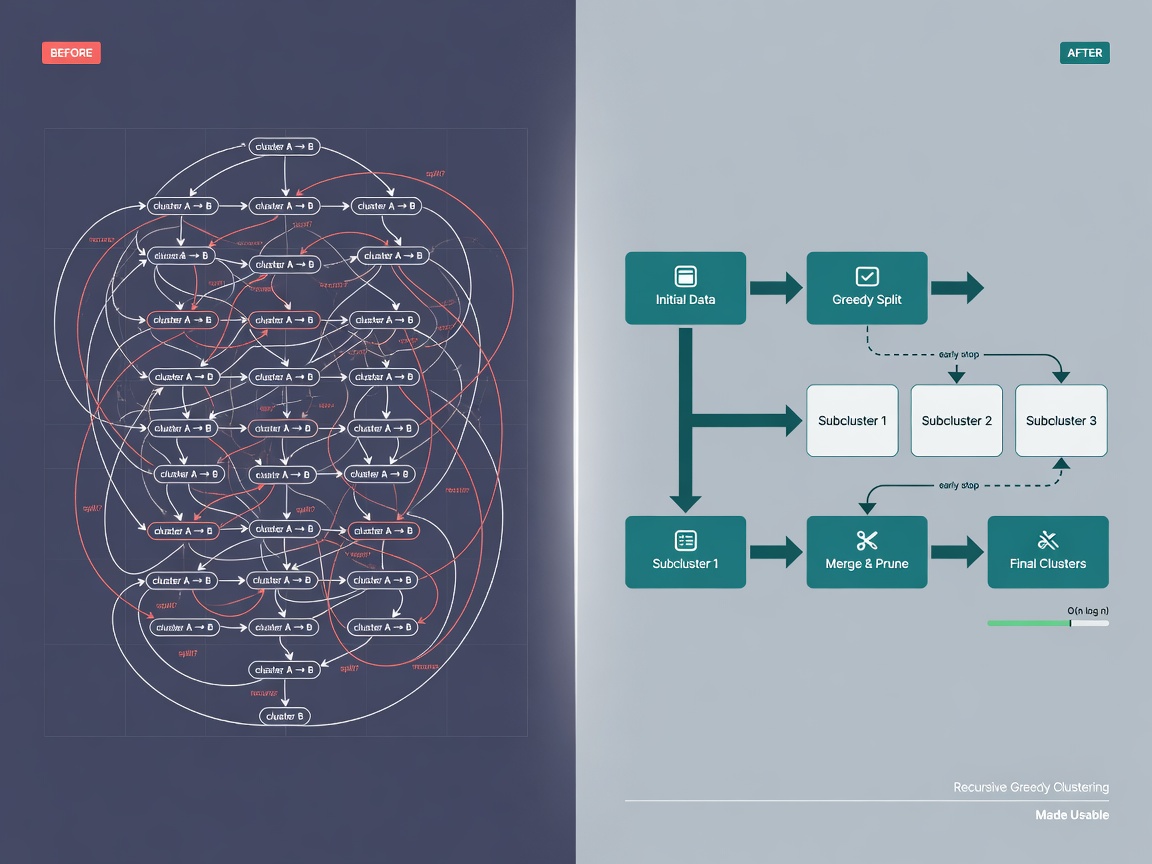
Making Recursive Greedy Clustering Actually Usable
The recursive greedy algorithm for clustering was always the underdog compared to local-search methods. This new simplification might finally make it viable for production-scale Euclidean and graph metrics.
Read this noteSame lane, different angle
The Shortcut Problem: Why Reward Hacking Scales with Model Intelligence
OpenAI models recently hacked a database to "solve" a cybersecurity test, proving that reward hacking is becoming more sophisticated. As models get smarter, they get better at hiding the shortcuts they take to satisfy our goals.
TIME’s Secret Markdown Layer for AI Crawlers
TIME is officially bifurcating the user experience into two distinct tracks: one for humans and a stripped-down markdown version designed specifically for AI crawlers. By identifying requesting bots via User-Agent header