From Exploration to Infrastructure: How Agents Build Their Own Production Code
Stop treating your AI agents like permanent cost centers! Right now, every time an agent handles a recurring IT incident, it re-invokes full LLM inference to figure out the steps again. It’s like hiring a world-class con
Automation needs a narrow first win
The best first AI workflow is usually a repeated task with a clear input, clear output, and a human approval step.
Stop treating your AI agents like permanent cost centers! Right now, every time an agent handles a recurring IT incident, it re-invokes full LLM inference to figure out the steps again. It’s like hiring a world-class consultant to do the same basic task every single morning—it works, but it’s a massive drain on your budget and scalability.
But there’s a shift happening that changes the math entirely. "Progressive crystallization" is a game-changing lifecycle that treats agent exploration as a discovery mechanism rather than a permanent execution model. Instead of letting an agent "think" its way through a problem every single time, this approach systematically converts those successful behaviors into deterministic, zero-token workflows. We’re moving from stochastic LLM-orchestrated execution to pre-coded logic as evidence of success accumulates.
Turning Exploration into Zero-Token Workflows
The magic of this lifecycle lies in its three-tiered playbook system. It starts with Type 3 playbooks, where the agent has the freedom to investigate within a bounded scope—using tools, making decisions, and hitting human-in-the-loop checkpoints for critical "write" actions. This is the high-cost exploration phase where the agent acts as a pioneer.
As the system gathers evidence of success, it "crystallizes" that behavior into a Type 2 hybrid playbook. Here, the structure is fixed, and the LLM is only invoked for specific tasks like interpretation or classification; every action is typed and schema-validated. Finally, once a pattern is consistently identified, it promotes to a Type 1 deterministic playbook. This is pre-coded logic that runs with the same guarantees as traditional workflow automation at zero token cost and full reproducibility.
In a real-world cloud network operations test, this wasn't just a cool theory—it was a massive win. Over eight months, the share of executions served by these deterministic workflows rose from zero to 45 percent. Even as incident volume doubled, the per-incident agent cost plummeted by more than 70 percent! Because the platform routes requests to the lowest-cost type available for that pattern, the agent layer becomes a discovery engine whose cost is amortized across every future execution of what it finds. Safety properties also improve monotonically across these promotions because determinism increases reproducibility and auditability.
Phugialy Picks

AI Engineering: Building Applications with Foundation Models
A practical guide to building real-world applications with foundation models and LLMs.

GMKtec K15 AI Mini PC Oculink Intel Ultra 5 125U 32GB DDR5 512GB SSD | Desktop Computer AI Boost, 3X M.2 2280 Storage Expansion, Dual NIC...

AI: Understand the Revolution: From Basics and Buzzwords to Tech Giants, Governments, and Your Future
Some Phugialy Picks use affiliate links. If you buy through one, Phugialy may earn a commission. It doesn't change what we recommend. Full disclosure →
The Shift from "Prompt Engineering" to "Self-Evolving Infrastructure"
The real story here isn't just a clever way to save on tokens; it's a fundamental shift in how we think about AI infrastructure. We are moving away from the idea that every automation requires a manual engineering sprint to code a new rule. Instead, we’re building systems that can autonomously "discover" the rules of their own environment.
What this actually points to is a future where the agent acts as the R&D department, and the deterministic code becomes the production factory. It quietly solves the massive bottleneck of scaling automation in complex environments where rules are constantly changing. Give this a year, and we won't be asking "how many tokens did that agent use?" but rather "how many new production workflows did the agent build today?" It turns the volatility of LLMs into a steady, reproducible, and infinitely scalable foundation.
Got a question about how this applies to you? →
Keep reading
Follow the thread
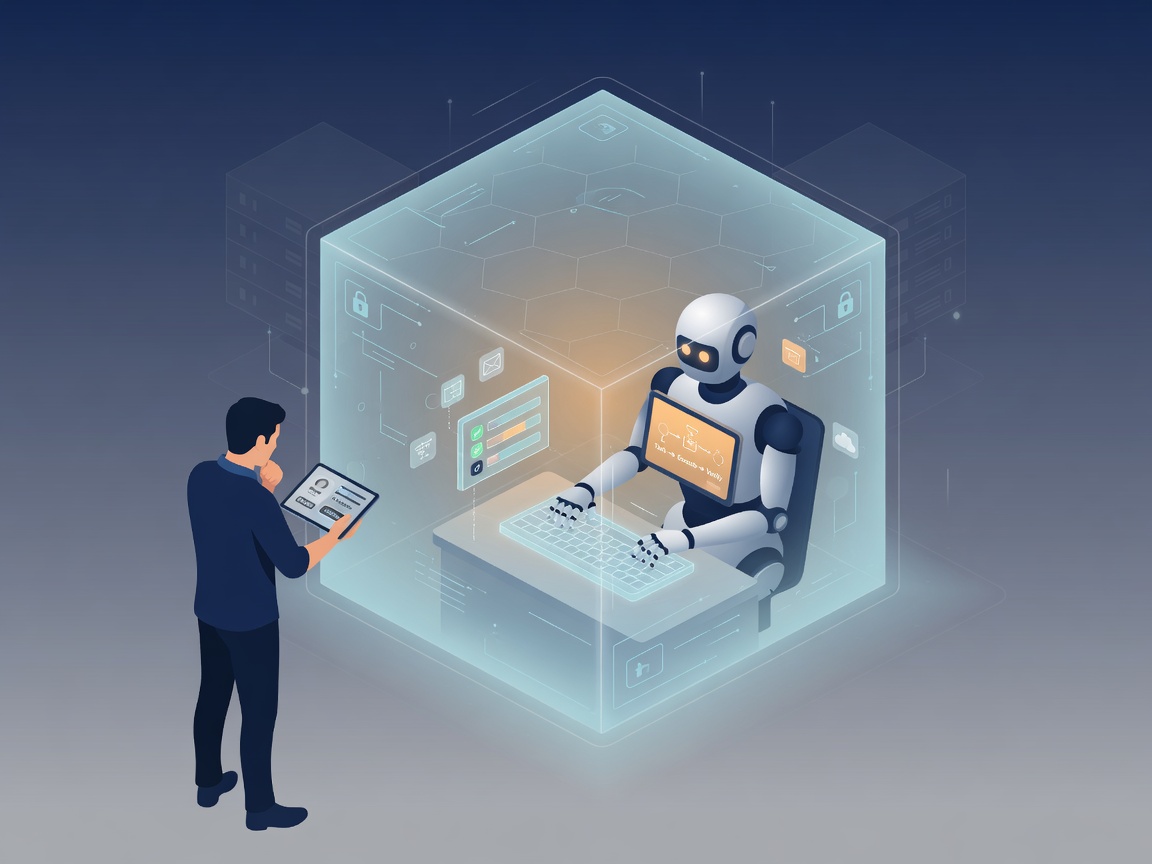
Giving AI Agents the Keys to the Kingdom (Without the Risk of Burning it Down)
Let’s talk about the 'Super-Powered Intern' problem. We all want an AI agent like Claude Code or Gemini CLI to handle the heavy lifting—writing code, managing configs, and spinning up entire environments—but every IT hea
Read this noteSame lane, different angle
The Engineering Reality of an AI-Driven Newsroom
Acutus just dropped on December 29, 2025, and it’s not your typical "wrapper" project. They’re building a high-velocity news site for AI policy and energy, but the real story is under the hood. They aren't just hitting a
From Oracles to Agents: The Next Phase of Scientific Discovery
AlphaFold was a massive milestone. It proved that high-quality data and deep learning could map protein structures with enough accuracy to build on 53 years of international cooperation and $21 billion worth of experimen