Clay’s Agent Platform Rebuild Targets Real CRM Work
Clay rebuilt Sculptor from a limited tool loop into a coding agent with access to its CLI and CRM data. The harder test now is whether its routing and workload controls hold up when providers fail and demand spikes.

Automation needs a narrow first win
The best first AI workflow is usually a repeated task with a clear input, clear output, and a human approval step.
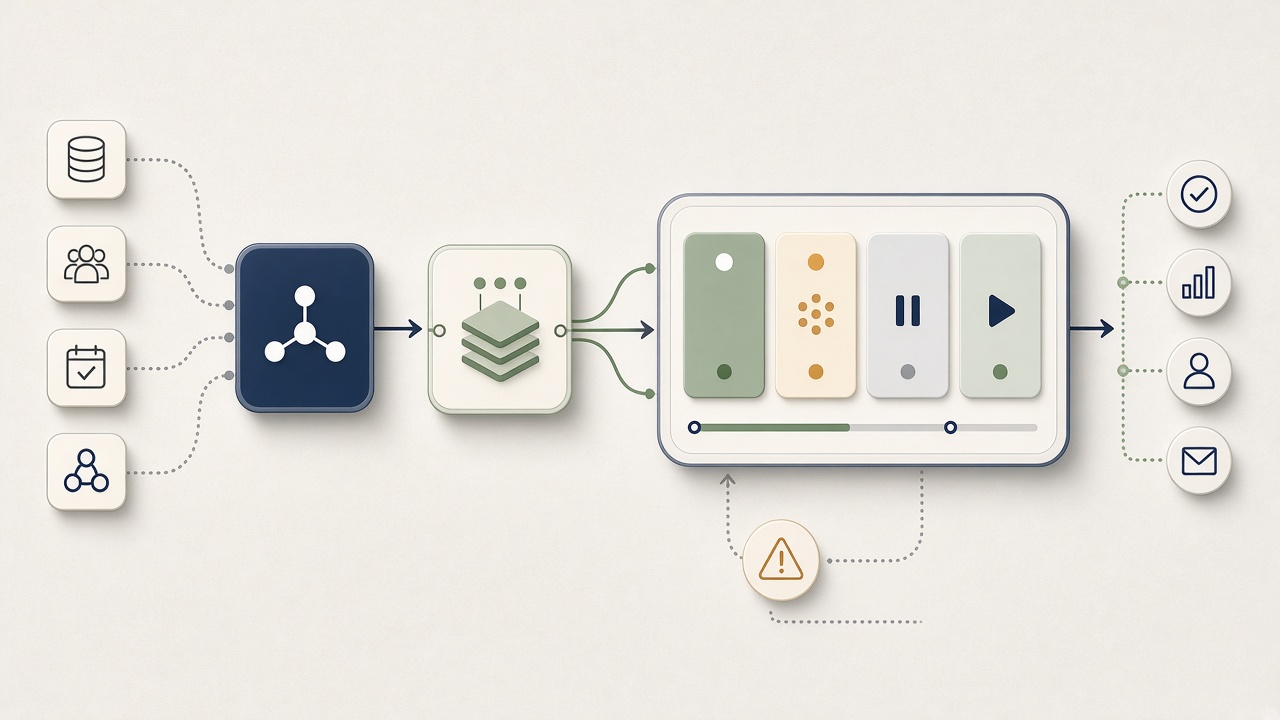
Clay’s agent platform now runs Sculptor as a coding agent in a cloud sandbox, with access to Clay’s CLI and CRM data. That changes the integration problem: the agent can work with more of the customer context and tools that complex tasks require, rather than relying on a limited tool loop.
Why Clay rebuilt Sculptor as a coding agent
Clay says its original tool-loop agent struggled with complex tasks and had limited access to customer data. The rebuild puts Sculptor on the Pi harness and gives it a sandbox, CLI access, and CRM data. That is a material shift in where the agent operates—not just a change to its prompt or model.
The practical question is whether that environment makes multi-step work more dependable. More access can let an agent handle tasks the old loop could not, but it also raises the importance of controlling what runs against customer data. The source describes the new capabilities, but does not report reliability or safety results. I’d treat the sandbox and data access as the useful architectural change, not as proof that every complex workflow is solved.
Worth a look
Phugialy Picks

AI Engineering: Building Applications with Foundation Models
A practical guide to building real-world applications with foundation models and LLMs.

GMKtec K15 AI Mini PC Oculink Intel Ultra 5 125U 32GB DDR5 512GB SSD | Desktop Computer AI Boost, 3X M.2 2280 Storage Expansion, Dual NIC...

Agentic AI Engineering: Systems That Reason and Act Autonomously – Designing, Building, and Prompting LLM-Based Agents for Real-World Deployment
Some Phugialy Picks use affiliate links. If you buy through one, Phugialy may earn a commission. It doesn't change what we recommend. Full disclosure →
Model routing is about matching cost to the task
Clay is developing an automatic router that will choose a model for each task while keeping a manual selector for users who want control. That design reflects a tension the company has already encountered: customers complain when they see the model selector, even though different tasks may benefit from different models.
Clay says qualification is close to solved on its evals, and that models have scored about as high as they can on those tests for roughly a year. Frontier models still matter for orchestration and deep research. The interpretation I’d draw is that a single “best model” setting is a poor fit for a product with varied work. Routing could hide that complexity from users, but only if it chooses well and does not make failures harder to diagnose.
The economics have different thresholds at different scales. Clay’s database contains about 40 million companies, and scoring all of them with a classifier would cost around $1,500. The source also puts the point where post-training savings become meaningful somewhere between $10 million and $100 million in inference spending. Those figures suggest that cheaper task-specific approaches can matter before custom training does—but they do not establish that every workload should use a smaller model.
Outside harnesses turn infrastructure into the product
Clay is also building infrastructure for customers to use Clay through outside agent harnesses, not only through Clay’s own product. Usage is already much closer to a 50/50 split between its agent and external harnesses. The team uses BullMQ and has built ways to throttle, pause, and resume work when demand spikes or providers fail.
That operational layer is the part I’d watch most closely. An agent that works in a clean demo can still become an unreliable integration when demand surges or a provider goes down. In my view, supporting outside harnesses makes queue control and recovery part of the product contract, not background plumbing. I’d evaluate this approach as the infrastructure matures; the useful signal will be whether routing and workload controls keep behaving under real provider failures and uneven demand.
Holiday picks
Black Friday: big-ticket buys
The big-ticket day: computers, screens, audio and home upgrades worth waiting for.

Monitors
Big purchaseAlienware 34 Curved Gaming Monitor – AW3425DWM - 34-inch WQHD 180Hz 1ms Display, 1500R, AMD FreeSync Premium, VESA AdaptiveSync.
View on Amazon (opens in a new tab): Alienware 34 Curved Gaming Monitor – AW3425DWM - 34-inch WQHD 180Hz 1ms Display, 1500R, AMD FreeSync Premium, VESA AdaptiveSync.Prices change daily. Check today's price on Amazon.

Home & Kitchen
eufy C28 Robot Vacuum Cleaner and Mop for pet hair, 15,000 Pa
View on Amazon (opens in a new tab): eufy C28 Robot Vacuum Cleaner and Mop for pet hair, 15,000 PaPrices change daily. Check today's price on Amazon.

Home & Kitchen
Keurig K-Elite Single Serve K-Cup Pod Coffee Maker, Brushed Silver
View on Amazon (opens in a new tab): Keurig K-Elite Single Serve K-Cup Pod Coffee Maker, Brushed SilverPrices change daily. Check today's price on Amazon.
We earn from qualifying purchases made through these links, at no extra cost to you, as an Amazon Associate and through other affiliate programs. Disclosure. See all Black Friday picks
Got a question about how this applies to you? →
For a related look at the economics behind model choice, read “AI Chip Demand Is Shifting From Training to Inference.”
Keep reading
Follow the thread

Agentic AI Evaluations Need Auditable Test Harnesses
An agent harness changed Terminal-Bench accuracy by up to 29.9 percentage points while the model stayed fixed. That makes evaluation setup part of the result, not background plumbing.
Read this noteSame lane, different angle
AI Simulation Agents Still Need a Human Test Loop
AI agents can assemble and run industrial, robotics, and VR simulations, but a successful render is not proof that the scene behaves correctly. The useful workflow still includes logs, direct testing, and a developer checking the result.
Enterprise AI Governance Starts Outside the Agent Loop
BMW Group’s agent governance model puts controls outside individual agents and assigns autonomy by workflow step. That’s a more practical starting point than deciding an entire agent is either trusted or not—but the evaluation dataset has to represent the work teams will actually deploy.