Agentic AI Evaluations Need Auditable Test Harnesses
An agent harness changed Terminal-Bench accuracy by up to 29.9 percentage points while the model stayed fixed. That makes evaluation setup part of the result, not background plumbing.

Automation needs a narrow first win
The best first AI workflow is usually a repeated task with a clear input, clear output, and a human approval step.
Agentic AI evaluations measure more than whether a model produces the right answer: they measure what an agent does inside a particular setup. That makes the harness, environment, verifier, traces, and scoring process part of the result—not implementation details you can safely ignore.
Agentic AI evaluations test the whole setup
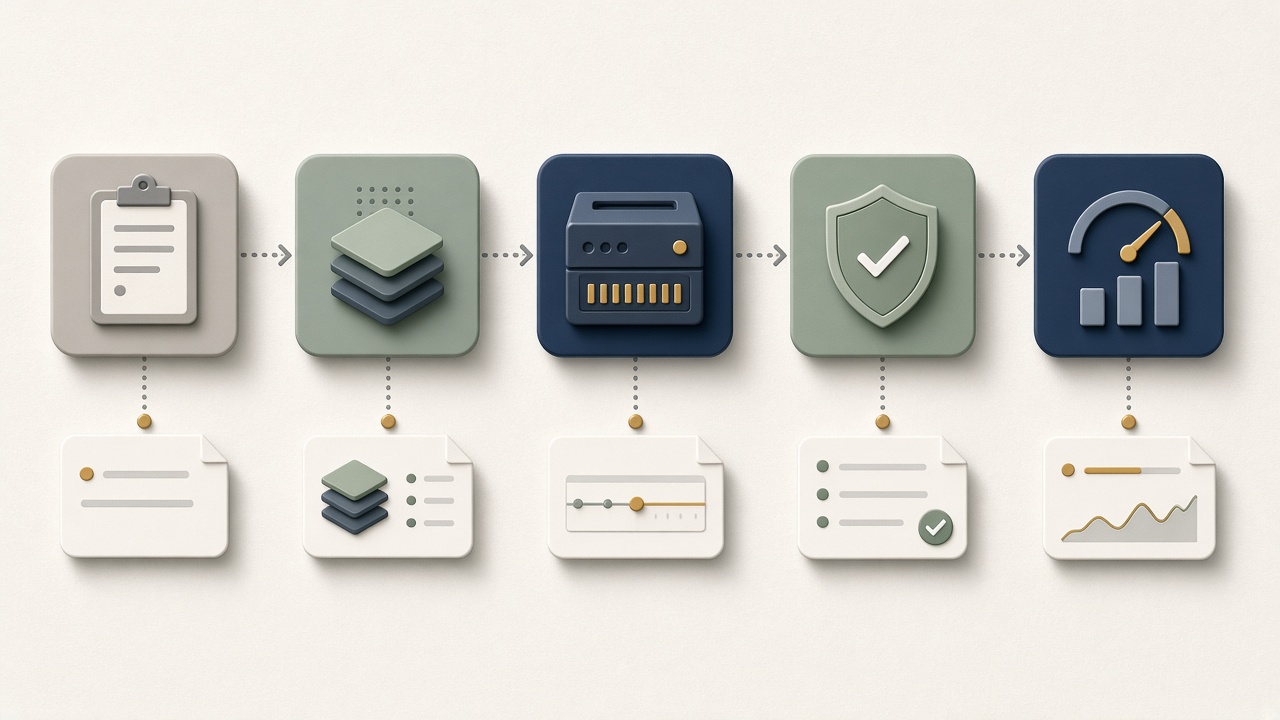
A question-answer benchmark can often be summarized as prompts, answers, and a score. An agentic evaluation has to account for actions in an environment, so the task design and software that runs the agent can change what is being measured. The source article lays out an eight-step process, beginning with defining the claim and ending with comparing models. The practical value is the discipline of making each part of that chain visible.
That visibility matters when the claim is about a model. If the test also depends on an agent harness, readers need enough evidence to distinguish model capability from the behavior of the surrounding system. Otherwise, a score can look like a clean model comparison while reflecting a different setup.
Worth a look
Phugialy Picks

AI Engineering: Building Applications with Foundation Models
A practical guide to building real-world applications with foundation models and LLMs.

GMKtec K15 AI Mini PC Oculink Intel Ultra 5 125U 32GB DDR5 512GB SSD | Desktop Computer AI Boost, 3X M.2 2280 Storage Expansion, Dual NIC...

Agentic AI Engineering: Systems That Reason and Act Autonomously – Designing, Building, and Prompting LLM-Based Agents for Real-World Deployment
Some Phugialy Picks use affiliate links. If you buy through one, Phugialy may earn a commission. It doesn't change what we recommend. Full disclosure →
A 29.9-point swing changes what scores mean
The clearest example is an audit of Terminal-Bench: with the model held fixed, changing the agent harness altered accuracy by up to 29.9 percentage points. That is not a small measurement wrinkle. It means a benchmark result may be sensitive to integration choices that are easy to leave out of a headline number.
The broader reporting picture makes scrutiny harder. The article says 98.2% of model-benchmark scores are reported by only one party. A single report is not automatically wrong, but it gives other teams fewer opportunities to reproduce the result or catch a task-design or grading error. The article also notes that 60% of its Intelligence Index v5 rests on evaluations with private test sets or held-out answers. That may serve some evaluation goals, but it limits what outsiders can independently inspect.
My read is that the main risk is not simply “bad benchmarks.” It is false precision: treating a score as a stable property of a model when the harness and evaluation design may be doing meaningful work. At production scale, that makes evaluation infrastructure part of the system you should version and review, not just a one-off script you run before a launch.
Shared evidence is more useful than a leaderboard alone
The Hugging Face hub hosts around 3,500 evaluation leaderboards and about 17,000 evaluation datasets, roughly 16 times as many evaluation datasets as a year earlier. Those numbers show a growing body of infrastructure, but volume alone cannot settle whether a particular result is reliable. The article’s recommendation is to share infrastructure, grading methods, and evidence about task design so others can scrutinize results and correct errors. When public release is unsuitable, it suggests controlled review instead.
For a team choosing or tuning an agent, I would treat a benchmark score as a starting point, then check whether the harness, verifier, and task evidence are available for review. Reusing shared evaluation components can make comparisons easier to inspect, but it does not remove the need to test the setup that matters to your own work. The useful standard is not just a score you can cite; it is a result another team can examine and challenge.
Holiday picks
Black Friday: big-ticket buys
The big-ticket day: computers, screens, audio and home upgrades worth waiting for.

Audio
Big purchaseBose QuietComfort Headphones - Wireless Bluetooth Headphones, Active Over Ear Noise Cancelling and Mic, USB-C Charging, Deep Bass, Up to ...
View on Amazon (opens in a new tab): Bose QuietComfort Headphones - Wireless Bluetooth Headphones, Active Over Ear Noise Cancelling and Mic, USB-C Charging, Deep Bass, Up to ...Prices change daily. Check today's price on Amazon.

Home & Kitchen
eufy C28 Robot Vacuum Cleaner and Mop for pet hair, 15,000 Pa
View on Amazon (opens in a new tab): eufy C28 Robot Vacuum Cleaner and Mop for pet hair, 15,000 PaPrices change daily. Check today's price on Amazon.

Home & Kitchen
Keurig K-Elite Single Serve K-Cup Pod Coffee Maker, Brushed Silver
View on Amazon (opens in a new tab): Keurig K-Elite Single Serve K-Cup Pod Coffee Maker, Brushed SilverPrices change daily. Check today's price on Amazon.
We earn from qualifying purchases made through these links, at no extra cost to you, as an Amazon Associate and through other affiliate programs. Disclosure. See all Black Friday picks
Got a question about how this applies to you? →
Keep reading
Follow the thread

Agentic AI for Lab Operations Depends on Better Data
SWARM reports roughly 130 times faster first responses and 96.2 percent automated ticket coverage. The more useful engineering lesson may be less about adding agents and more about building the equipment-specific document pipeline that helps them retrieve the right knowledge.
Read this noteSame lane, different angle
Clay’s Agent Platform Rebuild Targets Real CRM Work
Clay rebuilt Sculptor from a limited tool loop into a coding agent with access to its CLI and CRM data. The harder test now is whether its routing and workload controls hold up when providers fail and demand spikes.
AI Simulation Agents Still Need a Human Test Loop
AI agents can assemble and run industrial, robotics, and VR simulations, but a successful render is not proof that the scene behaves correctly. The useful workflow still includes logs, direct testing, and a developer checking the result.