AI Adoption Is a Workflow Decision, Not a License Buy
Enterprise interviews show AI automating manual work and helping build software—but also reveal that results depend on workflow changes and uneven adoption. The practical question is not whether to buy access; it is which work actually changes.

Automation needs a narrow first win
The best first AI workflow is usually a repeated task with a clear input, clear output, and a human approval step.
AI adoption is already changing who does the work, not just which software a business buys. Interviews with enterprise customers describe AI agents automating manual tasks and building software for business needs—but also show that output gains depend on how teams reorganize around the tools.
AI adoption is showing up as workflow change
The Anthropic researchers’ study draws on 66 interviews with 58 enterprise customers. It is not a random or systematically representative sample, so it is evidence about how some organizations are adopting AI, not a measure of how common those practices are across business.
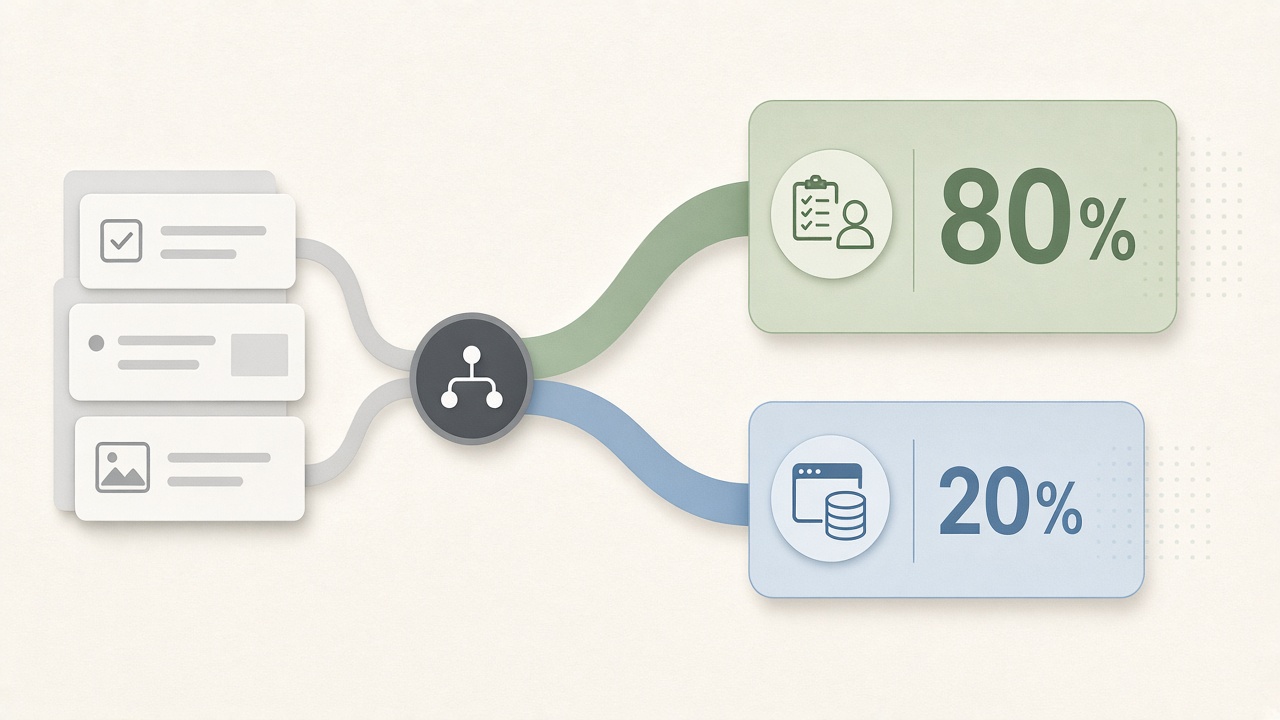
Within the work described, coding agents and other AI agents took on manual tasks and helped build software for business needs. The reported split is notable: 80% of the software automated previously manual work, while another 20% replaced existing software. The distinction matters. Automating a task can change how a team spends its time; replacing software can change what the business depends on. The interviews do not establish that either route produces savings in every case.
Worth a look
Phugialy Picks

AI Engineering: Building Applications with Foundation Models
A practical guide to building real-world applications with foundation models and LLMs.

GMKtec K15 AI Mini PC Oculink Intel Ultra 5 125U 32GB DDR5 512GB SSD | Desktop Computer AI Boost, 3X M.2 2280 Storage Expansion, Dual NIC...

Agentic AI Engineering: Systems That Reason and Act Autonomously – Designing, Building, and Prompting LLM-Based Agents for Real-World Deployment
Some Phugialy Picks use affiliate links. If you buy through one, Phugialy may earn a commission. It doesn't change what we recommend. Full disclosure →
More output still depends on people and process
Interviewees said AI often increased output and enabled new products or services. Some described the tools as “a second brain,” and one said, “For higher-level stuff, it just opens up possibilities.” Those accounts suggest the value is not limited to doing existing tasks faster: AI may also make work feasible that a team otherwise would not have pursued.
But the reported constraints are operational: resistance, uneven adoption, and tasks that AI did not accelerate. Some companies reorganized workflows and redeployed employees to preserve human expertise alongside AI. That is a useful corrective to the idea that adding a tool automatically frees up labor. In practice, employees may need to adapt their work, and the business still needs people who can supply judgment and expertise where the tools do not help.
The return depends on where work gets stuck
The business case, in my view, is not “AI raises productivity” in the abstract. It is whether a particular workflow has enough manual work, software needs, or unrealized product opportunities to justify the changes adoption requires. The interviews point to possible gains, but do not provide a general cost, payback period, or headcount impact. A company cannot use these findings alone to forecast its own return.
That makes a bounded trial a more defensible decision than a broad rollout: choose a workflow, identify what work the tool is expected to change, and check whether output improves without losing the human expertise the task still needs. This is an interpretation of the evidence, not a reported recommendation from the study. If adoption stays uneven or the chosen tasks do not accelerate, expanding access is unlikely to fix the underlying problem. The useful signal is not how many employees have a tool, but whether a defined workflow changes in a way the business can verify.
Holiday picks
Black Friday: big-ticket buys
The big-ticket day: computers, screens, audio and home upgrades worth waiting for.

Audio
Mid-size buySoundcore by Anker Q20i Hybrid Active Noise Cancelling Headphones, White | Over-Ear, Bluetooth, 40H ANC Playtime, Hi-Res Audio, Big Bass,...
View on Amazon (opens in a new tab): Soundcore by Anker Q20i Hybrid Active Noise Cancelling Headphones, White | Over-Ear, Bluetooth, 40H ANC Playtime, Hi-Res Audio, Big Bass,...Prices change daily. Check today's price on Amazon.

Home & Kitchen
eufy C28 Robot Vacuum Cleaner and Mop for pet hair, 15,000 Pa
View on Amazon (opens in a new tab): eufy C28 Robot Vacuum Cleaner and Mop for pet hair, 15,000 PaPrices change daily. Check today's price on Amazon.

Home & Kitchen
Keurig K-Elite Single Serve K-Cup Pod Coffee Maker, Brushed Silver
View on Amazon (opens in a new tab): Keurig K-Elite Single Serve K-Cup Pod Coffee Maker, Brushed SilverPrices change daily. Check today's price on Amazon.
We earn from qualifying purchases made through these links, at no extra cost to you, as an Amazon Associate and through other affiliate programs. Disclosure. See all Black Friday picks
Got a question about how this applies to you? →
Keep reading
Follow the thread

Enterprise AI Governance Starts Outside the Agent Loop
BMW Group’s agent governance model puts controls outside individual agents and assigns autonomy by workflow step. That’s a more practical starting point than deciding an entire agent is either trusted or not—but the evaluation dataset has to represent the work teams will actually deploy.
Read this noteSame lane, different angle
An AI Context Layer Could Make Enterprise AI Useful
An AI context layer is a proposed way to make enterprise AI more useful by connecting business systems to AI platforms and translating organizational knowledge into governed, machine-usable context. The case for it is pr
Why Most Enterprise AI Agents Never Reach Production
Two out of three enterprise AI agents never reach production — and the reason isn't model quality. It's that the agent doesn't know what your data means.