Baking Social Intuition into Robots: The Power of Knowledge Distillation
Let’s be real: making a robot navigate a crowd without it looking like a glitchy, reactive mess is a massive headache. Most current systems try to solve this by treating human behavior as a modular math problem—first, pr
Automation needs a narrow first win
The best first AI workflow is usually a repeated task with a clear input, clear output, and a human approval step.
Let’s be real: making a robot navigate a crowd without it looking like a glitchy, reactive mess is a massive headache. Most current systems try to solve this by treating human behavior as a modular math problem—first, predict where the person is going, then plan a path around them. But that gap between 'prediction' and 'planning' is exactly where social nuance goes to die. It feels jerky because the robot is always one step behind the human's intent.
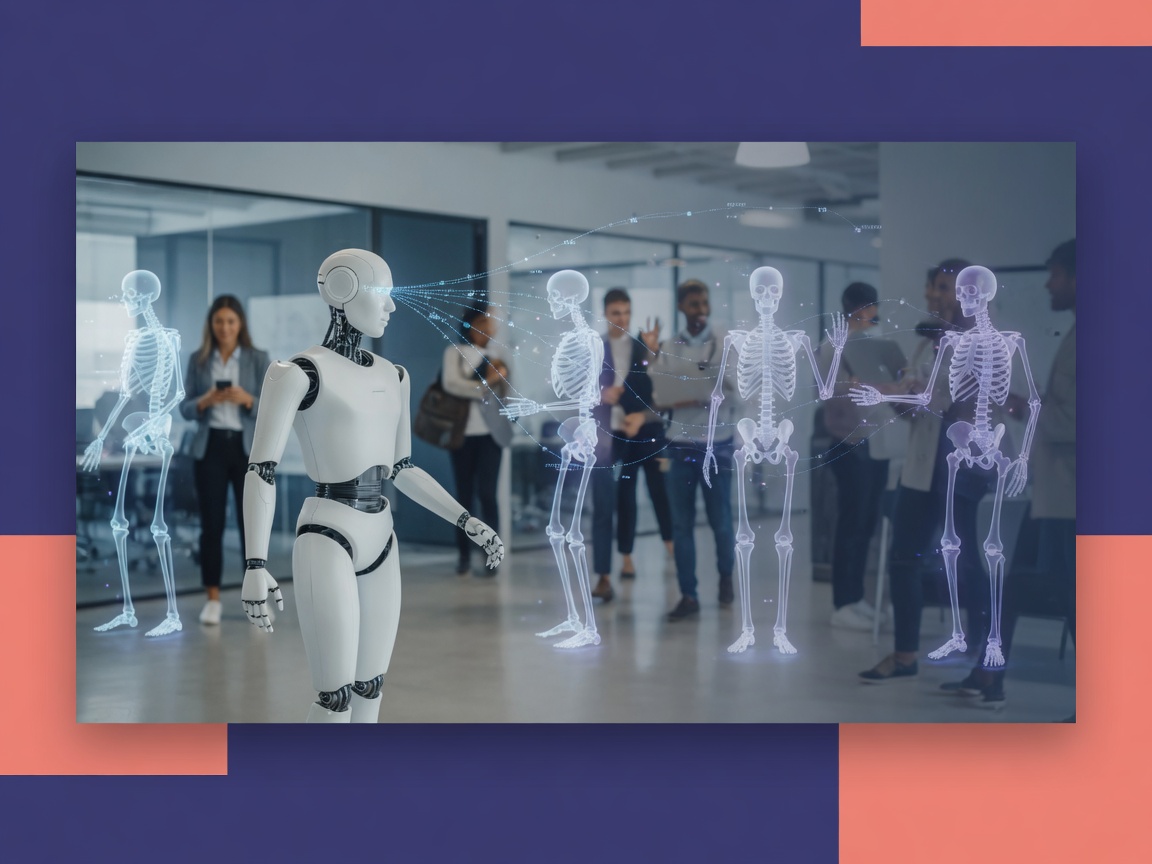
HumAIN changes the game by ditching that modularity for an end-to-end framework. It uses knowledge distillation to bake complex social cues—like gait, weight shifts, and orientation—directly into the robot's planning loop. Here’s the dev-friendly secret: they use a teacher-student strategy. The 'Teacher' model is trained on multi-modal data (images + skeletal keypoints) to learn the 'why' behind human movement. The 'Student' model, however, only sees raw pixels. It’s trained to mimic the Teacher’s latent representations.
Why does this matter for us? Because if you try to run a full Vision Language Model (VLM) or a high-fidelity pose estimator on a mobile robot, your latency will spike and your battery life will crater. By distilling the knowledge, HumAIN lets the robot reason about human behavior as if it had access to skeletal data, even though it’s only seeing raw pixels. You're moving the computational cost from the deployment phase to the training phase.
Solving the 'Moving Circle' Problem
The paper shows a 29.8% jump in trajectory prediction metrics, but for those of us building in the real world, the real win is avoiding the 'moving circle' problem. Too many systems treat humans as low-dimensional points or circles. That fails the moment someone leans forward or shifts their weight to turn. HumAIN captures those implicit cues, making for smoother, socially compliant navigation that actually feels natural.
Worth a look
Phugialy Picks

The Agentic AI Bible: The Complete and Up-to-Date Guide to Design, Develop, and Scale Goal-Driven, LLM-Powered Agents that Think, Execute...

AI Engineering: Building Applications with Foundation Models
A practical guide to building real-world applications with foundation models and LLMs.

GMKtec K15 AI Mini PC Oculink Intel Ultra 5 125U 32GB DDR5 512GB SSD | Desktop Computer AI Boost, 3X M.2 2280 Storage Expansion, Dual NIC...
Some Phugialy Picks use affiliate links. If you buy through one, Phugialy may earn a commission. It doesn't change what we recommend. Full disclosure →
The Reality Check: Messy Data and Edge Cases
The real-world friction isn't whether the demo works in a lab; it's what happens when the robot hits 'messy' human behavior that deviates from the training set. Distillation is only as good as the teacher’s exposure. If your teacher hasn't seen people on scooters, mobility aids, or erratic patterns, the student’s 'distilled intuition' might fail in ways that are incredibly hard to debug since there’s no pose data to inspect at runtime. For anyone looking to integrate this, the move from modular prediction-planning to a distilled end-to-end approach is a massive win for simplifying your deployment stack. Just make sure your teacher model is seeing the full spectrum of human 'subtle cues' before you ship.
Got a question about how this applies to you? →
Keep reading
Follow the thread

Evaluating Temporal Preservation in Conversational Image Editing
Most image editing models fail when an object is hidden and then revealed in a conversation. OCCUR-Bench is a new diagnostic tool designed to expose these specific failures in temporal consistency.
Read this noteSame lane, different angle
Polycepta Rethinks Multi-Object Tracking Appearance Modeling
A new tracking framework hits 92.27% MOTA on KITTI while running at 90 Hz - but the claim I'd actually stress-test first isn't the accuracy score.
Knowledge Distillation For Time Series Classification: What Holds Up
A study across three architectures found knowledge distillation helps time series models most at intermediate sizes — not at maximum compression. One distilled FCN student dropped parameters by a factor of 38.