From Lab Toys to Production: How ABot-C0 Unifies Quadruped Behavior
Let’s be real: most quadruped robots are still stuck in the "functional demo" phase—they can walk, but they don't really *know* how to behave in the wild. ABot-C0 is trying to flip that script by treating motion control
Automation needs a narrow first win
The best first AI workflow is usually a repeated task with a clear input, clear output, and a human approval step.
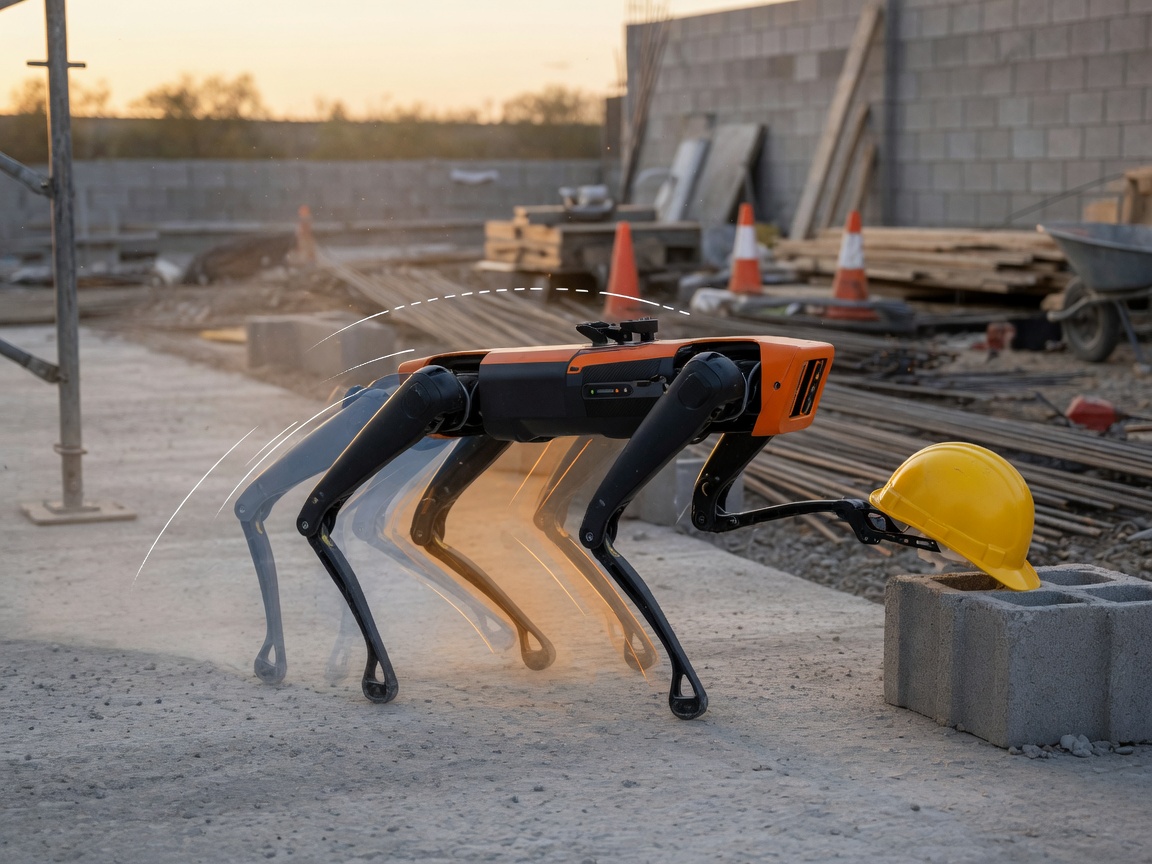
Let’s be real: most quadruped robots are still stuck in the "functional demo" phase—they can walk, but they don't really know how to behave in the wild. ABot-C0 is trying to flip that script by treating motion control as a Behavior Foundation Model (BFM). Instead of treating locomotion, tracking, and interaction as isolated modules, the researchers have unified them into a single stack. This isn't just a minor architectural tweak; it’s the move from "making a robot move" to "giving a robot behavioral intelligence."
Solving the Data Bottleneck with a "Pyramid"
The biggest hurdle in embodied AI is often data. High-fidelity motion capture is great, but it’s expensive and hard to scale. ABot-C0 solves this by using a scalable motion-data pyramid. It aggregates everything: motion capture, teleoperation, human-designed motions, and even a controllable video-generation pipeline. By synthesizing these diverse inputs, the model builds a much broader representational base. The takeaway for builders here is clear: the bottleneck for complex behavior isn't just the size of your neural network; it’s the diversity and volume of the underlying motion data you can feed into it.
Worth a look
Phugialy Picks

The Agentic AI Bible: The Complete and Up-to-Date Guide to Design, Develop, and Scale Goal-Driven, LLM-Powered Agents that Think, Execute...

Screen Mom Screen Cleaner Spray (16oz)
We'd buy this if: You've been wiping your monitor with your shirt sleeve.
We'd skip this if: You already have a cleaning routine sorted.
Anker USB-C to USB-C 60W Fast Charging Cable (2-Pack)
We'd buy this if: You need a reliable spare charging cable that won't fray in a month.
We'd skip this if: You already have enough cables lying around.
Some Phugialy Picks use affiliate links. If you buy through one, Phugialy may earn a commission. It doesn't change what we recommend. Full disclosure →
From Hard-Coded Switches to Continuous Flow
We’ve all seen robots that "switch" between behaviors—like a hard-coded toggle between walking and turning. It’s clunky and often breaks. ABot-C0’s locomotion stack is progressive, moving from velocity tracking to biomimetic omnidirectional gait control, and finally to unstructured terrain navigation. Because it’s a unified stack, it supports multimodal commands (language, velocity, spatial goals) and coordinates smooth transitions between them. This allows the robot to handle continuous, coordinated actions rather than jerky, discrete movements. It’s the difference between a robot that follows a script and one that can actually "understand, express, and interact" with its surroundings.
The Reality of Zero-Shot Success
The paper reports a 90% success rate with zero-shot generalization, which is impressive, but we need to talk about the "messy" reality of production. In a lab, "zero-shot" is a clean metric. In the real world, you have uneven surfaces, unexpected obstacles, and sensor noise. The real engineering win in ABot-C0 is the deployment stack—the safety mechanisms and recovery protocols that handle these perturbations. The real story here isn't just that the robot can perform a motion; it’s that the BFM maintains behavioral coherence when the environment deviates from the training data. For anyone building in this space, that’s the shift from a research paper to a viable product.
Got a question about how this applies to you? →
Keep reading
Follow the thread

How Social Norms Improve Human-AI Coordination
New research shows that AI agents informed by social norms can outperform human-human interactions by 43%. This suggests the next leap in coordination isn't better data, but better alignment with human social principles.
Read this noteSame lane, different angle
The OPTICS Benchmark Shows VLMs Still Can't Count
State-of-the-art vision-language models score below 40% on counting tasks in zero-shot settings — and even newer reasoning models trail humans by 20%. A new benchmark called OPTICS breaks down exactly where visual reasoning falls apart.
How AI Labs Are Becoming a Counterbalance to Government
Frontier AI labs are transitioning from mere software providers to critical infrastructure, creating a scenario where they may soon act as a counterbalance to government. As AI becomes the primary substrate for cognitive