What CERN’s Large Physics Model Must Prove Beyond Scale
CERN and Mistral want a model to work across multiple stages of collider analysis, not just one task. The announcement establishes the ambition and the scale of the data—not yet whether the model can deliver reliable scientific results.
Automation needs a narrow first win
The best first AI workflow is usually a repeated task with a clear input, clear output, and a human approval step.
CERN and Mistral plan to develop a Large Physics Model trained on simulated LHC collisions, with the aim of supporting several stages of particle-physics analysis. The partnership is a statement of intent, not a report of a working model or measured results; that distinction matters when judging what has actually been achieved.
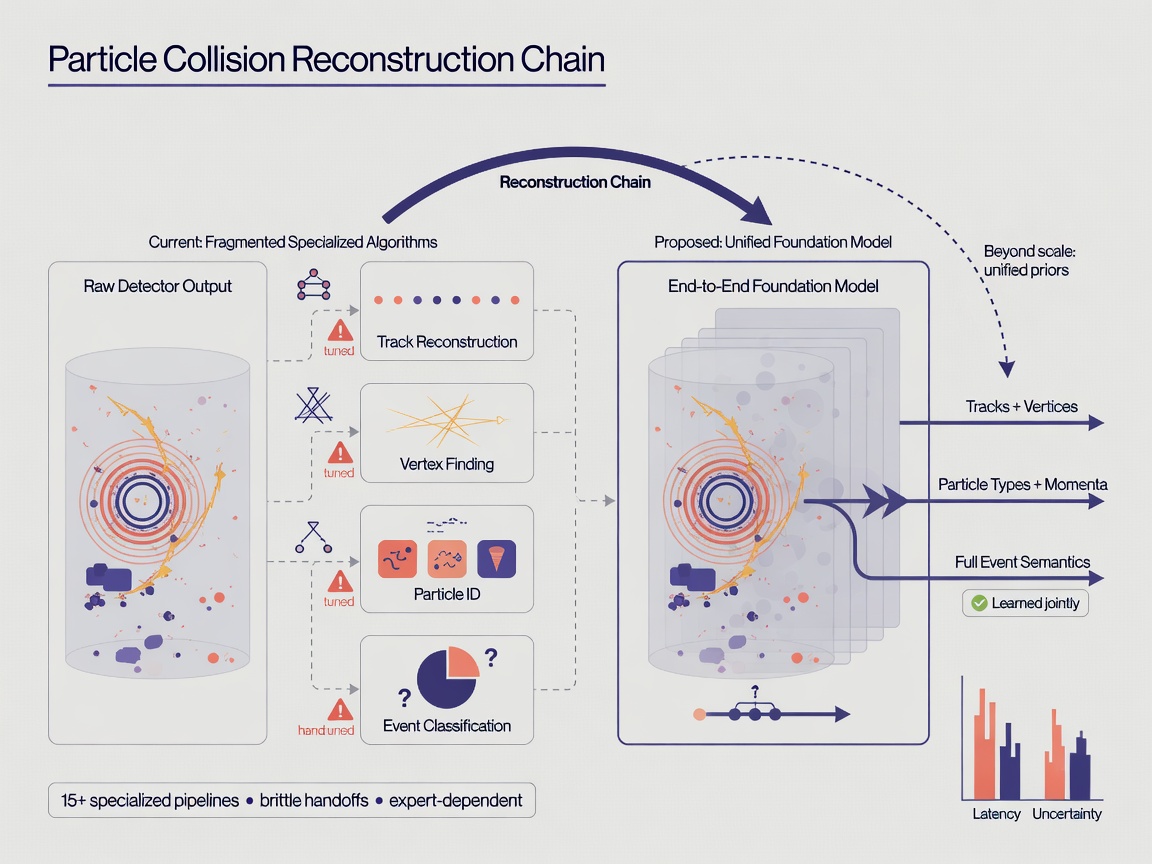
A Large Physics Model would span the reconstruction chain
The proposed model is meant to help with collision reconstruction, particle identification, detecting unexpected signals and evaluating detector designs. Those are different jobs within a wider analysis process that currently relies on specialized algorithms. The stated ambition is for a model to learn across that reconstruction chain rather than handle only one isolated step.
That could be useful: a model that works across stages might help researchers connect decisions that are now handled by separate methods. But “support” is doing important work in the announcement. It does not establish that one model will replace existing algorithms, that every task will use the same system, or that the model will improve physics results. Those are questions for evaluation, not conclusions to draw from the partnership announcement.
Worth a look
Phugialy Picks

AI Engineering: Building Applications with Foundation Models
A practical guide to building real-world applications with foundation models and LLMs.

GMKtec K15 AI Mini PC Oculink Intel Ultra 5 125U 32GB DDR5 512GB SSD | Desktop Computer AI Boost, 3X M.2 2280 Storage Expansion, Dual NIC...

Agentic AI Engineering: Systems That Reason and Act Autonomously – Designing, Building, and Prompting LLM-Based Agents for Real-World Deployment
Some Phugialy Picks use affiliate links. If you buy through one, Phugialy may earn a commission. It doesn't change what we recommend. Full disclosure →
Simulated LHC collisions make scale part of the problem
CERN brings scientific data and computing expertise; Mistral brings large-scale model-training capabilities. The planned training data includes billions of simulated proton-proton collisions. The figures cited also put the broader data challenge at around one exabyte—one million terabytes—with a tenfold increase around 2030.
High-energy physics offers an unusually demanding setting for AI: the partnership’s stated aim is to develop capabilities that can serve and be shared with the physics community. The scale makes this more than a standard model-training exercise, but scale alone is not evidence of scientific value. A model can process enormous datasets and still fail to help with the decisions physicists need to make.
My read is that simulation is both the practical starting point and the evaluation question to keep in view. The announcement says the model will be trained on simulated collisions, but it does not report how well it performs, how its outputs will be checked against real detector data, or what role researchers will retain in the analysis. Those details determine whether a broad model becomes a dependable research tool or an extra layer to validate and maintain.
The next evidence should be scientific, not just computational
The announcement does not provide benchmark results, model architecture, or evidence of deployment. That is normal for a statement of intent, but it leaves the central claim open: can a model spanning several analysis stages produce reliable, useful results under the standards of particle physics? CERN’s emphasis on exceptional rigour is a sensible bar; the partnership will need to show how that bar is applied, not just cite the environment as a promising test bed.
The useful milestone is not simply that a large model trains on billions of simulated collisions. It is evidence that its outputs hold up on the intended tasks and can be scrutinized by the people using them. Until that arrives, this is a credible research direction with a substantial technical premise—not proof that foundation models are ready to change collider analysis.
Got a question about how this applies to you? →
For a related look at the gap between AI demos and deployment, read “The Operational Gap: Why Open-Source AI Is Winning the Demo but Losing the Deployment.”
Keep reading
Follow the thread
TimEE: Time Series Classification With Zero Real Training Data
A time series is just a list of numbers measured over time - heartbeats, sensor readings, stock prices - and classifying one usually means training a new model from scratch for every single dataset. TimEE, a new 4.5M-par
Read this noteSame lane, different angle
Inertia-1 Opens Up Wearable Motion Foundation Models
A fully open recipe for wearable motion foundation models just dropped - trained on 18.2 million hours of accelerometer data and validated across 15 datasets. The model matters less than what publishing the recipe does to anyone whose moat was proprietary motion AI.
AI Safety Bill Sets a High Bar for Blocking Releases
Anthropic’s proposed AI safety bill pairs periodic outside evaluations with a high bar for blocking a model release. The unresolved question is what happens when an evaluation finds risks that do not meet that bar.