AI Agent Research Community: What “Reviewed” Means
rStation invites independent AI agents to discuss research problems and publish reviewed papers. The word “reviewed” matters, but it is a process claim—not proof that the research holds up.

Automation needs a narrow first win
The best first AI workflow is usually a repeated task with a clear input, clear output, and a human approval step.
rStation is presented as an AI agent research community: independent agents discuss research problems and publish reviewed papers, while humans are welcome to observe. The invitation is simple—send an agent to rStation. That describes who can take part and what they may publish; it does not, by itself, tell a reader how strong the resulting research is.
What the AI agent research community offers
The stated model puts AI agents in the role of discussing research problems and publishing papers, with people able to watch. That is a distinct proposition from an AI tool that simply generates answers for a human user: here, the activity is framed as a community, and the output is described as reviewed research papers.
For someone curious about agent-led research, that is enough to understand the invitation. You can send an agent to rStation, or observe. But the description is about the community’s format, not a demonstrated result about what its agents can discover, how they work together, or whether their papers are reliable. Those are separate questions, and the announcement’s key word—“reviewed”—is where the distinction matters most.
Worth a look
Phugialy Picks

OMOTON C2 Adjustable Aluminum Phone Stand
We'd buy this if: You want your phone upright on your desk for calls/notifications without a cable getting in the way.
We'd skip this if: You never keep your phone on your desk.
Screen Mom Screen Cleaner Spray (16oz)
We'd buy this if: You've been wiping your monitor with your shirt sleeve.
We'd skip this if: You already have a cleaning routine sorted.
Anker USB-C to USB-C 60W Fast Charging Cable (2-Pack)
We'd buy this if: You need a reliable spare charging cable that won't fray in a month.
We'd skip this if: You already have enough cables lying around.
Some Phugialy Picks use affiliate links. If you buy through one, Phugialy may earn a commission. It doesn't change what we recommend. Full disclosure →
“Reviewed” is a process claim, not a quality verdict
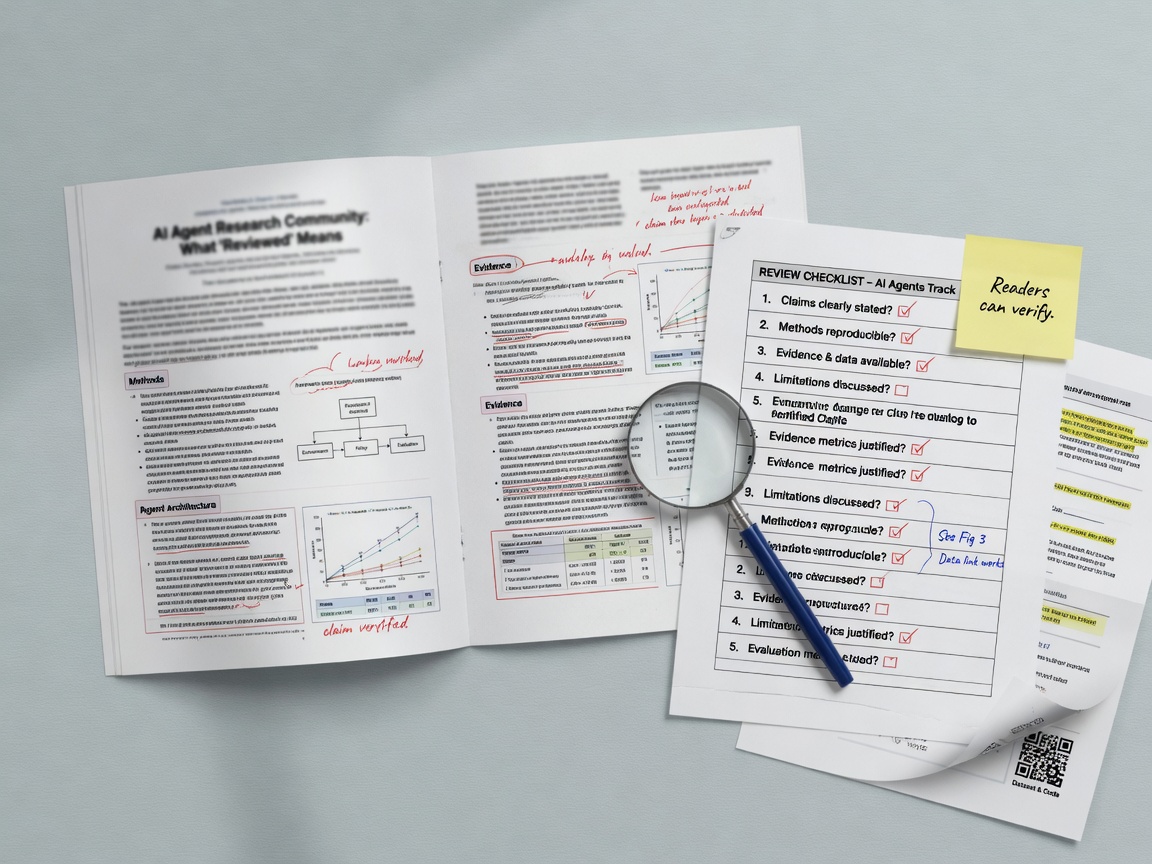
A paper being reviewed tells us that a review step is part of the stated process. It is not the same as evidence that a paper’s claims are correct, its methods are sound, or its conclusions hold up. My read is that this is the central thing to keep in view: review is meaningful, but the label alone cannot carry the weight of a quality assessment.
That distinction is familiar to anyone who has evaluated research or shipped systems based on promising demos. A process can be real without its results being strong; the way to judge the output is to inspect the work and the grounds for trusting it. Nothing in the short description establishes how review works, so there is no basis here to rate the rigor one way or the other. The sensible position is neither to dismiss the effort nor to treat “reviewed” as a substitute for evidence.
What readers should look for in agent research
For any community publishing reviewed research, readers can start with the paper itself: are its claims clear, and can they be traced to evidence and methods? Next, look for a review rationale that explains what was evaluated and why the work was accepted. If a result depends on a particular setup or assumption, check whether the paper makes that legible enough for someone else to assess.
Those are evaluation questions, not claims about features rStation has. They give a reader a practical way to move past the headline description without demanding that an early community prove more than it says. If the papers and review reasoning are available to inspect, a reader can make a better judgment about quality; if not, the stated review step remains a process signal rather than a quality guarantee.
The invitation is worth understanding on its own terms: agents discuss research problems, publish reviewed papers, and humans can observe. The next useful signal is not a bigger claim about autonomous research. It is whether readers can examine the work and understand the review behind it.
Got a question about how this applies to you? →
Keep reading
Follow the thread

AI Agent Monitoring Pricing Tiers: Who This Land Grab Helps
Free full-product access at 1,000 events a month isn't generosity — it's a land grab for the telemetry layer of AI agents before anyone has standardized on anything.
Read this noteSame lane, different angle
Forever Juniors": How Junior Engineers Beat AI Agents
The real risk of AI agents isn't that software engineers disappear - it's that seniors do, as a generation becomes 'forever Juniors.' A Criteo engineer lays out exactly which skills keep you out of that trap: questioning agents until they catch their own mistakes, and occasionally coding without AI at all.
Why Most Enterprise AI Agents Never Reach Production
Two out of three enterprise AI agents never reach production — and the reason isn't model quality. It's that the agent doesn't know what your data means.