The Dialect Gap: Why Robustness Doesn't Mean Fluency in LLMs
Training a model to understand a dialect is not the same as teaching it to speak one. The DiaLLM study reveals a technical dissociation between dialectal robustness and generation—a gap that means your 'robust' model might still be failing your users.
Automation needs a narrow first win
The best first AI workflow is usually a repeated task with a clear input, clear output, and a human approval step.
Adapting large language models to specific English dialects is more than a simple fine-tuning task; it’s a decoupling of understanding and expression. The DiaLLM framework exposes a significant technical hurdle: models can be trained to recognize a dialect without actually being able to speak it convincingly. This reveals a fundamental gap between dialectal robustness—the ability to process variety—and generation—the ability to produce it.
Benchmarks Capture Knowledge, Not Voice
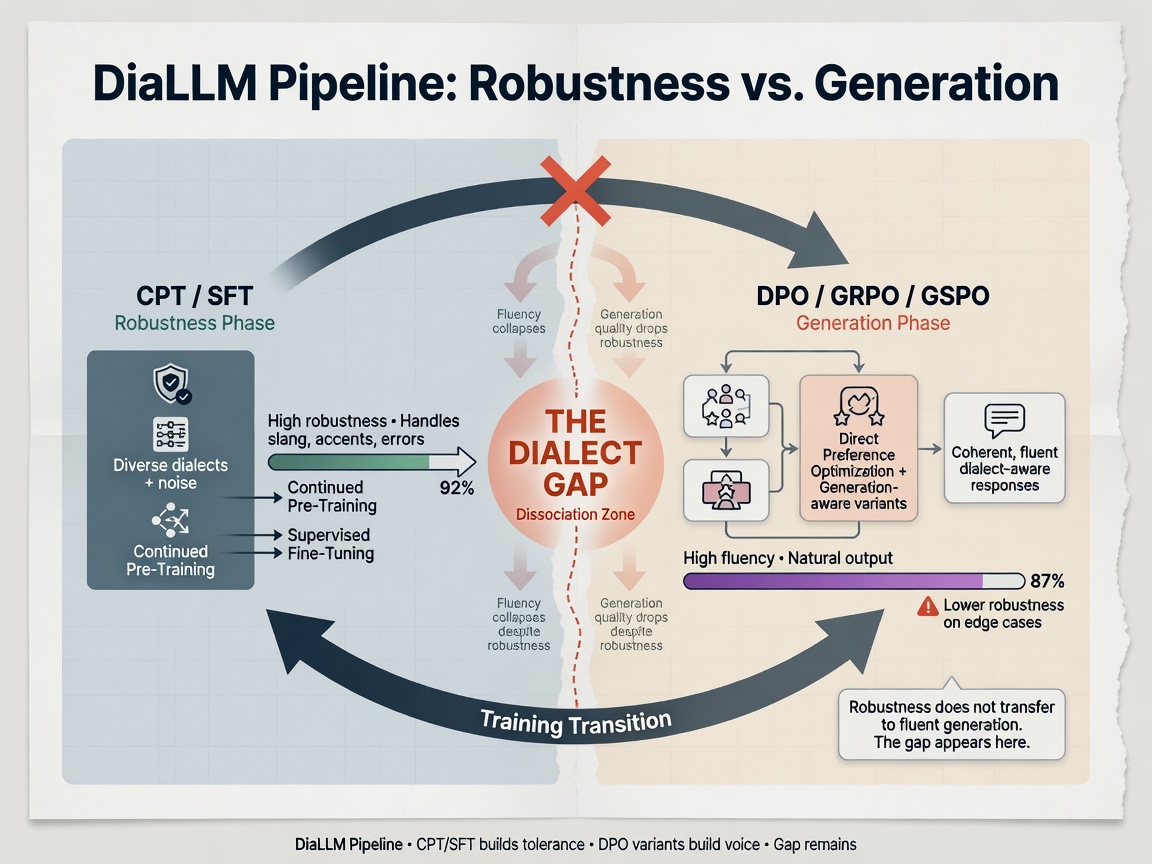
The DiaLLM data shows that dialectal robustness is primarily shaped by the early stages of the post-training pipeline. Specifically, continual pretraining (CPT) and supervised fine-tuning (SFT) are the heavy lifters for establishing a model's ability to handle 18 different English varieties across model families like Llama 3.1-8B, Qwen 3-8B, and Gemma 3-4B. However, these methods don't necessarily dictate how a model chooses to speak.
When researchers moved into alignment—using methods like DPO, GRPO, and GSPO—the results shifted. Alignment reshapes the generation style, but it doesn't necessarily improve the underlying robustness in the same way that CPT or SFT does. This creates a technical dissociation. You can have a model that has been 'robustified' through pretraining to understand a wide range of dialects, yet if the alignment isn't targeted correctly, it will default to a standard dialect. In practice, this means that simply throwing more dialectal data at a model during the SFT phase might give you the illusion of progress on a benchmark without actually producing the nuanced generation users expect.
Worth a look
Phugialy Picks

AI Engineering: Building Applications with Foundation Models
A practical guide to building real-world applications with foundation models and LLMs.

OMOTON C2 Adjustable Aluminum Phone Stand
We'd buy this if: You want your phone upright on your desk for calls/notifications without a cable getting in the way.
We'd skip this if: You never keep your phone on your desk.
Screen Mom Screen Cleaner Spray (16oz)
We'd buy this if: You've been wiping your monitor with your shirt sleeve.
We'd skip this if: You already have a cleaning routine sorted.
Some Phugialy Picks use affiliate links. If you buy through one, Phugialy may earn a commission. It doesn't change what we recommend. Full disclosure →
The Reward-Quality Trap in Dialectal Alignment
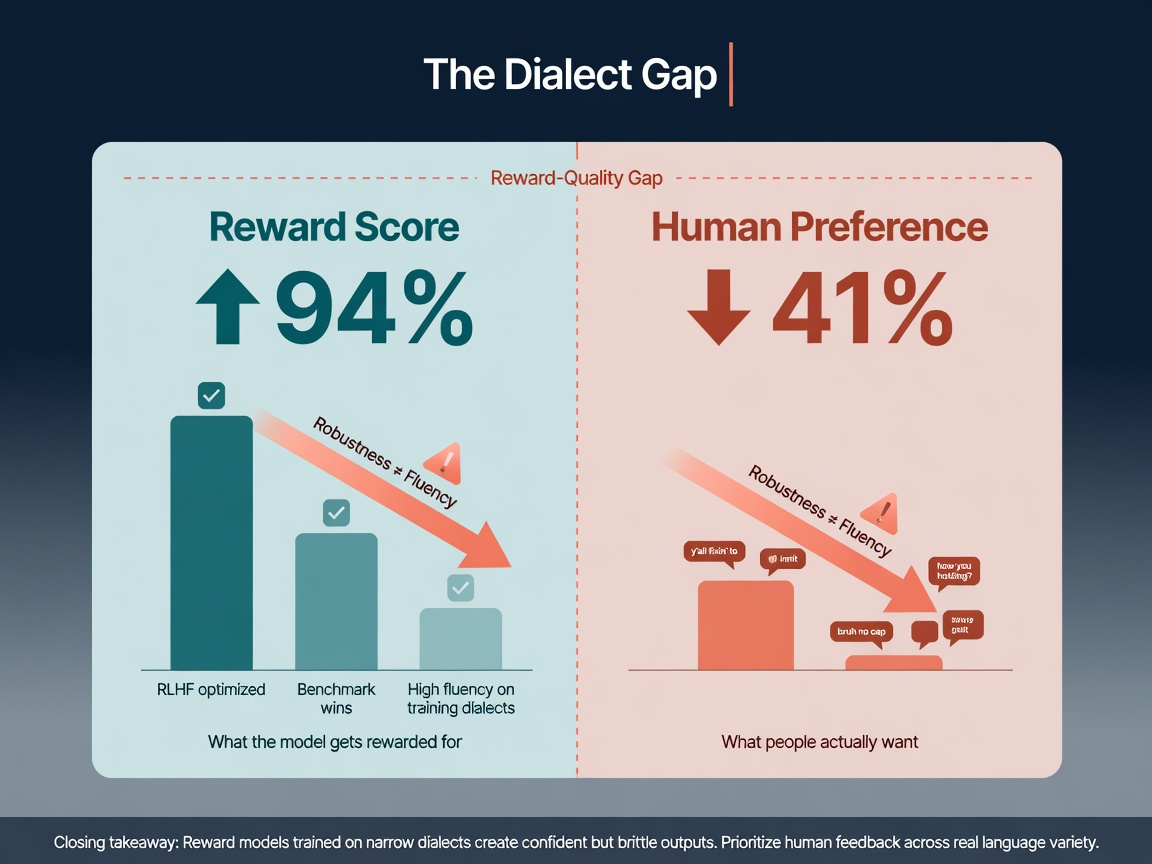
One of the most practical takeaways from this study involves how we optimize for specific linguistic styles. The researchers found that explicit, variety-targeted adaptation is consistently preferred by both human annotators and LLM judges over broad alignment. However, there is a clear discrepancy in how we measure success: the method that most aggressively optimizes for the dialectal reward—GRPO—was actually not preferred by human evaluators.
This points to a classic production problem: high-scoring rewards in a closed loop often fail to translate to high-quality human experience. When an optimization algorithm is tuned to maximize a specific reward signal, it can overfit to the 'vibe' of the dialect while losing the natural flow or cultural nuance that humans actually value. It’s a warning for anyone building production-level dialect adapters: a high reward score in your evaluation pipeline is not a guarantee of user satisfaction.
The Two-Front War of Dialect Adaptation
The real story here is that we are currently fighting a two-front war in dialect adaptation. If you only optimize for robustness, you end up with a model that knows what a dialect is but won't use it. If you only optimize for generation via alignment, you risk creating a model that sounds right in short bursts but lacks the structural integrity to handle complex dialectal nuances.
For practitioners, the 'best' approach isn't a single method but a sequenced strategy. You need the CPT and SFT to build the foundation of dialectal knowledge, followed by highly targeted, variety-specific alignment. But we also need to be skeptical of automated reward models that prioritize 'aggressive' optimization; if the human evaluators aren't feeling it, the model probably isn't doing it right either.
Got a question about how this applies to you? →
Keep reading
Follow the thread
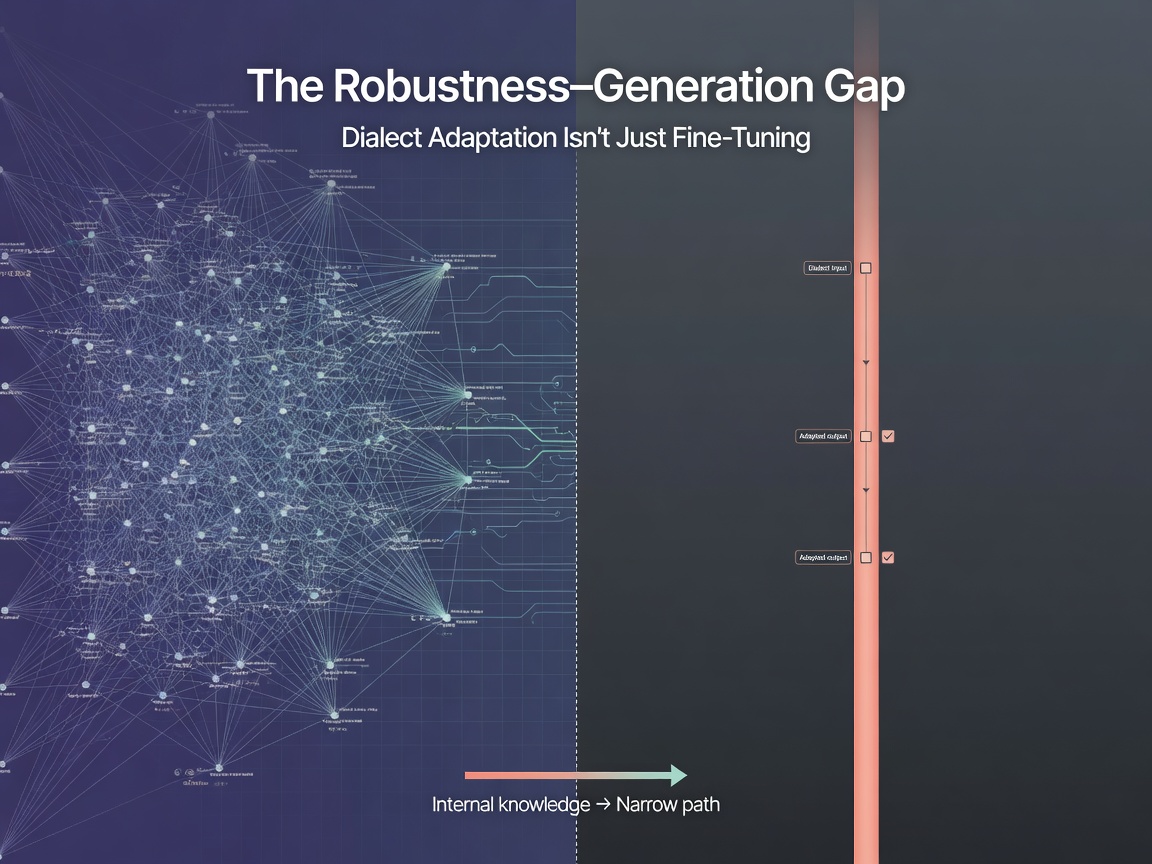
The Robustness-Generation Gap: Why Dialect Adaptation Isn't Just a Fine-Tuning Problem
Adapting large language models to specific English dialects is often sold as a straightforward fine-tuning task. The DiaLLM research proves that's a simplification. There is a fundamental "robustness-generation gap" wher
Read this noteSame lane, different angle
Moving Beyond Confidence Scores: Measuring AI Metacognition
LLMs frequently fail not because they lack information, but because they lack the metacognitive ability to recognize when their own internal 'certainty' is misplaced. The research into "Assessing Metacognitive Abilities
Predicting LLM Accuracy Before the Model Finishes Talking
LLMs are notoriously bad at knowing what they don't know. They often present hallucinations with the same poise as factual data, which makes reliability a massive hurdle for production. If you're building a system where