Cutting GA Hyperparameter Optimization Costs by 24%
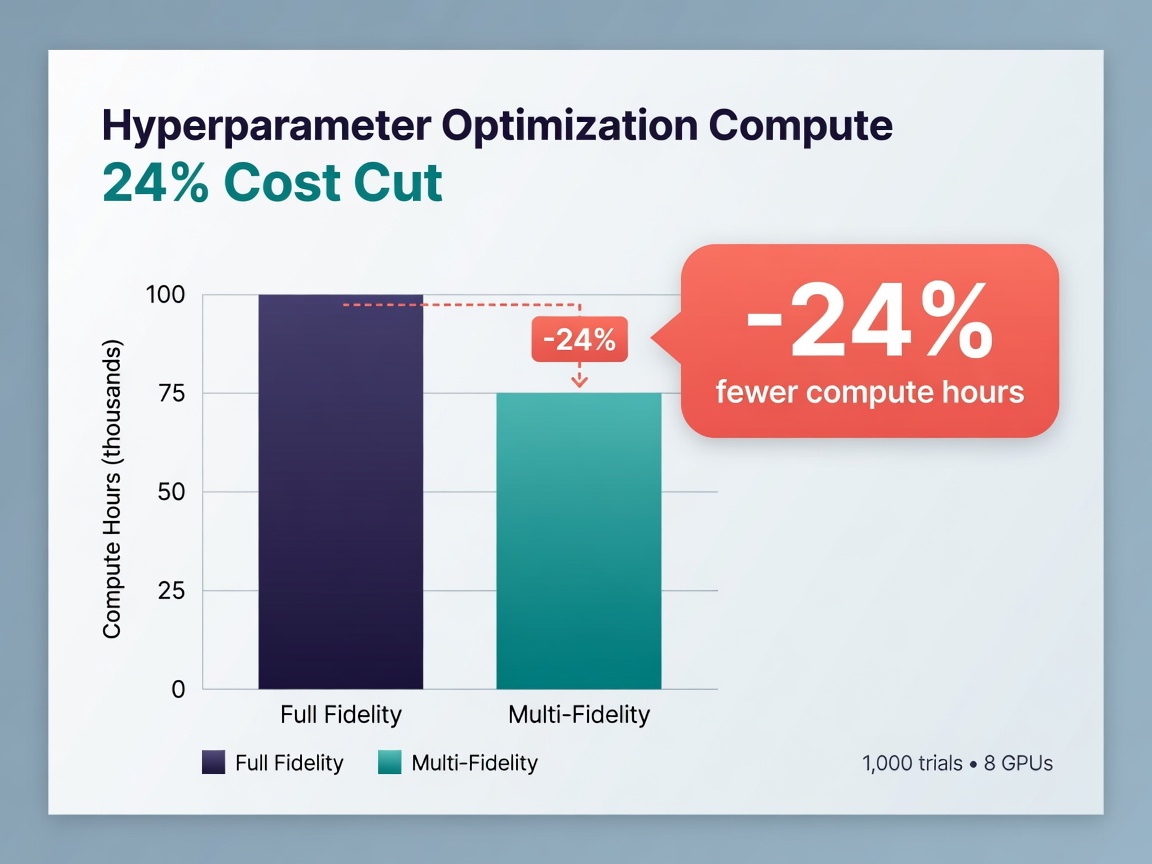
A new framework cut genetic algorithm compute time from 225 hours to 171 - not with faster hardware, but by deciding when each level of simulation accuracy was actually needed during search.
Automation needs a narrow first win
The best first AI workflow is usually a repeated task with a clear input, clear output, and a human approval step.
Cutting compute time on a genetic algorithm run from 225 hours to 171 is a 24% reduction, and it's the kind of number that matters if you're the one paying for simulation infrastructure. A recent study on arXiv presents a multi-fidelity framework for optimizing genetic algorithm hyperparameters, and while the domain is lattice materials design, the underlying economics apply anywhere surrogate-heavy optimization runs up a cloud bill.
What The Numbers Actually Show
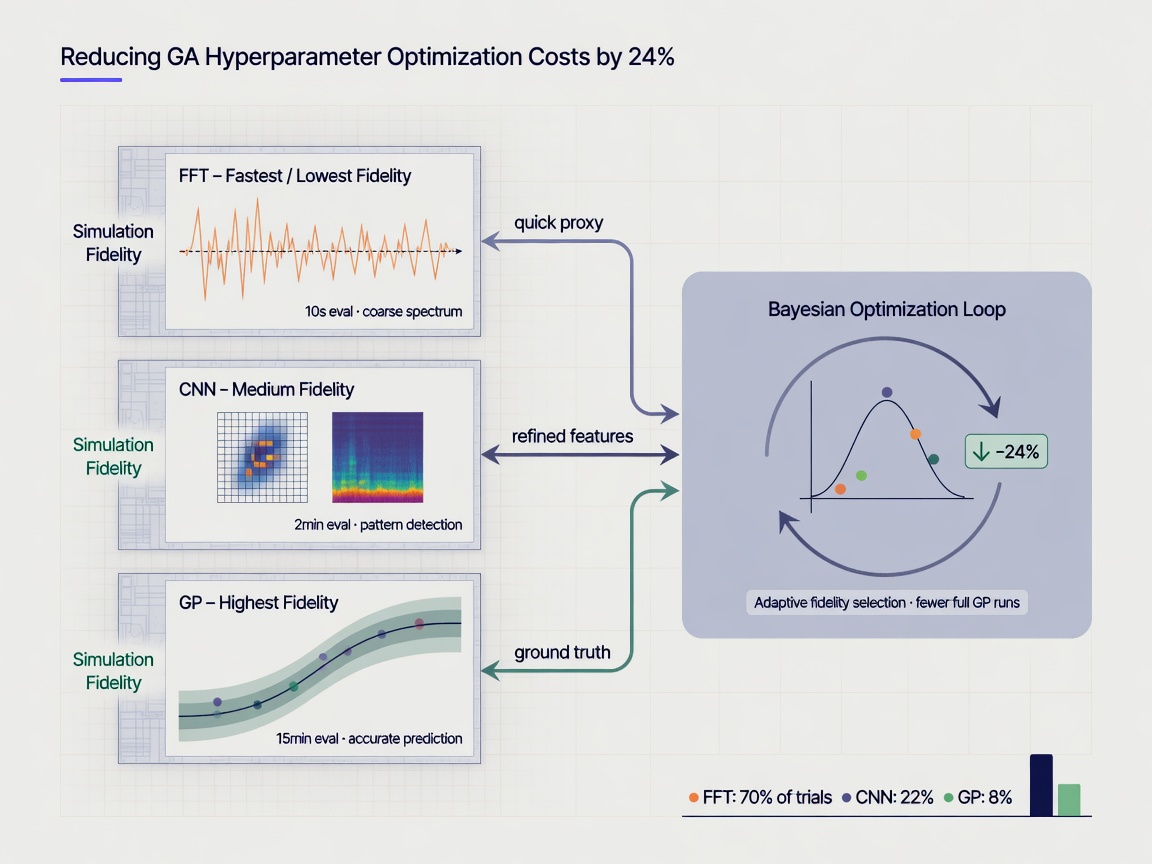
The framework stacks three fidelity levels: high-fidelity FFT homogenization as the ground-truth validator, a medium-fidelity 3D CNN surrogate, and a low-fidelity Gaussian process surrogate, all wired into Bayesian optimization. The high-fidelity checks are expensive, so the system spends most of its budget on cheap approximations and only escalates when it needs real validation.
Two design choices drive the results. First, the LogNEI acquisition function performed best because it accounts for noise in GA evaluations - a detail that sounds academic but determines whether your optimizer chases phantom improvements. Second, a penalized Bayesian optimization objective reduced the number of lattices evaluated with only minor decreases in achieved elastic modulus. That trade - give up a sliver of performance to cut evaluations - is exactly the trade most real-world teams should be making and often aren't.
The headline outcome: optimized hyperparameters cut computational cost by 24% while preserving mechanical performance. The runs involved a 25-generation GA nested inside a 75-generation optimization loop.
Worth a look
Phugialy Picks

AI Engineering: Building Applications with Foundation Models
A practical guide to building real-world applications with foundation models and LLMs.

GMKtec K15 AI Mini PC Oculink Intel Ultra 5 125U 32GB DDR5 512GB SSD | Desktop Computer AI Boost, 3X M.2 2280 Storage Expansion, Dual NIC...

Agentic AI Engineering: Systems That Reason and Act Autonomously – Designing, Building, and Prompting LLM-Based Agents for Real-World Deployment
Some Phugialy Picks use affiliate links. If you buy through one, Phugialy may earn a commission. It doesn't change what we recommend. Full disclosure →
Who Should Care, And Who Shouldn't
If you're running structural simulations - lattices, composites, metamaterials - this is directly relevant as a template for how to structure your own hyperparameter tuning. The specific combination (FFT + CNN + GP surrogates) is tuned to that problem shape, but the pattern of tiered fidelity with noise-aware acquisition generalizes.
If your ML workloads are standard training or inference, there's nothing here to adopt directly. My read is that this paper's value for most businesses isn't the code or even the framework - it's the cost discipline it demonstrates. Teams routinely burn compute tuning hyperparameters at full fidelity because it's simpler to set up. The 24% figure quantifies what that simplicity costs.
What It Would Actually Take To Adopt
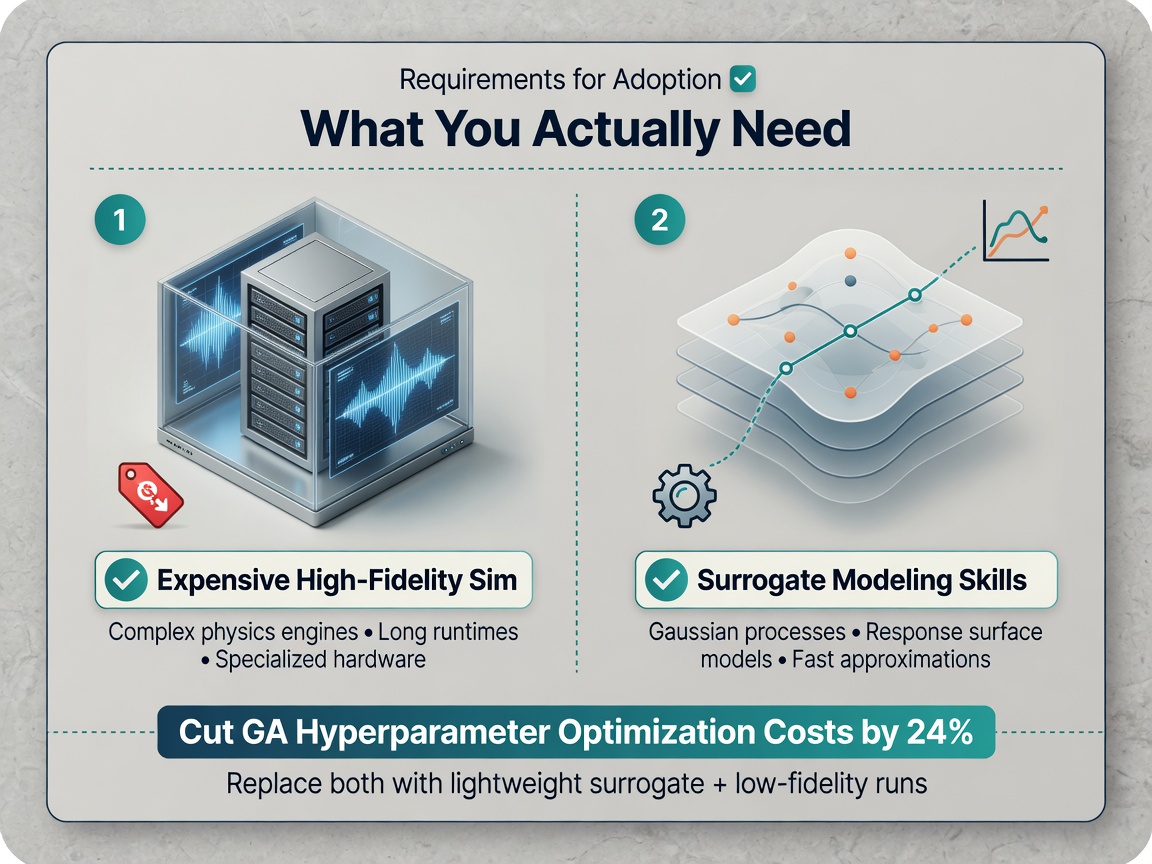
The operational hurdle isn't licensing or hardware; it's building and validating the surrogates themselves. A medium-fidelity CNN surrogate only pays off if someone on your team can train it against your high-fidelity simulator and trust its outputs enough to let it drive most optimization decisions. That's a skills-and-validation investment before any savings arrive.
So this is worth adopting once you have two things in place: an expensive high-fidelity simulation you run repeatedly enough for tuning costs to be material (hundreds of hours per run qualifies), and someone who can build surrogate models against it. If either is missing, keep paying full fidelity - 24% of an occasional run doesn't justify building three modeling layers.
The Broader Point Worth Taking Away
What this actually points to is a shift in where optimization savings live: not in faster hardware or smarter base algorithms, but in deciding when each level of accuracy is actually needed during search. The penalized objective doing much of the work here isn't exotic - it just makes 'stop evaluating candidates that won't pay off' explicit.
For anyone budgeting simulation-heavy R&D, that reframing is worth more than the specific architecture: audit where your compute goes across fidelity levels before you buy more capacity.
Got a question about how this applies to you? →
Keep reading
Follow the thread

AI Tutors Work Only If Students Use Them: Trial
A two-year trial across 18 middle schools found Khan Academy's AI tutor raised math scores modestly - but here's the catch: the gains looked just like those from practice without any AI at all. The real story isn't whether AI tutoring works; it's that 96% of students tried it and almost none used it when they actually needed help.
Read this noteSame lane, different angle
Spectral Attacks Reveal a Hidden Weak Spot in Vision-Language Models
Researchers found a way to attack vision-language models using the model's own internal geometry — aligning representations with the subspaces the model cares about least. It beats existing baselines, and the same insight could make these models tougher.
SPEAR Turns Any Unreal Project Into an Embodied AI Simulator
A new open-source library exposes over 14,000 Unreal Engine functions to Python at no wrapper cost — turning any UE project into candidate training infrastructure for embodied AI at 73 fps photorealistic rendering.