Tool Use and LLM Automation: The Business Skill Trade-Off
An LLM can handle paper-reading, but the task may also be where people learn to write, argue, notice, and think. For businesses, the decision is whether that practice is expendable—or part of the capability they need to keep.

Automation needs a narrow first win
The best first AI workflow is usually a repeated task with a clear input, clear output, and a human approval step.
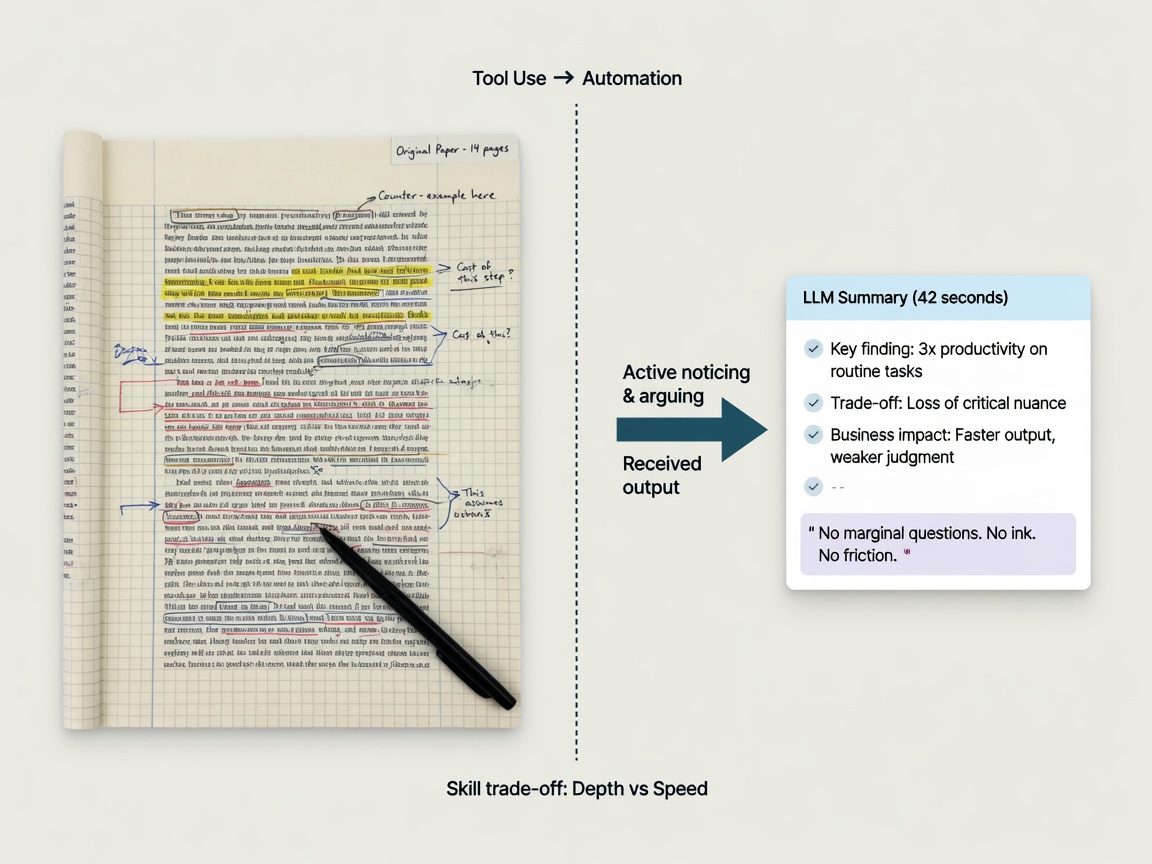
LLM automation may be worth using when the output matters more than the practice required to produce it. But calling it tool use can hide the trade-off: the source article argues that tools build skill through control and feedback, while LLMs automate work.
Tool use depends on control and feedback
A tool, in the source article’s framing, is something a person wields: they direct it with intention and adjust their technique as they use it. That repeated application, informed by sensory feedback, is how tool use builds expertise. The tool does not do the task in the person’s place; it extends what the person can do.
The article draws a different boundary around LLMs. They lack the continuous direction, sensory feedback, and intimacy of this kind of tool use, so the author categorizes them as automation instead. That distinction matters less as a vocabulary test than as a way to notice what the arrangement asks of a worker: an automated system performs the task, while the person may have less direct practice doing it.
Worth a look
Phugialy Picks

AI Engineering: Building Applications with Foundation Models
A practical guide to building real-world applications with foundation models and LLMs.

GMKtec K15 AI Mini PC Oculink Intel Ultra 5 125U 32GB DDR5 512GB SSD | Desktop Computer AI Boost, 3X M.2 2280 Storage Expansion, Dual NIC...

2084 and the AI Revolution, Updated and Expanded Edition: How Artificial Intelligence Informs Our Future
Some Phugialy Picks use affiliate links. If you buy through one, Phugialy may earn a commission. It doesn't change what we recommend. Full disclosure →
Paper-reading automation can replace practice
The source’s paper-reading example makes the trade-off specific. When someone uses an LLM to read papers for them, the author argues, they may abdicate learning how to write, formulate arguments, notice things, and think through the material. The point is not simply that a system produces a summary. It is that reading is also a practice through which those capabilities develop.
For a business, that raises a different question from “Can the model complete this task?” If employees need the underlying skill to do later work, assess arguments, or build expertise, automating the practice could weaken something the organization relies on. That is an interpretation of the source’s argument, not a claim that every use of an LLM causes skill loss. The relevant distinction is whether the task is only a step to clear or also a way the team learns to do its work.
When LLM automation is worth the dependency
The business case, in my view, depends on what the organization needs to retain. If hands-on practice is part of the capability the team must build, replacing it with LLM automation carries a learning trade-off, even if the immediate output is useful. If that practice is not important to the work, automation may be a reasonable choice—but the organization should still recognize that it is relying on a system rather than wielding a tool.
That reliance has its own operational condition. The article notes that people using automation may try to divine and game how it works, but a software update can make that accumulated know-how obsolete. This is different from building a durable technique with a tool. An operator should therefore ask not only whether automation completes a task, but whether the team can tolerate dependence on behavior it does not continuously control or direct.
The practical test is straightforward: automate where the output is the goal and reduced practice is acceptable; preserve hands-on work where doing the task is how the team learns a capability it needs. That makes the decision about the work and its learning value—not whether “tool” sounds like a more comfortable label.
Got a question about how this applies to you? →
Keep reading
Follow the thread
SRE Deskilling: What AI Incident Automation Can Erode
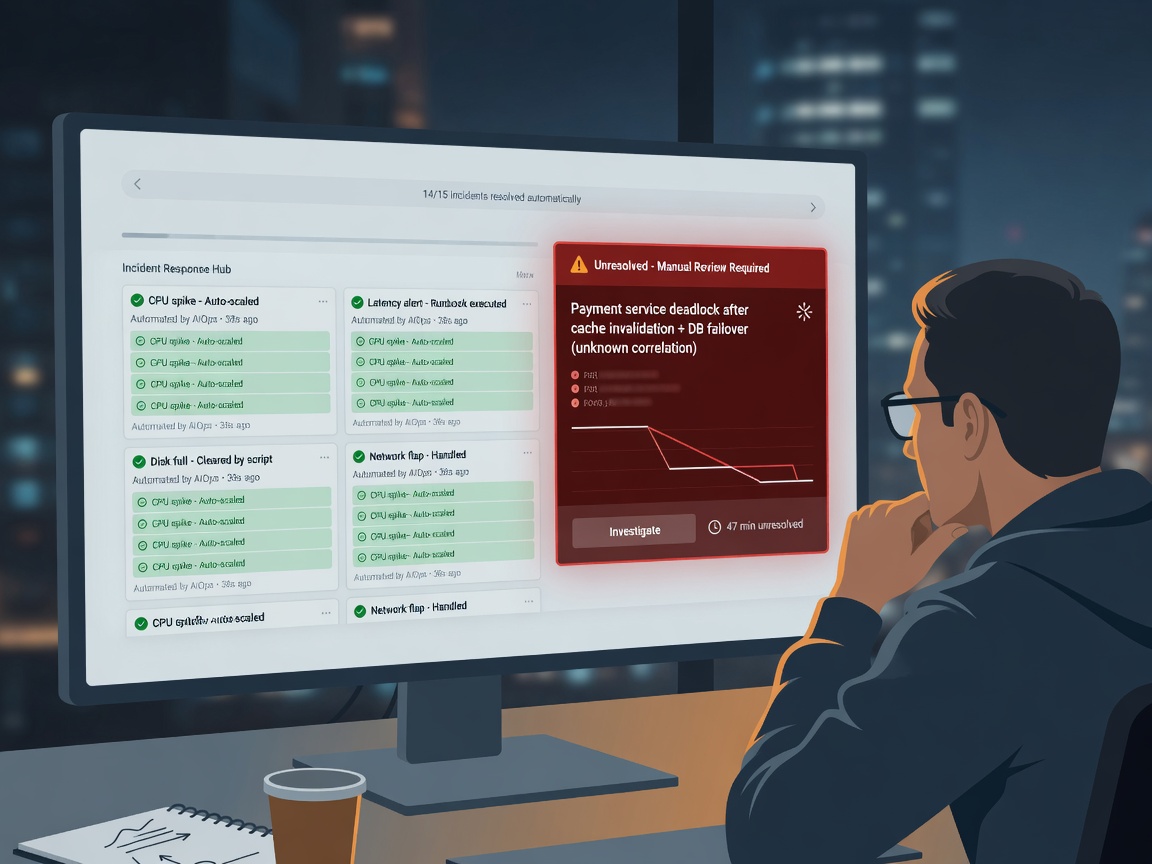
AI already automates routine SRE work: grouping alerts, surfacing known-issue runbooks, flagging anomalies, and handling some remediation. The concern is not that these systems can’t help with incident response. It’s tha
Read this noteSame lane, different angle
AI Adoption by Industry: The Skills Behind the Gap
AI adoption by industry is uneven: 48% of finance workers say they’ve been asked to use AI chatbots, while the source article frames differences between sectors as a technology-diffusion timeline, not a scorecard. That d
Warehouse Automation AI: Which Tier To Deploy First
Gartner says warehouse AI has crossed from pilots to live deployments across four tiers - but not all four deserve your budget at once. The sequencing advice buried in their report matters more than the tier list itself.