What an AI Data Labeling Map Reveals About Hidden Labor
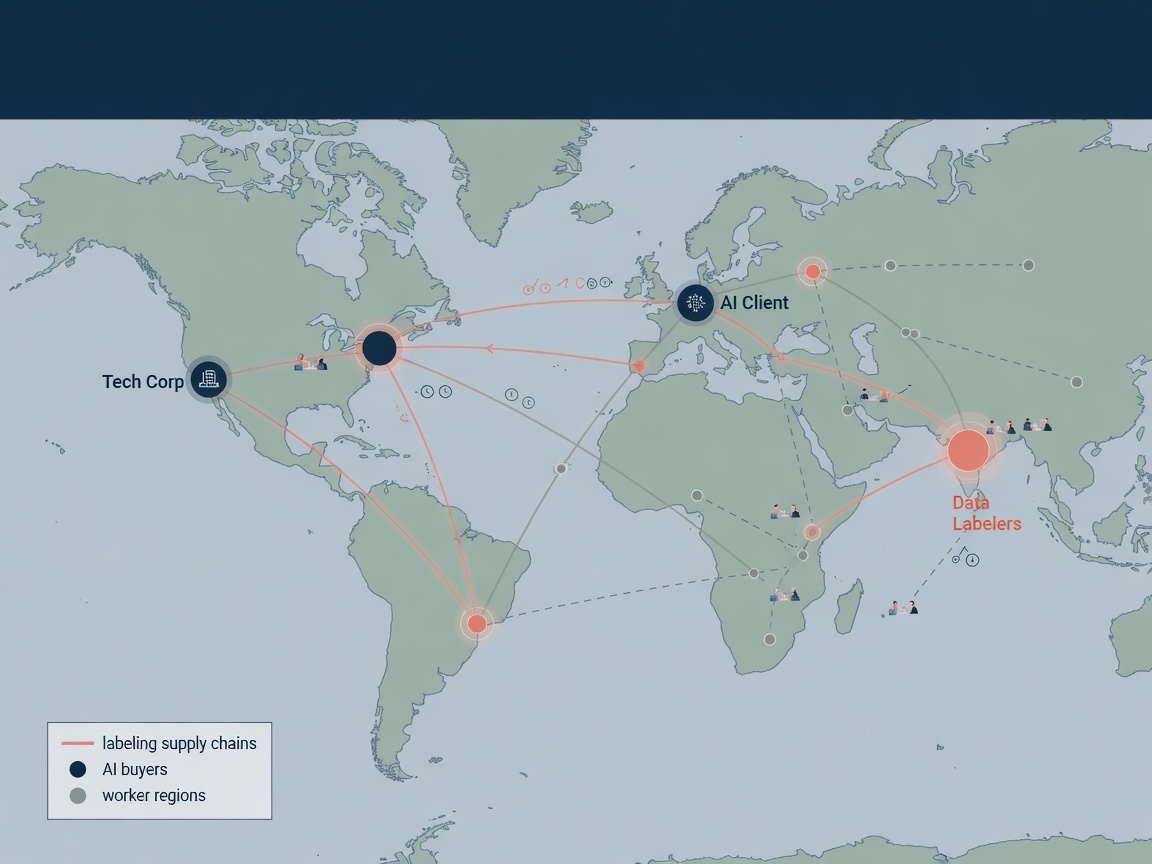
A new map links 13 data-labeling firms to 141 corporate customers and worker sites in 31 countries. It cannot tell a buyer exactly how much labor sits behind a specific AI product, but it makes the hidden supply chain harder to ignore.
Automation needs a narrow first win
The best first AI workflow is usually a repeated task with a clear input, clear output, and a human approval step.
AI data labeling is easy to miss when a business evaluates AI by model performance and vendor price. A Brown University project makes part of that labor chain visible, mapping 13 data-labeling companies, 141 corporate customers and worker sites in 31 countries.
The map does not change what a model can do. Its value is showing that AI services are connected to people and places that can disappear from a buyer’s view once work is outsourced.
What the AI data labeling map connects
The project visualizes links between data-labeling firms, the companies that use them and the countries where data workers are located. Its creator, Ma, presents it as a public education tool and hopes it may also help workers find one another.
That makes the map useful as a starting point for questions, not as a complete account of any one company’s labor practices. The source describes the relationships and locations represented, but does not say the map measures pay, working conditions or the share of a customer’s work handled by a particular firm. A business should not read a mapped connection as proof of how much labor it uses or what that labor costs.
Worth a look
Phugialy Picks

Claude Visual Bible: A step-by-step, screenshot-by-screenshot guide to writing, researching, analyzing, and automating with Claude

AI Engineering: Building Applications with Foundation Models
A practical guide to building real-world applications with foundation models and LLMs.

GMKtec K15 AI Mini PC Oculink Intel Ultra 5 125U 32GB DDR5 512GB SSD | Desktop Computer AI Boost, 3X M.2 2280 Storage Expansion, Dual NIC...
Some Phugialy Picks use affiliate links. If you buy through one, Phugialy may earn a commission. It doesn't change what we recommend. Full disclosure →
Why Ma calls the labor chain AI colonialism
Ma describes the outsourcing of difficult, low-paid data work to the Global South as “AI colonialism”: in Ma’s words, “the extraction of difficult, low-paid labor from the Global South for profit in the West.” The framing draws attention to a distribution question behind AI: where the work happens, and who benefits from the systems it helps build.
The point is not that the map settles that debate. It offers a way to see some of the links and locations that are otherwise easy to treat as background. Ma’s shorter reminder, “It’s all humans underneath,” captures the practical implication: AI development still depends on human work, even when that work is not visible to the person using a finished tool.
What a business can do with this visibility
For a buyer, the map is not a procurement calculator or a new AI service to adopt. Its immediate use is as a prompt to ask vendors and internal teams where labeling work is performed and which firms are involved. That is an interpretation of the project’s practical value, not a claim that the map answers those questions for every buyer.
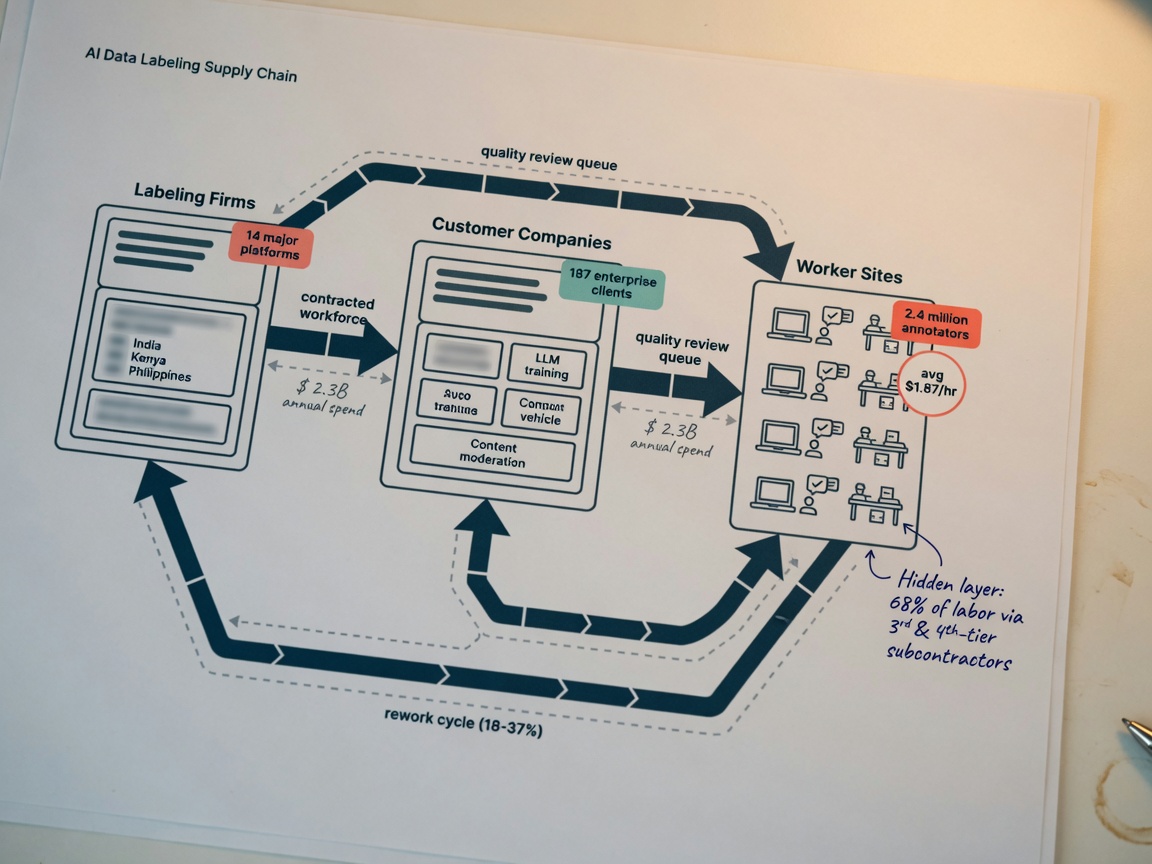
The operational payoff depends on whether a company can connect those questions to its own vendor relationships. Without that link, the map can raise awareness but cannot establish the labor arrangements behind a particular product. With it, a team reviewing AI suppliers has a clearer reason to include labor visibility in due diligence, alongside the questions it already asks about performance and cost.
Ma hopes to expand the map to include labor in the semiconductor industry. That would widen the view beyond data labeling, but the current project already makes a useful point for business readers: a vendor’s price and a model’s output do not show the full chain of human work underneath. The practical next step is not to assume what a map proves; it is to ask what your own AI supply chain leaves out.
Got a question about how this applies to you? →
Keep reading
Follow the thread
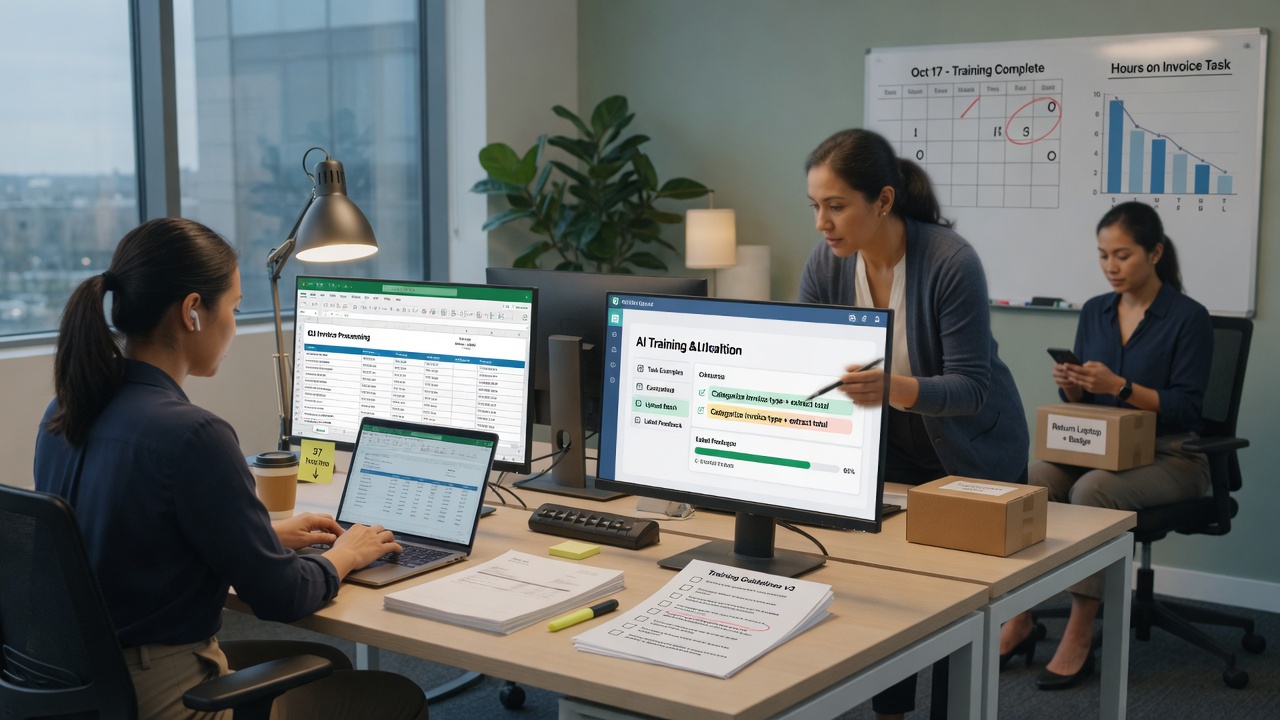
37 An Hour To Train Your Replacement: Inside AI Training Jobs
A South African Ph.D. graduate was offered $37 an hour to train the AI system that could eventually replace him — and turned it down. The offer came through an AI recruiter, paid 600 rand an hour against a national minim
Read this noteSame lane, different angle
NVIDIA’s Robotics Simulation Stack Faces the Transfer Test
GR00T 2 reached 40 of 50 tasks without task-specific demonstrations, and its reported success rose to 95% with five demonstrations per task. The harder question is whether these results transfer beyond the evaluation setup—and NVIDIA’s simulation stack is where that question can be tested at greater scale.
AI Coding and the Cost of a Fragile SaaS Codebase
AI coding can speed up pull requests while leaving the tests shallow and the code harder to understand. The deciding question is not how much code it generates, but whether your team can still verify and maintain it.